数据结构奇妙旅程之二叉树初阶

꒰˃͈꒵˂͈꒱ write in front ꒰˃͈꒵˂͈꒱
ʕ̯•͡˔•̯᷅ʔ大家好,我是xiaoxie.希望你看完之后,有不足之处请多多谅解,让我们一起共同进步૮₍❀ᴗ͈ . ᴗ͈ აxiaoxieʕ̯•͡˔•̯᷅ʔ—CSDN博客
本文由xiaoxieʕ̯•͡˔•̯᷅ʔ 原创 CSDN 如需转载还请通知˶⍤⃝˶
个人主页:xiaoxieʕ̯•͡˔•̯᷅ʔ—CSDN博客
系列专栏:xiaoxie的JAVA系列专栏——CSDN博客●'ᴗ'σσணღ*
我的目标:"团团等我💪( ◡̀_◡́ ҂)"( ⸝⸝⸝›ᴥ‹⸝⸝⸝ )欢迎各位→点赞👍 + 收藏⭐️ + 留言📝+关注(互三必回)!

一.树
1.概念(简单了解即可)
树是一种 非线性 的数据结构,它是由 n ( n>=0 )个有限结点组成一个具有层次关系的集合。 把它叫做树是因为它看
起来像一棵倒挂的树,也就是说它是根朝上,而叶朝下的 。它具有以下的特点:
有一个特殊的结点,称为根结点,根结点没有前驱结点
除根结点外,其余结点被分成 M(M > 0) 个互不相交的集合 T1 、 T2 、 ...... 、 Tm ,其中每一个集合 Ti (1 <= i <= m) 又是一棵与树类似的子树。
每棵子树的根结点有且只有一个前驱,可以有 0 个或多个后继 。树是递归定义的。
注意:树形结构中,子树之间不能有交集,否则就不是树形结构
2.树的基本术语

2.1需要重点记忆的
结点的度:一个结点含有子树的个数称为该结点的度; 如上图:A的度为3
树的度 :一棵树中,所有结点度的最大值称为树的度; 如上图:树的度为3
叶子结点或终端结点 :度为 0 的结点称为叶结点; 如上图:E, F, G, H, I, J 等节点为叶结点
双亲结点或父结点 :若一个结点含有子结点,则这个结点称为其子结点的父结点; 如上图: A 是 B 的父结点
孩子结点或子结点 :一个结点含有的子树的根结点称为该结点的子结点; 如上图: B 是 A 的孩子结点
根结点 :一棵树中,没有双亲结点的结点;如上图: A
结点的层次 :从根开始定义起,根为第 1 层,根的子结点为第 2 层,以此类推
树的高度或深度 :树中结点的最大层次; 如上图:树的高度为3
2.2简单了解即可
非终端结点或分支结点 :度不为 0 的结点; 如上图:B 、C 、D 等节点为分支结点
兄弟结点 :具有相同父结点的结点互称为兄弟结点; 如上图: B 、 C 是兄弟结点
堂兄弟结点 :双亲在同一层的结点互为堂兄弟;如上图: H 、 I 互为兄弟结点
结点的祖先 :从根到该结点所经分支上的所有结点;如上图: A 是所有结点的祖先
子孙 :以某结点为根的子树中任一结点都称为该结点的子孙。如上图:所有结点都是 A 的子孙
森林 :由 m ( m>=0 )棵互不相交的树组成的集合称为森林
3.树的代码表示形式(简单了解)
树结构相对线性表就比较复杂了,要存储表示起来就比较麻烦了,实际中树有很多种表示方式,如:双亲表示法,
孩子表示法 、 孩子双亲表示法 、 孩子兄弟表示法 等等。我们这里就简单的了解其中最常用的 孩子兄弟表示法 。
class Node {
int value; // 树中存储的数据
Node firstChild; // 第一个孩子引用
Node nextBrother; // 下一个兄弟引用
}
二.二叉树(重点掌握)
1.概念
一棵二叉树是结点的一个有限集合,该集合:
1. 或者为空
2. 或者是由 一个根节 点加上两棵别称为 左子树 和 右子树 的二叉树组成。

从上图可以看出:
1. 二叉树不存在度大于 2 的结点
2. 二叉树的子树有左右之分,次序不能颠倒,因此二叉树是有序树
注意:对于任意的二叉树都是由以下几种情况复合而成的:
1.1二叉树的基本形态

1.2两种特殊的二叉树
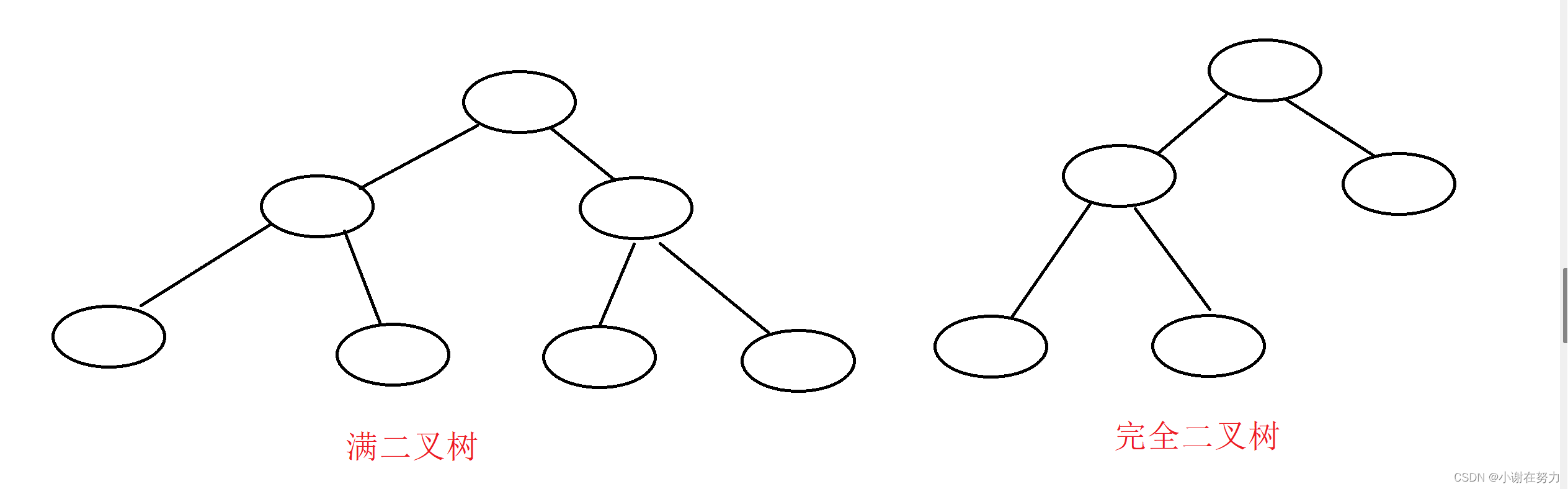
1. 满二叉树 : 一棵二叉树,如果 每层的结点数都达到最大值,则这棵二叉树就是满二叉树 。也就是说, 如果一棵 二叉树的层数为 K ,且结点总数是 2^k - 1 ,则它就是满二叉树 。
2. 完全二叉树 : 完全二叉树是效率很高的数据结构,完全二叉树是由满二叉树而引出来的。对于深度为 K 的,有 n
个结点的二叉树,当且仅当其每一个结点都与深度为 K 的满二叉树中编号从 0 至 n-1 的结点一一对应时称之为完全二叉树。 要注意的是满二叉树是一种特殊的完全二叉树。
2.性质
1. 若规定 根结点的层数为 1 ,则一棵 非空二叉树的第 i 层上最多有 2^(i-1) (i>0) 个结点
2. 若规定只有 根结点的二叉树的深度为 1 ,则 深度为 K 的二叉树的最大结点数是2^k - 1
(k>=0)
3. 对任何一棵二叉树 , 如果其 叶结点个数为 n0, 度为 2 的非叶结点个数为 n2, 则有 n0 = n2 + 1
4. 具有 n 个结点的完全二叉树的深度 k 为 log2(n+1) 上取整
5. 对于具有 n 个结点的完全二叉树 ,如果按照 从上至下从左至右的顺序对所有节点从 0 开始编号 ,则对于 序号为 i 的结点有 :
若i>0 , 双亲序号: (i-1)/2 ; i=0 , i 为根结点编号 ,无双亲结点
若 2i+1<n ,左孩子序号: 2i+1 ,否则无左孩子
若 2i+2<n ,右孩子序号: 2i+2 ,否则无右孩子
3.基本操作
public class BinaryTree {static class TreeNode {public char val;public TreeNode left;public TreeNode right;public TreeNode(char val) {this.val = val;}}//以穷举的方式 创建一棵二叉树出来public TreeNode createTree() {TreeNode A = new TreeNode('A');TreeNode B = new TreeNode('B');TreeNode C = new TreeNode('C');TreeNode D = new TreeNode('D');TreeNode E = new TreeNode('E');TreeNode F = new TreeNode('F');TreeNode G = new TreeNode('G');TreeNode H = new TreeNode('H');A.left = B;A.right = C;B.left = D;B.right = E;C.left = F;C.right = G;E.right = H;return A;}//前序遍历public void preOrder(TreeNode root) {if(root == null) {return;}System.out.print(root.val + " ");preOrder(root.left);preOrder(root.right);}//中序遍历public void inOrder(TreeNode root) {if(root == null){return;}inOrder(root.left);System.out.print(root.val + " ");inOrder(root.right);}//后序遍历public void postOrder(TreeNode root) {if(root == null){return;}postOrder(root.left);postOrder(root.right);System.out.print(root.val + " ");}// 获取二叉树中节点的个数public int size(TreeNode root) {if(root == null) {return 0;}return size(root.left)+size(root.right)+1;}// 获取叶子节点的个数public int getLeafNodeCount(TreeNode root) {if(root == null) {return 0;}if(root.left == null && root.right == null) {return 1;}return getLeafNodeCount(root.left) + getLeafNodeCount(root.right);}// 获取第K层节点的个数public int getKLevelNodeCount(TreeNode root,int k) {if(root == null) {return 0;}if(k == 1) {return 1;}return getKLevelNodeCount(root.left,k-1) + getKLevelNodeCount(root.right,k-1);}// 获取二叉树的高度public int getHeight(TreeNode root) {if(root == null) {return 0;}int leftH = getHeight(root.left);int rightH = getHeight(root.right);return Math.max(leftH,rightH)+1;}// 检测值为value的元素是否存在public boolean find(TreeNode root,char val) {if(root == null) {return false;}if(root.val == val) {return true;}return find(root.left, val) || find(root.right, val);}//层序遍历使用队列来辅助//当涉及到层序遍历时,通常情况下使用队列来实现会更为简单和高效public void levelOrder(TreeNode root) {if(root == null) {return;}Queue<TreeNode> q = new LinkedList<>();q.offer(root);while (!q.isEmpty()) {TreeNode cur = q.poll();System.out.print(cur.val + " ");if(cur.left != null) {q.offer(cur.left);}if(cur.right != null) {q.offer(cur.right);}}}// 判断一棵树是不是完全二叉树public boolean isCompleteTree(TreeNode root) {if (root == null) {return true;}Queue<TreeNode> queue = new LinkedList<>();queue.offer(root);boolean end = false;while (!queue.isEmpty()) {TreeNode current = queue.poll();if (current == null) {end = true;} else {if (end) {return false; // 如果已经遇到空节点,再遇到非空节点,说明不是完全二叉树}queue.offer(current.left);queue.offer(current.right);}}return true;}
}
三.说明
以上就是关于二叉树的一些基础问题了,如果你已经对这些比较基础的问题都大概了解,就可以开始尝试做题,你也可以移步到博主的下一篇关于二叉树面试题的文章,帮助你更好的掌握二叉树,感谢你的观看,愿你一天开心愉快