2.26数据结构

链栈的代码

//link_stack.h
#ifndef __LINK_STACK_H__
#define __LINK_STACK_H__
#include <stdio.h>
#include <stdlib.h>
typedef int datatype;
typedef struct link_stack
{int data;struct link_stack *next;
}link_stack,*link_p;//栈顶指针类型
typedef struct top_t
{int len;link_p ptop;
}top_t,*top_p;//申请栈顶指针
top_p create_top();
//申请结点的函数
link_p create_node(int data);
//入栈/压栈
void push_stack(top_p T,int data);
//判空
int empty_stack(top_p T);
//出栈/弹栈
void pop_stack(top_p T);
//遍历
void show(top_p T);
//销毁
void free_stack(top_p T);#endif
//link_stack.c
#include "link_stack.h"//申请栈顶指针
top_p create_top()
{top_p top = (top_p)malloc(sizeof(top_t));if(top==NULL){printf("空间申请失败\n");return NULL;}top->len = 0;top->ptop = NULL; //刚申请栈指针时没有指向元素return top;
}
//申请结点的函数
link_p create_node(int data)
{link_p new = (link_p)malloc(sizeof(link_stack));if(new==NULL){printf("申请空间失败\n");return NULL;}new->data = data;return new;
}
//入栈/压栈
void push_stack(top_p T,int data)
{if(T==NULL){printf("入参为空\n");return;}link_p new = create_node(data);//入栈new->next = T->ptop;T->ptop = new;T->len++;
}
//判空
int empty_stack(top_p T)
{if(T==NULL){printf("入参为空\n");return -1;}return T->ptop==NULL?1:0;
}//出栈/弹栈
void pop_stack(top_p T)
{if(T==NULL){printf("入参为空\n");return;}if(empty_stack(T)){printf("链栈为空\n");return;}link_p p = T->ptop;int pdata = p->data;T->ptop = p->next;T->len--;printf("出栈的元素:\n");printf("%d-->",pdata);free(p);
}
//遍历
void show(top_p T)
{if(T==NULL){printf("入参为空\n");return;}if(empty_stack(T)){printf("栈为空\n");return;}link_p p = T->ptop;while (p != NULL) { printf("%d ", p->data); p = p->next; } printf("\n"); }
//销毁
void free_stack(top_p T)
{if(T==NULL){printf("入参为空\n");return;}link_p del = T->ptop;while(T->ptop){T->ptop = T->ptop->next;free(del);del=T->ptop;}T->ptop=NULL;
}
//main.c
#include "link_stack.h"int main()
{top_p T = create_top();push_stack(T,90);push_stack(T,23);push_stack(T,45);push_stack(T,56);show(T);pop_stack(T);show(T);printf("判空函数的返回值为--->%d\n",empty_stack(T));free_stack(T);show(T);return 0;
}

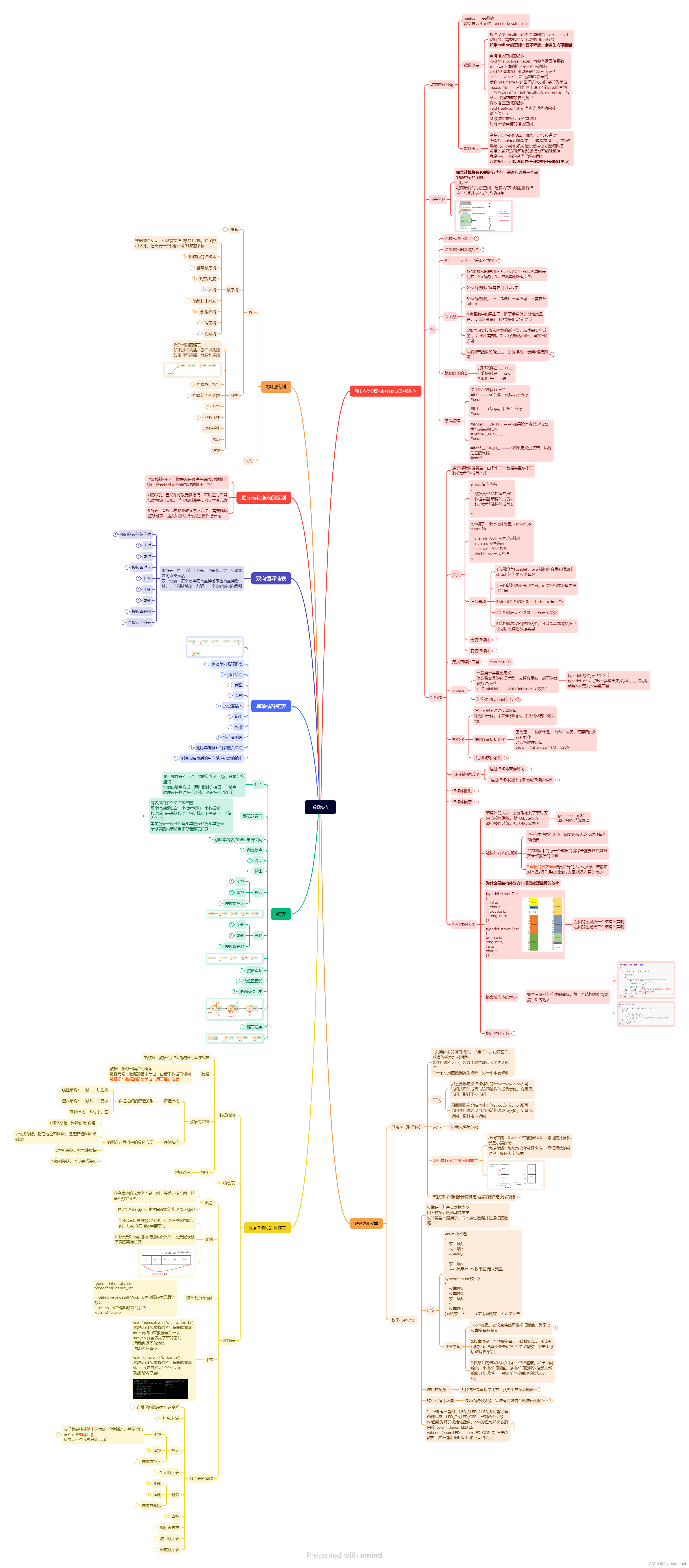
思维导图