栈和队列的OJ题--13.用队列实现栈

13. 用队列实现栈
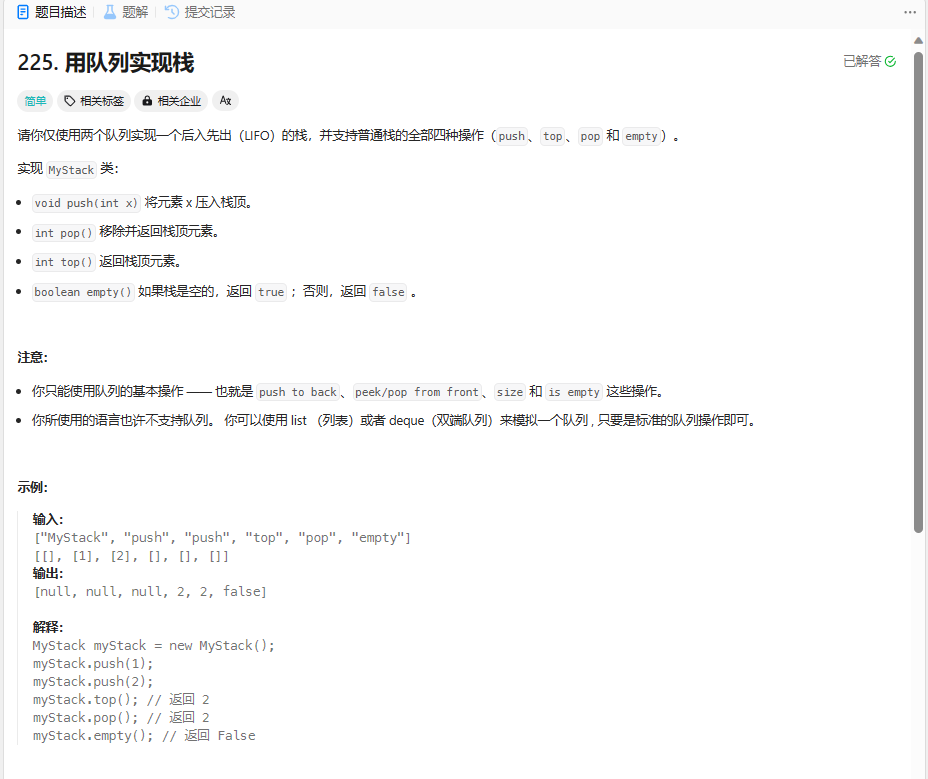
225. 用队列实现栈 - 力扣(LeetCode)
/*解题思路: 此题可以用两个队列去实现一个栈,每次始终保持一个队列为空,
入栈操作相当于给非空队列进行入队操作
出栈操作相当于非空队列的队尾元素出队,此时需要把非空队列除最后一个元素之外的其余元素入队到空队列,然后出队最后一个队尾元素 */
typedef struct {Queue q1;Queue q2;} MyStack;/** Initialize your data structure here. */
MyStack* myStackCreate(int maxSize) {MyStack* pst = (MyStack*)malloc(sizeof(MyStack));QueueInit(&pst->q1);QueueInit(&pst->q2);return pst;
}/** Push element x onto stack. */
void myStackPush(MyStack* obj, int x) {//给非空队列进行入队操作if(QueueEmpty(&obj->q1) != 0){QueuePush(&obj->q1, x);}else{QueuePush(&obj->q2, x);}
}/** Removes the element on top of the stack and returns that element. */
int myStackPop(MyStack* obj) {//把非空队列的除最后一个元素之外的剩余元素全部入队空队列Queue* pEmpty = &obj->q1, *pNonEmpty = &obj->q2;if(QueueEmpty(&obj->q1) != 0){pEmpty = &obj->q2;pNonEmpty = &obj->q1;}while(QueueSize(pNonEmpty) > 1){QueuePush(pEmpty, QueueFront(pNonEmpty));QueuePop(pNonEmpty);}int top = QueueFront(pNonEmpty);//队尾元素出队QueuePop(pNonEmpty);return top;
}/** Get the top element. */
int myStackTop(MyStack* obj) {//获取非空队列的队尾元素Queue* pEmpty = &obj->q1, *pNonEmpty = &obj->q2;if(QueueEmpty(&obj->q1) != 0){pEmpty = &obj->q2;pNonEmpty = &obj->q1;}return QueueBack(pNonEmpty);
}/** Returns whether the stack is empty. */
bool myStackEmpty(MyStack* obj) {return !(QueueEmpty(&obj->q1) | QueueEmpty(&obj->q2));
}void myStackFree(MyStack* obj) {QueueDestory(&obj->q1);QueueDestory(&obj->q2);free(obj);
}