Linux网络协议栈从应用层到内核层①

文章目录
- 1、socket系统调用源码剖析
- 2、struct socket 是如何创建的
- 3、struct socket 和文件的联系
- 4、相关数据结构的联系
- 5、socket系统调用的整体流程图
1、socket系统调用源码剖析
系统调用原型
int socket(int domain, int type, int protocol);
domain:表示协议族,在Linux系统中,有很多个协议族,比如IPv4的协议族为AF_INET,IPv6的协议族为AF_INET6,从字面意思上看,domain是int类型的,那它在内核层面是如何帮我们定位到特定协议族的代码呢?这个问题后面再谈
Linux下所有的协议族
Name Purpose AF_UNIX, AF_LOCAL Local communication AF_INET IPv4 Internet protocols AF_INET6 IPv6 Internet protocols AF_IPX IPX - Novell protocolsAF_NETLINK Kernel user interface device AF_X25 ITU-T X.25 / ISO-8208 protocol AF_AX25 Amateur radio AX.25 protocolAF_ATMPVC Access to raw ATM PVCsAF_APPLETALK Appletalk AF_PACKET Low level packet interface
type:表示通信的语义,最常见的就是SOCK_STREAM和SOCK_DGRAM,除了这两个比较常见为,还有其他的协议族,可以自行使用man手册查看

protocol:表示一个传输层协议号,传输层的协议包括IPPROTO_TCP,IPPROTO_UDP;或者对于SOCK_RAW来讲,它是一个通配协议号IPPROTO_IP,用于通配网络层的附属协议ICMP,IGMP等。对于传输层协议来讲,IPPROTO_TCP对应的套接字类型总是SOCK_STREAM,IPPRTO_UDP对应的套接字类型总是STREAM_DGRAM,所以在socket系统调用时,可以不必指定协议号,而直接使用通配符IPPROTO_IP
比如创建一个tcp的套接字:int sockfd = socket(AF_INET, SOCK_STREAM, 0);
这里的0就表示默认使用tcp,不同的协用不同的数字表明,在in.h中定义了内核中所有协议号
enum {IPPROTO_IP = 0,		/* Dummy protocol for TCP		*/
#define IPPROTO_IP		IPPROTO_IPIPPROTO_ICMP = 1,		/* Internet Control Message Protocol	*/
#define IPPROTO_ICMP		IPPROTO_ICMPIPPROTO_IGMP = 2,		/* Internet Group Management Protocol	*/
#define IPPROTO_IGMP		IPPROTO_IGMPIPPROTO_IPIP = 4,		/* IPIP tunnels (older KA9Q tunnels use 94) */
#define IPPROTO_IPIP		IPPROTO_IPIPIPPROTO_TCP = 6,		/* Transmission Control Protocol	*/
#define IPPROTO_TCP		IPPROTO_TCPIPPROTO_EGP = 8,		/* Exterior Gateway Protocol		*/
#define IPPROTO_EGP		IPPROTO_EGPIPPROTO_PUP = 12,		/* PUP protocol				*/
#define IPPROTO_PUP		IPPROTO_PUPIPPROTO_UDP = 17,		/* User Datagram Protocol		*/
#define IPPROTO_UDP		IPPROTO_UDPIPPROTO_IDP = 22,		/* XNS IDP protocol			*/
#define IPPROTO_IDP		IPPROTO_IDPIPPROTO_TP = 29,		/* SO Transport Protocol Class 4	*/
#define IPPROTO_TP		IPPROTO_TPIPPROTO_DCCP = 33,		/* Datagram Congestion Control Protocol */
#define IPPROTO_DCCP		IPPROTO_DCCPIPPROTO_IPV6 = 41,		/* IPv6-in-IPv4 tunnelling		*/
#define IPPROTO_IPV6		IPPROTO_IPV6IPPROTO_RSVP = 46,		/* RSVP Protocol			*/
#define IPPROTO_RSVP		IPPROTO_RSVPIPPROTO_GRE = 47,		/* Cisco GRE tunnels (rfc 1701,1702)	*/
#define IPPROTO_GRE		IPPROTO_GREIPPROTO_ESP = 50,		/* Encapsulation Security Payload protocol */
#define IPPROTO_ESP		IPPROTO_ESPIPPROTO_AH = 51,		/* Authentication Header protocol	*/
#define IPPROTO_AH		IPPROTO_AHIPPROTO_MTP = 92,		/* Multicast Transport Protocol		*/
#define IPPROTO_MTP		IPPROTO_MTPIPPROTO_BEETPH = 94,		/* IP option pseudo header for BEET	*/
#define IPPROTO_BEETPH		IPPROTO_BEETPHIPPROTO_ENCAP = 98,		/* Encapsulation Header			*/
#define IPPROTO_ENCAP		IPPROTO_ENCAPIPPROTO_PIM = 103,		/* Protocol Independent Multicast	*/
#define IPPROTO_PIM		IPPROTO_PIMIPPROTO_COMP = 108,		/* Compression Header Protocol		*/
#define IPPROTO_COMP		IPPROTO_COMPIPPROTO_SCTP = 132,		/* Stream Control Transport Protocol	*/
#define IPPROTO_SCTP		IPPROTO_SCTPIPPROTO_UDPLITE = 136,	/* UDP-Lite (RFC 3828)			*/
#define IPPROTO_UDPLITE		IPPROTO_UDPLITEIPPROTO_MPLS = 137,		/* MPLS in IP (RFC 4023)		*/
#define IPPROTO_MPLS		IPPROTO_MPLSIPPROTO_RAW = 255,		/* Raw IP packets			*/
#define IPPROTO_RAW		IPPROTO_RAWIPPROTO_MAX
};
2、struct socket 是如何创建的
socket系统调用源码:
SYSCALL_DEFINE3(socket, int, family, int, type, int, protocol)
{int retval;//返回值struct socket *sock;//struct socket主要用于给上层提供接口,会跟文件系统相关联//后续还会有一个结构体:struct sock,它主要用于向下对接协议栈int flags;//做一些检测BUILD_BUG_ON(SOCK_CLOEXEC != O_CLOEXEC);BUILD_BUG_ON((SOCK_MAX | SOCK_TYPE_MASK) != SOCK_TYPE_MASK);BUILD_BUG_ON(SOCK_CLOEXEC & SOCK_TYPE_MASK);BUILD_BUG_ON(SOCK_NONBLOCK & SOCK_TYPE_MASK);flags = type & ~SOCK_TYPE_MASK;if (flags & ~(SOCK_CLOEXEC | SOCK_NONBLOCK))return -EINVAL;type &= SOCK_TYPE_MASK;if (SOCK_NONBLOCK != O_NONBLOCK && (flags & SOCK_NONBLOCK))flags = (flags & ~SOCK_NONBLOCK) | O_NONBLOCK;//创建socket,将上层的struct socket 和下层的 struct sock 关联在一起retval = sock_create(family, type, protocol, &sock);if (retval < 0)goto out;retval = sock_map_fd(sock, flags & (O_CLOEXEC | O_NONBLOCK));if (retval < 0)goto out_release;out:/* It may be already another descriptor 8) Not kernel problem. */return retval;out_release:sock_release(sock);return retval;
}
定义好相关的结构,做完相应的检测,接着会调用retval = sock_create(family, type, protocol, &sock);
int sock_create(int family, int type, int protocol, struct socket **res)
{return __sock_create(current->nsproxy->net_ns, family, type, protocol, res, 0);
}
接着进一步调用
int __sock_create(struct net *net, int family, int type, int protocol,struct socket **res, int kern)
{int err;struct socket *sock;const struct net_proto_family *pf;//struct net_proto_family是协议族管理类型,负责不同协议族套接字的创建/**struct net_proto_family {int	family;int		(*create)(struct net *net, struct socket *sock,int protocol, int kern);struct module	*owner;
};*///判断family是否在有效范围内if (family < 0 || family >= NPROTO)return -EAFNOSUPPORT;if (type < 0 || type >= SOCK_MAX)return -EINVAL;//不重要if (family == PF_INET && type == SOCK_PACKET) {pr_info_once("%s uses obsolete (PF_INET,SOCK_PACKET)\n",current->comm);family = PF_PACKET;}err = security_socket_create(family, type, protocol, kern);if (err)return err;sock = sock_alloc();//申请struct socket//申请失败则返回if (!sock) {net_warn_ratelimited("socket: no more sockets\n");return -ENFILE;	/* Not exactly a match, but its theclosest posix thing */}sock->type = type;//将应用层传入的type进行赋值#ifdef CONFIG_MODULESif (rcu_access_pointer(net_families[family]) == NULL)request_module("net-pf-%d", family);
#endifrcu_read_lock();//rcu锁,给数据的访问做一些保护pf = rcu_dereference(net_families[family]);//进行协议管理类型的复制/*static const struct net_proto_family __rcu *net_families[NPROTO] __read_mostly;所有的协议族管理类型都放在了这个数组中,因为family是int类型,把它当成下标,就能拿到对应的协议族管理类型*/err = -EAFNOSUPPORT;if (!pf)goto out_release;if (!try_module_get(pf->owner))goto out_release;rcu_read_unlock();//pf就是我们想要的协议族,再调用协议族中对应的创建套接字的函数err = pf->create(net, sock, protocol, kern);if (err < 0)goto out_module_put;if (!try_module_get(sock->ops->owner))goto out_module_busy;module_put(pf->owner);err = security_socket_post_create(sock, family, type, protocol, kern);if (err)goto out_sock_release;*res = sock;return 0;out_module_busy:err = -EAFNOSUPPORT;
out_module_put:sock->ops = NULL;module_put(pf->owner);
out_sock_release:sock_release(sock);return err;out_release:rcu_read_unlock();goto out_sock_release;
}
struct net_proto_family管理不同协议族套接字的创建方法,其中create指针指向具体协议族套接字的创建函数。在include/linux/socket.h文件中,内核用整数定义这些协议族。在初始化时,Linux系统支持的协议族被注册到数组static struct net_proto_family *net_families中。以下为内核中部分协议族的定义:
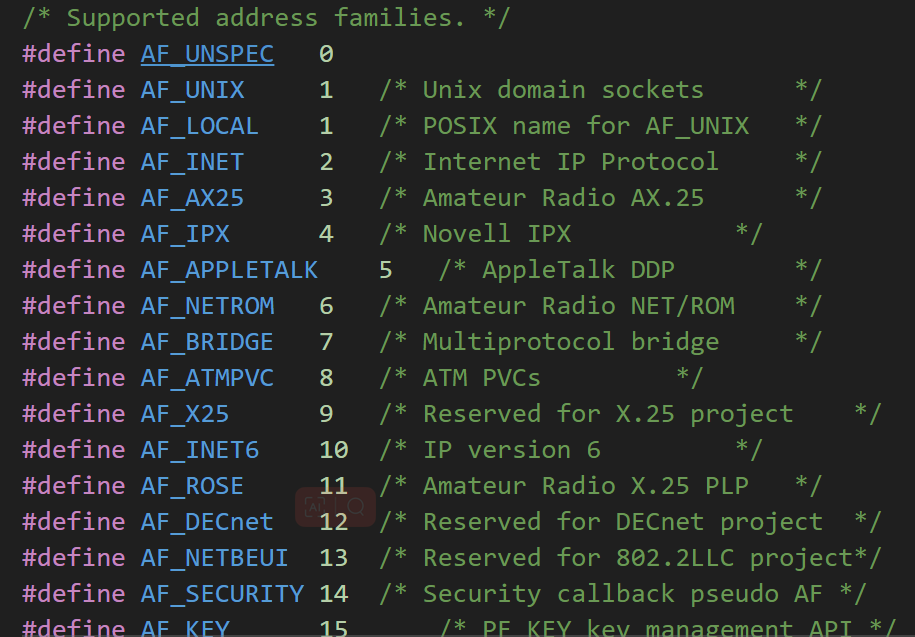
比如INET协议族初始化时,函数inet_init调用sock_register来注册INET套接字的创建方法
协议族被sock_register函数(位于net\socket.c中)注册到net_families中:
int sock_register(const struct net_proto_family *ops)
{int err;if (ops->family >= NPROTO) {pr_crit("protocol %d >= NPROTO(%d)\n", ops->family, NPROTO);return -ENOBUFS;}spin_lock(&net_family_lock);//协议族被注册到net_familiesif (rcu_dereference_protected(net_families[ops->family],lockdep_is_held(&net_family_lock)))err = -EEXIST;else {rcu_assign_pointer(net_families[ops->family], ops);err = 0;}spin_unlock(&net_family_lock);pr_info("NET: Registered protocol family %d\n", ops->family);return err;
}
inet_init函数则在\net\ipv4\af_inet.c下:
static int __init inet_init(void)
{...(void)sock_register(&inet_family_ops);...
}
而 inet_family_ops 则是定义在af_inet.c下的静态变量,并且已经进行了相应的初始化
static const struct net_proto_family inet_family_ops = {.family = PF_INET,  //表示INET协议族.create = inet_create,  //表示INET套接字的创建方法.owner	= THIS_MODULE,
};
这里的逻辑就是在af_inet.c中,将INET协议族(net_proto_family)定义好,再调用sock_register函数,将其注册到net_families数组中,通过net_families数组中的family和上层传入的family进行对比,就能拿到对应net_proto_family,从而调用对应的套接字的创建方法
针对同一个协议族,但却有着不同的type,那么在inet_create内部是如何正确的调用对应的套接字的创建方法呢?
在看inet_create之前,需要了解一下inet_protosw 结构体
struct inet_protosw {struct list_head list;//双向链表,将所有的inet_protosw (内部封装了套接字类型和对应的协议)都链在一起unsigned short	 type;	   //socket的第二个参数unsigned short	 protocol; //socket的第三个参数struct proto	 *prot;       //传输层协议对应函数的具体实现const struct proto_ops *ops;  //针对同一个type的函数集unsigned char	 flags;      /* See INET_PROTOSW_* below.  */
};
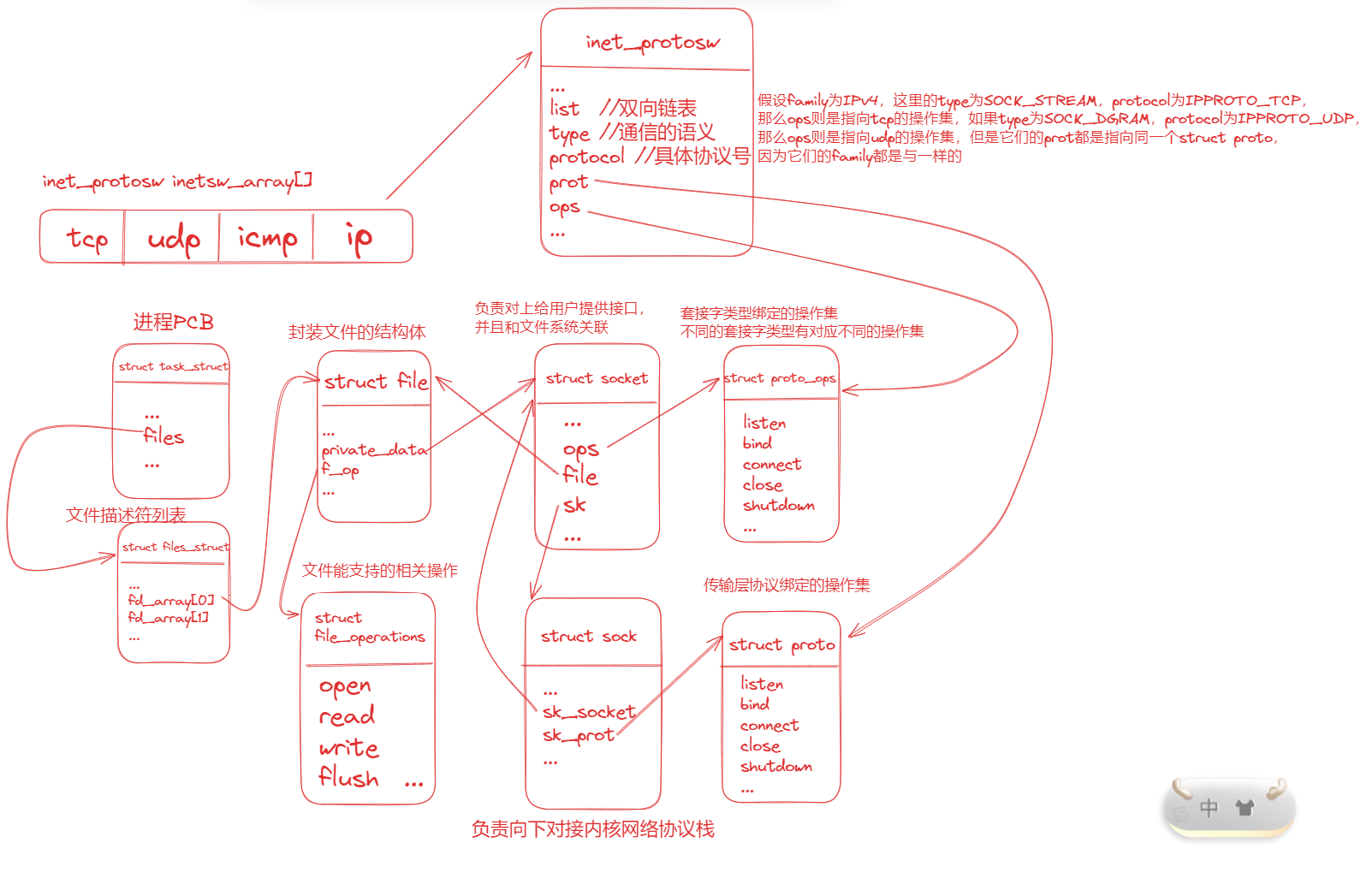
针对struct proto和struct proto_ops,得特别强调一下两者的关系:
proto是一个传输层协议绑定的操作集,比如对于IPPROTO_TCP,它就是tcp_prot,对于IPPROTO_UDP,它就是udp_prot。而对于类型为SOCK_RAW的套接字,它没有相应的传输层协议,而是用于通配所有的网络层附属协议,所以,prot就是所有网络层附属协议共用的一个操作集raw_prot。
proto_ops是套接字类型绑定的操作集,对应于SOCK_STREAM, SOCK_DGRAM, SOCK_RAW,操作集分别为inet_stream_ops,inet_dgram_ops,inet_sockraw_ops。
举个例子,例如针对于type,假设为SOCK_STREAM,它定义了一组通用的接口(函数),tcp的type为SOCK_STREAM,那它就必须要实现这些接口(函数),所以 struct proto 就是tcp中这些接口(函数)的具体实现,如果又有人实现了其他协议,那么则需要重新实现这些接口(函数)
在初始化时,内核已经将我们常用的inet_protosw 结构体(套接字类型和对应的协议)定义好了,放在了一个名为inet_protosw 数组中,一共有四组
static struct inet_protosw inetsw_array[] =
{//这一组就表示tcp{.type =       SOCK_STREAM,.protocol =   IPPROTO_TCP,.prot =       &tcp_prot,.ops =        &inet_stream_ops,.flags =      INET_PROTOSW_PERMANENT |INET_PROTOSW_ICSK,},//udp{.type =       SOCK_DGRAM,.protocol =   IPPROTO_UDP,.prot =       &udp_prot,.ops =        &inet_dgram_ops,.flags =      INET_PROTOSW_PERMANENT,},//icmp{.type =       SOCK_DGRAM,.protocol =   IPPROTO_ICMP,.prot =       &ping_prot,.ops =        &inet_sockraw_ops,.flags =      INET_PROTOSW_REUSE,},//ip{.type =       SOCK_RAW,.protocol =   IPPROTO_IP,	/* wild card */.prot =       &raw_prot,.ops =        &inet_sockraw_ops,.flags =      INET_PROTOSW_REUSE,}
};
通过函数inet_register_protosw将inet_protosw 注册到inetsw数组中,并且将他们链接在一起
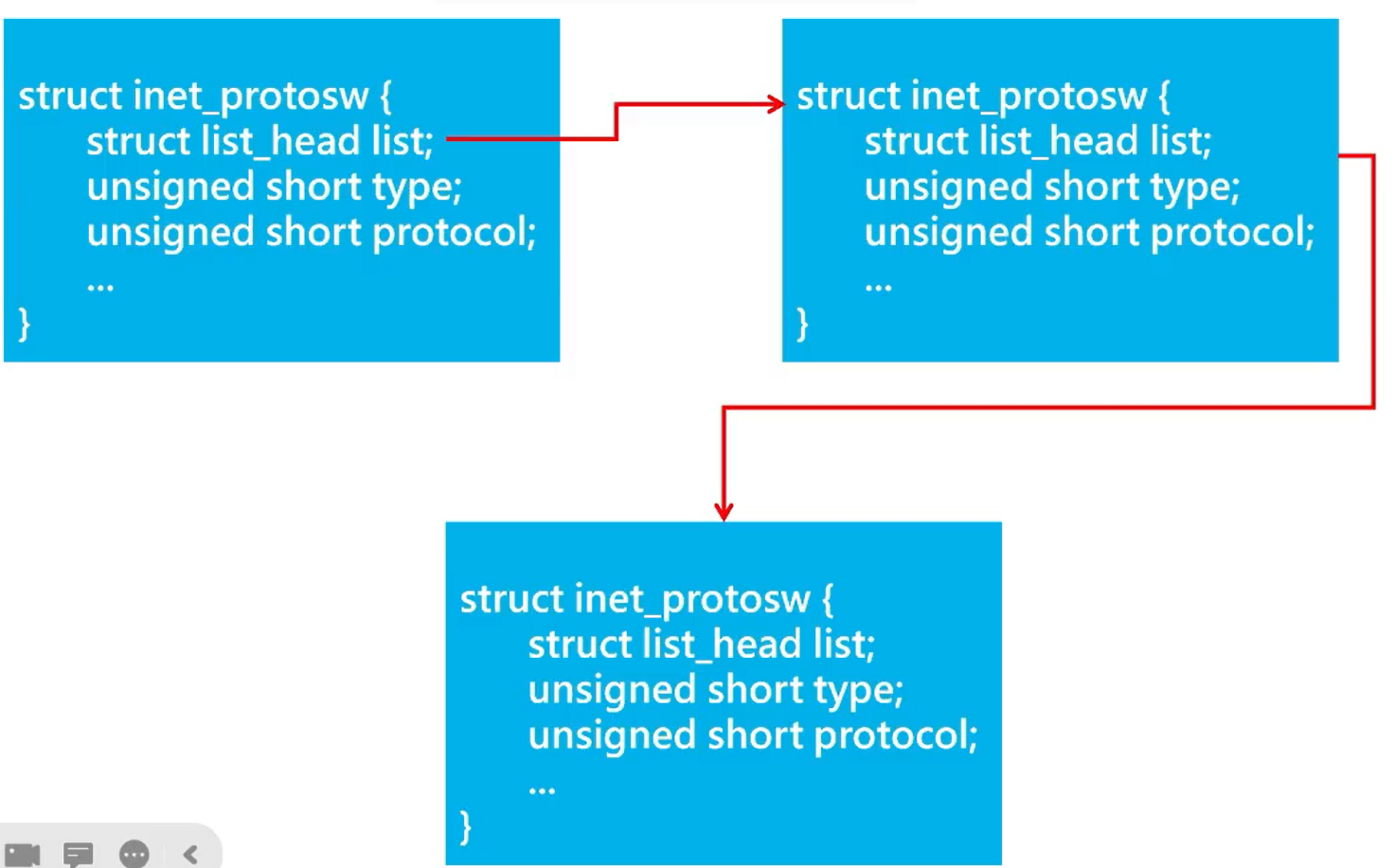
INET套接字的创建方法inet_create也定义在af_inet.c下
static int inet_create(struct net *net, struct socket *sock, int protocol,int kern)
{struct sock *sk;struct inet_protosw *answer; //内部封装了套接字类型和对应的协议,以及操作套接字的相关函数struct inet_sock *inet;      //struct inet_sock是对struct sock进一步封装struct proto *answer_prot;   //传输层协议对应函数的具体实现unsigned char answer_flags;int try_loading_module = 0;int err;if (protocol < 0 || protocol >= IPPROTO_MAX)return -EINVAL;sock->state = SS_UNCONNECTED;lookup_protocol:err = -ESOCKTNOSUPPORT;rcu_read_lock();//list_for_each_entry_rcu一个宏定义,主要是用于遍历,获取inet_protosw数组中的每个元素,并赋值给answer,//并且判断answer中protocol和上层传入的protocol是否一致,如果一致,则说明找到了对应的协议list_for_each_entry_rcu(answer, &itsw[sock->type], list) {err = 0;//如果上层传入的protocl是0,inet_protosw数组的第一个元素的protocol是6(IPPROTO_TCP)//那么就会进入elseif (protocol == answer->protocol) {if (protocol != IPPROTO_IP)break;} else {   //IPPROTO_IP和protocol相等,都为0,那么就会将inet_protosw数组的第一个元素的protocol是6赋值给上层传入的protocol,此时protocol就为6了,表示IPPROTO_TCPif (IPPROTO_IP == protocol) {protocol = answer->protocol;break;}if (IPPROTO_IP == answer->protocol)break;}err = -EPROTONOSUPPORT;}if (unlikely(err)) {if (try_loading_module < 2) {rcu_read_unlock();if (++try_loading_module == 1)request_module("net-pf-%d-proto-%d-type-%d",PF_INET, protocol, sock->type);elserequest_module("net-pf-%d-proto-%d",PF_INET, protocol);goto lookup_protocol;} elsegoto out_rcu_unlock;}err = -EPERM;if (sock->type == SOCK_RAW && !kern &&!ns_capable(net->user_ns, CAP_NET_RAW))goto out_rcu_unlock;//找到正确的inet_protosw,也就是answer,就将最开始定义的变量进行赋值sock->ops = answer->ops;answer_prot = answer->prot;answer_flags = answer->flags;rcu_read_unlock();WARN_ON(!answer_prot->slab);err = -ENOBUFS;//调用sk_alloc申请struct socksk = sk_alloc(net, PF_INET, GFP_KERNEL, answer_prot, kern);if (!sk)goto out;err = 0;if (INET_PROTOSW_REUSE & answer_flags)sk->sk_reuse = SK_CAN_REUSE;inet = inet_sk(sk);inet->is_icsk = (INET_PROTOSW_ICSK & answer_flags) != 0;inet->nodefrag = 0;if (SOCK_RAW == sock->type) {inet->inet_num = protocol;if (IPPROTO_RAW == protocol)inet->hdrincl = 1;}if (net->ipv4.sysctl_ip_no_pmtu_disc)inet->pmtudisc = IP_PMTUDISC_DONT;elseinet->pmtudisc = IP_PMTUDISC_WANT;inet->inet_id = 0;//用struct sock(sk) 初始化 struct socket(sock),并将它们关联起来sock_init_data(sock, sk);sk->sk_destruct	   = inet_sock_destruct;sk->sk_protocol	   = protocol;sk->sk_backlog_rcv = sk->sk_prot->backlog_rcv;inet->uc_ttl	= -1;inet->mc_loop	= 1;inet->mc_ttl	= 1;inet->mc_all	= 1;inet->mc_index	= 0;inet->mc_list	= NULL;inet->rcv_tos	= 0;sk_refcnt_debug_inc(sk);if (inet->inet_num) {inet->inet_sport = htons(inet->inet_num);err = sk->sk_prot->hash(sk);if (err) {sk_common_release(sk);goto out;}}if (sk->sk_prot->init) {err = sk->sk_prot->init(sk);if (err)sk_common_release(sk);}
out:return err;
out_rcu_unlock:rcu_read_unlock();goto out;
}
sk_alloc函数
struct sock *sk_alloc(struct net *net, int family, gfp_t priority,struct proto *prot, int kern)
{struct sock *sk;//申请struct socksk = sk_prot_alloc(prot, priority | __GFP_ZERO, family);if (sk) {//如果申请成功就进行相关数据的初始化sk->sk_family = family;sk->sk_prot = sk->sk_prot_creator = prot;sock_lock_init(sk);sk->sk_net_refcnt = kern ? 0 : 1;if (likely(sk->sk_net_refcnt))get_net(net);sock_net_set(sk, net);atomic_set(&sk->sk_wmem_alloc, 1);mem_cgroup_sk_alloc(sk);cgroup_sk_alloc(&sk->sk_cgrp_data);sock_update_classid(&sk->sk_cgrp_data);sock_update_netprioidx(&sk->sk_cgrp_data);}return sk;
}
void sock_init_data(struct socket *sock, struct sock *sk)
{...sk_set_socket(sk, sock);//sk->sk_socket = sock;if (sock) {sk->sk_type	=	sock->type;sk->sk_wq	=	sock->wq;sock->sk	=	sk;}...
}//负责对上给用户提供接口,并且和文件系统关联;
struct socket {...struct file		*file;struct sock		*sk;const struct proto_ops	*ops;
};//负责向下对接内核网络协议栈;
struct sock {struct socket		*sk_socket;...
};//通过sk->sk_socket = sock;和sock->sk = sk; 就将两者链接了起来
3、struct socket 和文件的联系
通过调用sock_create,将上层的struct socket 和下层的 struct sock 链接了起来,接着还会调用sock_map_fd,将struct socket 和文件系统关联在一起,因为我们在上层创建socket的时候,返回的是文件描述符(fd),后续进行所有的操作都是对fd进行操作的
static int sock_map_fd(struct socket *sock, int flags)
{struct file *newfile; //文件指针int fd = get_unused_fd_flags(flags); //获取一个未使用的fdif (unlikely(fd < 0))return fd;newfile = sock_alloc_file(sock, flags, NULL);//申请一个文件,并且在内部会将socket和文件关联起来if (likely(!IS_ERR(newfile))) {fd_install(fd, newfile);//将文件和fd关联起来return fd;}put_unused_fd(fd);return PTR_ERR(newfile);
}
sock_alloc_file函数
struct file *sock_alloc_file(struct socket *sock, int flags, const char *dname)
{...//将socket和文件链接起来sock->file = file;file->private_data = sock;return file;
}
fd_install函数
void fd_install(unsigned int fd, struct file *file)
{__fd_install(current->files, fd, file);
}void __fd_install(struct files_struct *files, unsigned int fd,struct file *file)
{struct fdtable *fdt;might_sleep();rcu_read_lock_sched();while (unlikely(files->resize_in_progress)) {rcu_read_unlock_sched();wait_event(files->resize_wait, !files->resize_in_progress);rcu_read_lock_sched();}smp_rmb();fdt = rcu_dereference_sched(files->fdt);BUG_ON(fdt->fd[fd] != NULL);rcu_assign_pointer(fdt->fd[fd], file); //就是将文件放到进程的文件描述符列表中rcu_read_unlock_sched();
}//fd是给应用层看的,而内核操作的却是struct file
4、相关数据结构的联系
5、socket系统调用的整体流程图
