【Leetcode 程序员面试金典 02.08】 —— 环路检测 |双指针

面试题02.08. 环路检测
给定一个链表,如果它是有环链表,实现一个算法返回环路的开头节点。若环不存在,请返回null。
如果链表中有某个节点,可以通过连续跟踪next指针再次到达,则链表中存在环。 为了表示给定链表中的环,我们使用整数pos来表示链表尾连接到链表中的位置(索引从 0 开始)。 如果pos是 -1,则在该链表中没有环。注意:pos不作为参数进行传递,仅仅是为了标识链表的实际情况。
题目分析
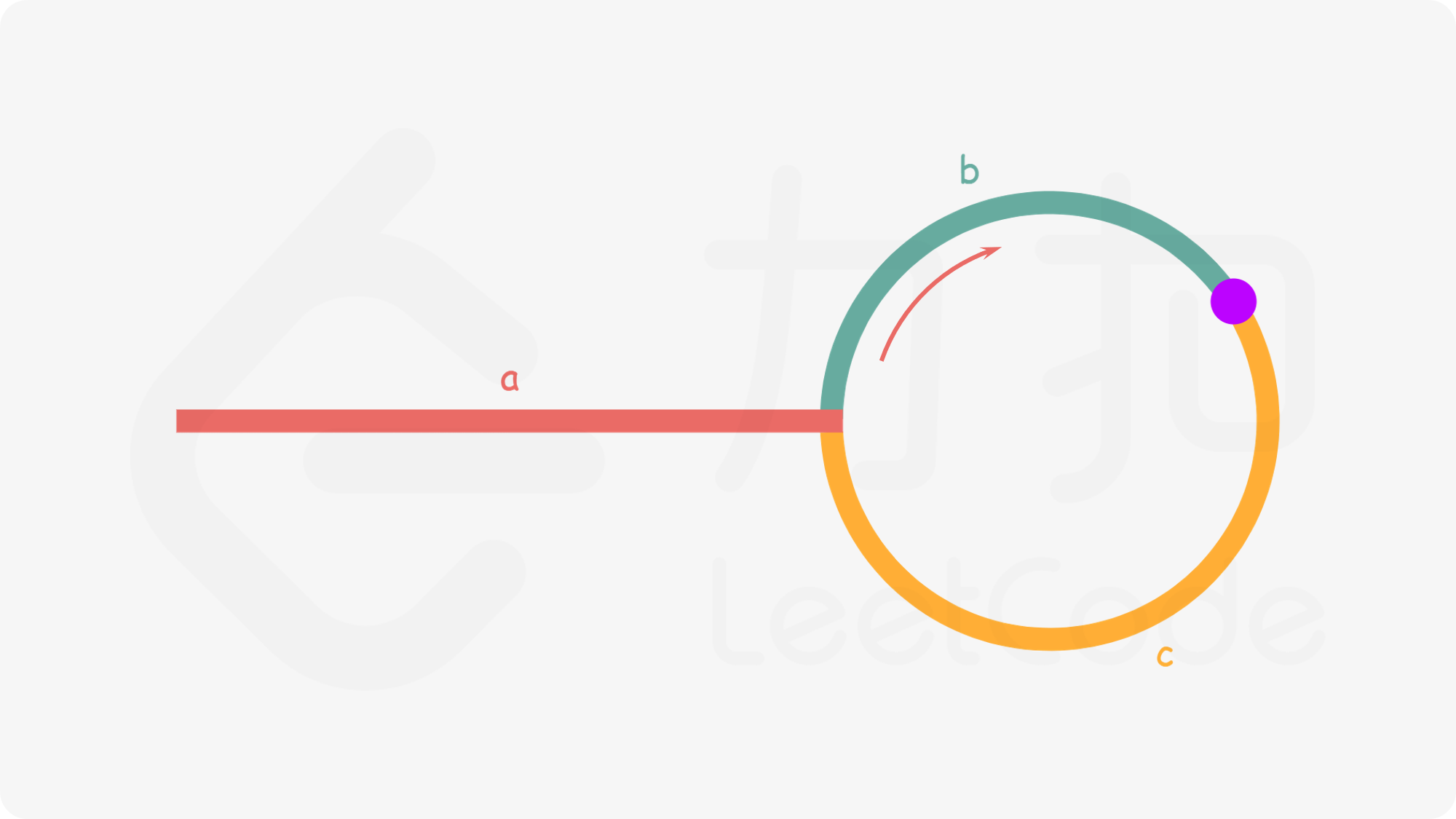
我们可以使用双指针解决本题
快指针走了: a + ( b + c ) m + b a + (b+c)m + b a+(b+c)m+b
慢指针走了: a + ( b + c ) n + b a + (b+c)n + b a+(b+c)n+b
根据快走的是慢的两倍,
a + ( b + c ) m + b = 2 ( a + ( b + c ) n + b ) a + (b+c)m + b = 2(a + (b+c)n + b) a+(b+c)m+b=2(a+(b+c)n+b) =>
a = ( b + c ) ( m − 2 n ) − b a = (b+c)(m-2n) - b a=(b+c)(m−2n)−b
得 a 的距离为(环长度的倍数 - b),即 tmp 指针从头节点走到环开头节点等于 slow 指针走到环开头节点的距离
双指针顾名思义,就是同时使用两个指针,在序列、链表结构上指向的是位置,在树、图结构中指向的是节点,通过或同向移动,或相向移动来维护、统计信息
经典双指针的数组遍历,更多案例可见 Leetcode 双指针详解
/*** Definition for singly-linked list.* class ListNode {*     int val;*     ListNode next;*     ListNode(int x) {*         val = x;*         next = null;*     }* }*/
public class Solution {public ListNode detectCycle(ListNode head) {if(head == null){return null;}ListNode slow = head, fast = head;while(fast != null){slow = slow.next;if(fast.next != null){fast = fast.next.next;} else {return null;}if(slow == fast){ListNode tmp = head;while(tmp != slow){tmp = tmp.next;slow = slow.next;}return tmp;}}return null;}
}