第3章 【例题】(完整版)
)
目录
前言
【例3.1】有关成绩结构体的例子
【例3.2】使用Score类的完整程序
【例 3.3】一个存在错误的程序
【例3.4】用对象赋值语句的例子
【例3.5】为类Score定义一个构造函数
【例3.6】建立对象的同时,用构造函数给数据成员赋初值
【例3.7】用成员初始化列表对数据成员进行初始化
【例3.8】类成员初始化的顺序
【例3.9】带有默认参数的构造函数
【例3.10】含有构造函数和析构函数的Score类
【例3.11】较完整的学生类例子
【例3.12】正确对数据成员赋初值
【例3.13】用初始值列表初始化公有数据成员
【例3.14】分析下列程序的运行结果
【例3.15】构造函数的重载
【例3.16】计时器的实现
【例3.17】自定义拷贝构造函数
【例3.18】默认拷贝构造函数的调用
【例3.19】调拷贝构造函数的三种情况用
【例3.20】分析下列程序的运行结果
【例3.21】有关浅拷贝的例子
【例3.22】有关深拷贝的例子
前言
基于教材:c++面向对象程序设计(第三版)陈维兴 林小茶 编著 第三章的所有例题
【例3.1】有关成绩结构体的例子
//3.1有关成绩结构体的例子
#include <iostream>
using namespace std;
struct Score            //声明了一个名为Score的结构体
{   int mid_exam;int fin_exam;
};
int main()
{Score score1;score1.mid_exam=80;//可以在结构体外直接访问数据mid_examscore1.fin_exam=88;//可以在结构体外直接访问数据fin_examcout<<"期中成绩:"<<score1.mid_exam<<"\n期末成绩:"<<score1.fin_exam<<"\n总评成绩:"<<(int)(0.3*score1.mid_exam+0.7*score1.fin_exam)<<endl;return 0;
}
【例3.2】使用Score类的完整程序
//3.2使用Score类的完整程序
#include <iostream>
using namespace std;
class Score{public:void setScore(int m,int f) {mid_exam=m;fin_exam=f;}void showScore() {cout<<"\n期中成绩:"<<mid_exam<<"\n期末成绩:"<<fin_exam<<"\n";cout<<"总评成绩:"<<(int)(0.3*mid_exam+0.7*fin_exam)<<endl;}private:int mid_exam;       //私有数据成员int fin_exam;       //私有数据成员
};
int main()
{Score op1,op2;          //定义对象op1和op2;op1.setScore(80,88);//调用op1的成员函数setScore(),给op1的数据成员赋值op2.setScore(90,92);//调用对象op2的成员函数setScore(),给op2的数据成员赋值op1.showScore();//调用op1的成员函数showScore()op2.showScore();//调用op的成员函数showScore()return 0;
}
【例 3.3】一个存在错误的程序
//3.3一个存在错误的程序
#include <iostream>
using namespace std;
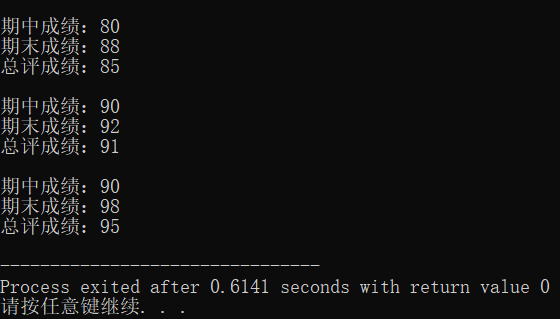
class Score{public:void setScore(int m,int f){mid_exam=m;fin_exam=f;}void showScore(){cout<<"\n期中成绩:"<<mid_exam<<"\n期末成绩:"<<fin_exam<<"\n";cout<<"总评成绩:"<<(int)(0.3*mid_exam+0.7*fin_exam)<<endl;}private:int mid_exam;       //私有数据成员int fin_exam;       //私有数据成员
};
int main()
{Score op1,op2;          //定义对象op1和op2;op1.setScore(80,88);//调用op1的成员函数setScore(),给op1的数据成员赋值op2.setScore(90,92);//调用对象op2的成员函数setScore(),给op2的数据成员赋值
//	cout<<"\n期中成绩:"<<op1.mid_exam<<"\n期末成绩"<<op1.fin_exam<<endl;
//从类的外部访问对象的私有成员是错误的,除非公有数据成员op1.showScore();//调用op1的成员函数showScore()op2.showScore();//调用op的成员函数showScore()Score op3,*ptr;ptr=&op3;(*ptr).setScore(90,98);ptr->showScore();return 0;
} 
【例3.4】用对象赋值语句的例子
//3.4用对象赋值语句的例子#include <iostream>
using namespace std;
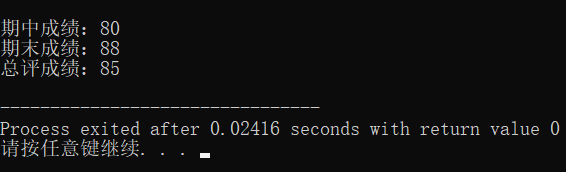
class Score{public:void setScore(int m,int f) {mid_exam=m;fin_exam=f;}void showScore() {cout<<"\n期中成绩:"<<mid_exam<<"\n期末成绩:"<<fin_exam<<"\n";cout<<"总评成绩:"<<(int)(0.3*mid_exam+0.7*fin_exam)<<endl;}private:int mid_exam;       //私有数据成员int fin_exam;       //私有数据成员
};
int main()
{Score op1,op2;          //定义对象op1和op2;op1.setScore(80,88);//调用op1的成员函数setScore(),给op1的数据成员赋值op2=op1;//将对象op1数据成员的值赋给对象op2op2.showScore();return 0;
} 
【例3.5】为类Score定义一个构造函数
//3.5为类Score定义一个构造函数
#include <iostream>
using namespace std;
class Score{public:Score(int m,int f);//声明构造函数Score()的原型void setScore(int m,int f);void showScore();private:int mid_exam;int fin_exam;//私有数据成员
};
Score::Score(int m,int f)//定义构造函数Score()
{cout<<"构造函数使用中..."<<endl;mid_exam=m;fin_exam=f;
}
int main()
{}
【例3.6】建立对象的同时,用构造函数给数据成员赋初值
//3.6建立对象的同时,用构造函数给数据成员赋初值
#include <iostream>
using namespace std;
class Score{public:Score(int m,int f);//声明构造函数Score()的原型void setScore(int m,int f);void showScore();private:int mid_exam;int fin_exam;//私有数据成员
};
Score::Score(int m,int f)//定义构造函数Score()
{cout<<"构造函数使用中..."<<endl;mid_exam=m;fin_exam=f;
}
void Score::setScore(int m,int f)
{mid_exam=m;fin_exam=f;
}
inline void Score::showScore()
{cout<<"\n期中成绩:"<<mid_exam<<"\n期末成绩:"<<fin_exam<<"\n";cout<<"总评成绩:"<<(int)(0.3*mid_exam+0.7*fin_exam)<<endl;
}
int main()
{Score score1(80,88);//定义类Score的对象score1,自动调用构造函数//给对象score1的数据成员赋初值cout<<endl<<"成绩输出:";score1.showScore();//调用成员函数showScore(),显示score1的数据score1.setScore(90,92);cout<<endl<<"成绩输出:";score1.showScore();return 0;
}

【例3.7】用成员初始化列表对数据成员进行初始化
//3.7用成员初始化列表对数据成员进行初始化
#include <iostream>
using namespace std;
class A{public:A(int x1):x(x1),rx(x),pi(3.14)//用成员初始化列表对引用类型的数据成员赋值{}void print()//rx和const修饰的数据成员pi进行初始化{cout<<"x="<<x<<"  "<<"rx="<<rx<<"  "<<"pi="<<pi<<endl;}private:int x;int& rx;//rx是整形变量的引用const double pi;//pi是用const修饰的常量
};
int main()
{A a(10);a.print();return 0;
}
【例3.8】类成员初始化的顺序
//3.8类成员初始化的顺序
#include <iostream>
using namespace std;
class D{public:D(int i):mem2(i),mem1(mem2+1)//是按照mem1,mem2的顺序(数据成员声明的顺序){                            //进行初始化的。mem1先进行初始化,由于mem2还未被//初始化,所以此时是个随机数cout<<"mem1: "<<mem1<<endl;cout<<"mem2: "<<mem2<<endl;}private:int mem1;int mem2;
};
int main()
{D d(15);return 0;
}
【例3.9】带有默认参数的构造函数
//3.9带有默认参数的构造函数
#include <iostream>
using namespace std;
class Score{public:Score(int m=0,int f=0);//声明构造函数Score()的原型void setScore(int m,int f);void showScore();private:int mid_exam;//私有数据成员int fin_exam;//私有数据成员
};
Score::Score(int m,int f): mid_exam(m),fin_exam(f)//定义构造函数Score()
{cout<<"构造函数使用中..."<<endl;
}
void Score::setScore(int m,int f)
{mid_exam=m;fin_exam=f;
}
inline void Score::showScore()
{cout<<"\n期中成绩:"<<mid_exam<<"\n期末成绩:"<<fin_exam<<"\n";cout<<"总评成绩:"<<(int)(0.3*mid_exam+0.7*fin_exam)<<endl;
}
int main()
{Score op1(80,88);//传递两个实参Score op2(90);//只传递了一个实参,第二个参数用默认值Score op3;//没有传递实参,全部用默认值op1.showScore();op2.showScore();op3.showScore();return 0;
} 
【例3.10】含有构造函数和析构函数的Score类
//3.10含有构造函数和析构函数的Score类
#include <iostream>
using namespace std;
class Score{public:Score(int m,int f);//声明构造函数Score()的原型~Score();//声明析构函数void setScore(int m,int f);void showScore();private:int mid_exam;//私有数据成员int fin_exam;//私有数据成员
};
Score::Score(int m,int f): mid_exam(m),fin_exam(f)//定义构造函数Score()
{cout<<"构造函数使用中..."<<endl;
}
Score::~Score()//定义析构函数
{cout<<endl<<"析构函数使用中..."<<endl;}
void Score::setScore(int m,int f)
{mid_exam=m;fin_exam=f;
}
inline void Score::showScore()
{cout<<"\n期中成绩:"<<mid_exam<<"\n期末成绩:"<<fin_exam<<"\n";cout<<"总评成绩:"<<(int)(0.3*mid_exam+0.7*fin_exam)<<endl;
}
int main()
{Score score1(80,88);//定义类Score的对象Score1,自动调用构造函数,给对象Score的数据成员赋初值cout<<endl<<"成绩输出:";score1.showScore();//调用成员函数showScore(),显示score1的数据score1.setScore(90,92);cout<<endl<<"成绩输出:";score1.showScore();//调用成员函数showScore(),显示score1的数据return 0;//这条语句之后,析构函数自动被调用
}
【例3.11】较完整的学生类例子
//3.11较完整的学生类例子
#include <iostream>
#include<string>
using namespace std;
class Student{public:Student(char *name1,char *stu_no1,float score1);//声明构造函数~Student();//声明析构函数void modify(float score1);//成员函数,用以修改数据void show();//成员函数,用以显示数据private:char *name;//学生姓名char *stu_no;//学生学号float score;//学生成绩
};
Student::Student(char *name1,char *stu_no1,float score1)//定义构造函数
{name=new char[strlen(name1)+1];strcpy(name,name1);stu_no=new char[strlen(stu_no1)+1];strcpy(stu_no,stu_no1);score=score1;
}
Student::~Student()//定义析构函数
{delete []name;delete []stu_no;cout<<endl<<"析构函数使用中..."<<endl;
}
void Student::modify(float score1)
{score=score1;
}
void Student::show()
{cout<<"姓名:"<<name<<endl;cout<<"学号:"<<stu_no<<endl;cout<<"分数:"<<score<<endl;
}
int main()
{Student stu1("黎明","201502021",90);//定义类Student的对象stu1,调用构造函数,初始化对象stu1stu1.show();//调用成员函数show(),显示stu1的数据stu1.modify(88);//调用成员函数modify(),修改stu1的数据cout<<"修改后:-------"<<endl;stu1.show();//调用成员函数show(),显示stu1修改后的数据
}
可以正常运行,但编译有警告

【例3.12】正确对数据成员赋初值
//3.12正确对数据成员赋初值
#include <iostream>
using namespace std;class Myclass{public:int no;
};
int main()
{Myclass a;a.no=2015;cout<<a.no<<endl;return 0;
} 
如果将程序修改为:
//将3.12程序修改
#include <iostream>
using namespace std;
class Myclass{public:int no;
};
int main()
{Myclass a;cout<<a.no<<endl;return 0;
} 
也许我用的是新版编译器,没有出现像书上那样的报错
实际上可以理解为调用了默认的构造函数给数据成员赋初值,默认的构造函数一般只负责给对象分配存储空间,而不承担给数据成员赋初值的任务。
但这个代码如果加上一个带参数的的构造函数一定错误。 因为:
当在类中一旦定义了带参数的构造函数,系统将不再提供无参的默认的构造函数,需要自己再重新定义一个无参的构造函数以代替默认的构造函数。
如下:
#include <iostream>
using namespace std;
class Myclass{public:Myclass(int no1){no=no1;}int no;
};
int main()
{Myclass a;cout<<a.no<<endl;return 0;
}
编译错误提示:

而加上一个无参的构造函数或者定义对象时给定初值就没问题了。
【例3.13】用初始值列表初始化公有数据成员
//3.13用初始值列表初始化公有数据成员
#include <iostream>
using namespace std;
class Myclass{public:char name[10];int no;
};
int main()
{Myclass a={"chen",25};cout<<a.name<<"  "<<a.no<<endl;return 0;
}

【例3.14】分析下列程序的运行结果
//3.14分析下列程序的运行结果
#include <iostream>
using namespace std;
class Score{public:Score(int m,int f);//声明构造函数Score()的原型~Score();//声明析构函数void setScore(int m,int f);void showScore();private:int mid_exam;//私有数据成员int fin_exam;//私有数据成员
};
Score::Score(int m,int f): mid_exam(m),fin_exam(f)//定义构造函数Score()
{cout<<"构造函数使用中..."<<endl;
}
Score::~Score()//定义析构函数
{   cout<<endl<<"析构函数使用中..."<<endl;  }
void Score::setScore(int m,int f)
{mid_exam=m;fin_exam=f;
}
inline void Score::showScore()
{cout<<"\n期中成绩:"<<mid_exam<<"\n期末成绩:"<<fin_exam<<"\n";cout<<"总评成绩:"<<(int)(0.3*mid_exam+0.7*fin_exam)<<endl;
}
int main()
{Score score1;//定义类Score的对象score1,自动调用构造函数score1.setScore(80,88);//给类对象score1的数据成员赋初值cout<<endl<<"成绩输出";score1.showScore();return 0;
}
//当类中定义了带有参数的构造函数之后,系统将不再给它提供默认的构造函数
//解决办法:
//1. 再类中添加一个无参数的构造函数
//Score()
//{ }
//2.或在主函数中给对象参数
//int main()
//{
//	Score score(80,88);
//}

【例3.15】构造函数的重载
//【3.15】构造函数的重载
#include <iostream>
using namespace std;
class Score{public:Score(int m, int f);//声明有参数的构造函数Score();//声明无参数的构造函数~Score();//声明析构函数void setScore(int m,int f);void showScore();private:int mid_exam;//私有数据成员int fin_exam;//私有数据成员
};
Score::Score(int m,int f)//定义有参数的构造函数
{cout<<"构造..."<<endl;mid_exam=m;fin_exam=f;
}
Score::Score()//定义无参数的构造函数
{   cout<<"构造函数使用中..."<<endl;    }
Score::~Score()
{cout<<endl<<"析构函数使用中..."<<endl;
}
void Score::setScore(int m, int f)
{mid_exam=m;fin_exam=f;
}inline void Score::showScore()
{cout<<"\n期中成绩:"<<mid_exam<<"\n期末成绩:"<<fin_exam<<"\n";cout<<"总评成绩:"<<(int)(0.3*mid_exam+0.7*fin_exam)<<endl;
}int main()
{Score score1;//定义类Score的对象score1,调用无参构造函数score1.setScore(80,88);//给对象score1的数据成员赋初值cout<<endl<<"成绩输出:";score1.showScore();//显示score1的数据Score score2(90,92);//定义义类Score的对象score2,调用有参构造函数cout<<endl<<"成绩输出:";score2.showScore();//显示score2的数据return 0;
}
【例3.16】计时器的实现
//3.16计时器的实现
#include <iostream>
#include<stdlib.h>
#include<string>
using namespace std;
class Timer{public:Timer()//定义无参数的构造函数,将seconds初始化为零{	seconds=0;	}Timer(char* t)//定义一个含数字串参数的构造函数{	seconds=atoi(t);	}//atoi函数功能:将数字串转为整形Timer(int t)//定义一个含整形参数的构造函数{	seconds=t;	}Timer(int min,int sec)//定义含两个整形参数的构造函数{	seconds=min*60+sec;	}int showtime(){	cout<<"时间="<<seconds<<"秒"<<endl;	}private:int seconds;
};
int main()
{Timer a,b(10),c("20"),d(1,10);a.showtime();b.showtime();c.showtime();d.showtime();
}
【例3.17】自定义拷贝构造函数
//3.17自定义拷贝构造函数
#include <iostream>
using namespace std;
class Score{public:Score(int m,int f);//声明有参数的构造函数Score();//声明无参数的构造函数Score(const Score &p);//自定义拷贝构造函数//拷贝构造函数是函数名与类名相同,参数是同类对象的引用~Score();//声明析构函数void setScore(int m,int f);void showScore();private:int mid_exam;int fin_exam;
};
Score::Score(int m,int f)//定义有参数的构造函数
{cout<<"构造函数使用中..."<<endl;mid_exam=m;fin_exam=f;
}
Score::Score()//定义无参数的构造函数
{}
Score::~Score()//定义析构函数
{	cout<<"析构函数使用中...\n";}
Score::Score(const Score &p)//自定义的拷贝构造函数
{mid_exam=2*p.mid_exam;fin_exam=2*p.fin_exam;cout<<"拷贝构造函数使用中...\n";
}
void Score::setScore(int m,int f)
{mid_exam=m;fin_exam=f;
}inline void Score::showScore()
{cout<<"\n期中成绩:"<<mid_exam<<"\n期末成绩:"<<fin_exam<<"\n";cout<<"总评成绩:"<<(int)(0.3*mid_exam+0.7*fin_exam)<<endl;
}
int main()
{Score score1(90,92);//定义类Score的对象,调用有参构造函数Score score2(score1);//拷贝构造函数,拷贝构造函数只在创建对象时被调用
//	Score score2=score1;//作用是一样的cout<<endl<<"成绩输出...";score1.showScore();
//	cout<<endl<<"成绩输出...";
//	score2.showScore();return 0;
} 
【例3.18】默认拷贝构造函数的调用
//3.18默认拷贝构造函数的调用
#include <iostream>
using namespace std;
class Score{public:Score(int m,int f);//声明有参数的构造函数~Score();void showScore();private:int mid_exam;int fin_exam;//私有数据成员
};
Score::Score(int m,int f)
{cout<<"构造函数使用中...";mid_exam=m;fin_exam=f;
}
Score::~Score()  {	cout<<"析构函数使用中...\n";  }
void Score::showScore()
{cout<<"\n期中成绩:"<<mid_exam<<"\n期末成绩:"<<fin_exam<<"\n";cout<<"总评成绩:"<<(int)(0.3*mid_exam+0.7*fin_exam)<<endl;
}
int main()
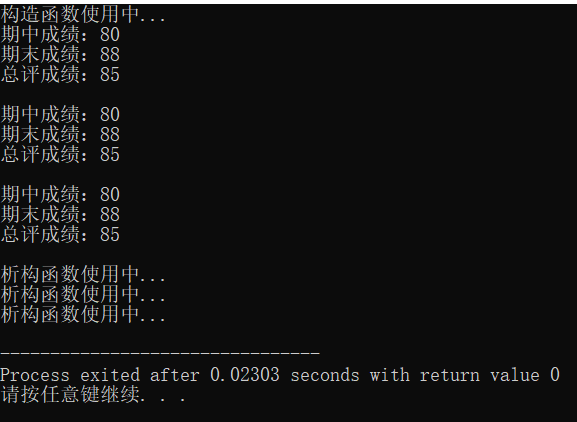
{Score p1(80,88);//定义对象p1,调用普通构造函数初始化对象p1Score p2(p1);//以代入法调用了默认的拷贝函数,用对象p1初始化对象p2Score p3=p1;//以赋值法调用默认的拷贝函数,用对象p1初始化p3p1.showScore();p2.showScore();p3.showScore();cout<<endl;return 0;
} 
【例3.19】调拷贝构造函数的三种情况用
//3.19调用拷贝构造函数的三种情况
#include <iostream>
using namespace std;
class Score{public:Score(int m,int f);//声明有参数的构造函数Score(const Score &p);void showScore();private:int mid_exam;int fin_exam;
};
Score::Score(int m,int f)
{cout<<"构造函数使用中...";mid_exam=m;fin_exam=f;
}
Score::Score(const Score &p)//自定义拷贝构造函数
{mid_exam=p.mid_exam;fin_exam=p.fin_exam;cout<<"拷贝构造函数使用中...\n";
}
void Score::showScore()
{cout<<"\n期中成绩:"<<mid_exam<<"\n期末成绩:"<<fin_exam<<"\n";cout<<"总评成绩:"<<(int)(0.3*mid_exam+0.7*fin_exam)<<endl;
}
void fun1(Score p)//形参是对象,在这里调用了拷贝构造函数。
{p.showScore();
}
Score fun2()
{Score p4(80,88);return p4;//renturn时,调用了拷贝构造函数,将p4拷贝倒匿名对象中。
}
int main()
{Score p1(80,88);//定义对象p1,第1次调用普通的构造函数p1.showScore();Score p2(p1);//第一次调用拷贝构造函数,用对象p1初始化对象p2p2.showScore();Score p3=p1;//第二次调用拷贝构造函数p3.showScore();fun1(p1);//对象p1作为fun1()的实参,第三次调用拷贝构造函数p2=fun2();//在哪函数fun()2内部定义对象时,第2次调用普通的构造函数//函数的返回值是对象,第4次调用拷贝构造函数,//但在匿名对象给p2赋值时,不会调用拷贝构造函数,函数结束时,//匿名对象也随之消失p2.showScore();return 0;
}
【例3.20】分析下列程序的运行结果
//3.20分析下列程序的运行结果
#include <iostream>
using namespace std;
class Coord{public:Coord(int a=0,int b=0);//声明构造函数Coord(const Coord &p);//声明拷贝构造函数~Coord(){	cout<<"析构函数使用中...\n";	}void print(){	cout<<x<<" "<<y<<endl;	}int getX(){	return x;	}int getY(){	return y;	}private:int x,y;
};
Coord::Coord(int a,int b)//定义构造函数
{x=a;y=b;cout<<"构造函数使用中...\n";
}
Coord::Coord(const Coord &p)//定义拷贝构造函数
{x=p.x;y=p.y;cout<<"拷贝构造函数使用中...\n";
}
Coord fun(Coord p)//函数fun()的形参是对象
{cout<<"函数使用中...\n";int a,b;a=p.getX()+10;b=p.getY()+20;Coord r(a,b);return r;//函数fun()的返回值是对象
}
int main()
{Coord p1(30,40);Coord p2;Coord p3(p1);p2=fun(p3);p2.print();return 0;
} 
【例3.21】有关浅拷贝的例子
//3.21有关浅拷贝的例子
#include <iostream>
#include <string>
using namespace std;
class Student{public:Student(char *name1,float score1);~Student();private:char *name;//学生姓名float score;//学生成绩};
Student::Student(char *name1,float score1)
{cout<<"构造函数使用中..."<<name1<<endl;name=new char[strlen(name1)+1];if(name!=0){strcpy(name,name1);score=score1;}
}
Student::~Student()
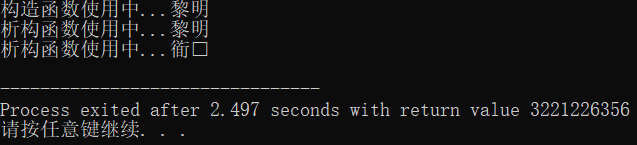
{cout<<"析构函数使用中..."<<name<<endl;name[0]='\0';delete []name;
}
int main()
{Student stu1("黎明",90);//调用构造函数Student stu2=stu1;//调用默认的拷贝构造函数return 0;
} 
【例3.22】有关深拷贝的例子
//3.22有关深拷贝的例子
#include <iostream>
#include <string>
using namespace std;
class Student{public:Student(char *name1,float score1);Student(Student& stu);~Student();private:char *name;//学生姓名float score;//学生成绩};
Student::Student(char *name1,float score1)
{cout<<"构造函数使用中..."<<name1<<endl;name=new char[strlen(name1)+1];if(name!=0){strcpy(name,name1);score=score1;}
}
Student::Student(Student& stu)
{cout<<"拷贝构造函数使用中..."<<stu.name<<endl;name=new char[strlen(stu.name)+1];if(name!=0){strcpy(name,stu.name);score=stu.score;}
}
Student::~Student()
{cout<<"析构函数使用中..."<<name<<endl;name[0]='\0';delete []name;
}
int main()
{Student stu1("黎明",90);//调用构造函数Student stu2=stu1;//调用默认的拷贝构造函数return 0;
}