工具系列:TensorFlow Decision Forests_(1)构建、训练和评估模型
构建、训练和评估模型)
文章目录
- 1. 介绍
- 2. 安装 TensorFlow Decision Forests
- 3. 导入库
- 4. 训练一个随机森林模型
- 4.1 加载数据集并将其转换为tf.Dataset
- 4.2 训练模型
- 4.3 备注
- 5. 评估模型
- 6. 为TensorFlow Serving准备这个模型。
- 7. 绘制模型
- 8. 模型结构和特征重要性
- 9. 模型自我评估
- 10. 绘制训练日志
- 11. 使用不同的学习算法重新训练模型
- 12. 使用特征子集
- 13. 超参数
- 14. 特征预处理
- 15. 训练回归模型
1. 介绍
决策森林(DF)是一类用于监督分类、回归和排序的机器学习算法。顾名思义,DF使用决策树作为构建块。如今,最流行的DF训练算法是随机森林和梯度提升决策树。
TensorFlow决策森林(TF-DF)是一个用于训练、评估、解释和推断决策森林模型的库。
在本教程中,您将学习如何:
- 在包含数值、分类和缺失特征的数据集上训练一个多类分类随机森林模型。
- 在测试数据集上评估模型。
- 准备模型以供TensorFlow Serving使用。
- 检查模型的整体结构和每个特征的重要性。
- 使用不同的学习算法(梯度提升决策树)重新训练模型。
- 使用不同的输入特征集。
- 更改模型的超参数。
- 预处理特征。
- 训练一个回归模型。
详细文档可在用户手册中找到。示例目录包含其他端到端示例。
2. 安装 TensorFlow Decision Forests
通过运行以下单元格来安装 TF-DF。
# 安装tensorflow_decision_forests库
!pip install tensorflow_decision_forests
Collecting tensorflow_decision_forestsObtaining dependency information for tensorflow_decision_forests from https://files.pythonhosted.org/packages/67/84/dc181dc6d4ec2692432bb168119e932a3175ffcfddcca41bc8a1a6d5a8b9/tensorflow_decision_forests-1.5.0-cp39-cp39-manylinux_2_17_x86_64.manylinux2014_x86_64.whl.metadataDownloading tensorflow_decision_forests-1.5.0-cp39-cp39-manylinux_2_17_x86_64.manylinux2014_x86_64.whl.metadata (4.9 kB)
Requirement already satisfied: numpy in /tmpfs/src/tf_docs_env/lib/python3.9/site-packages (from tensorflow_decision_forests) (1.24.3)
Requirement already satisfied: pandas in /tmpfs/src/tf_docs_env/lib/python3.9/site-packages (from tensorflow_decision_forests) (2.0.3)
Requirement already satisfied: tensorflow~=2.13.0 in /tmpfs/src/tf_docs_env/lib/python3.9/site-packages (from tensorflow_decision_forests) (2.13.0)
Requirement already satisfied: six in /tmpfs/src/tf_docs_env/lib/python3.9/site-packages (from tensorflow_decision_forests) (1.16.0)
Requirement already satisfied: absl-py in /tmpfs/src/tf_docs_env/lib/python3.9/site-packages (from tensorflow_decision_forests) (1.4.0)
Requirement already satisfied: wheel in /tmpfs/src/tf_docs_env/lib/python3.9/site-packages (from tensorflow_decision_forests) (0.40.0)
Collecting wurlitzer (from tensorflow_decision_forests)Using cached wurlitzer-3.0.3-py3-none-any.whl (7.3 kB)
Requirement already satisfied: astunparse>=1.6.0 in /tmpfs/src/tf_docs_env/lib/python3.9/site-packages (from tensorflow~=2.13.0->tensorflow_decision_forests) (1.6.3)
Requirement already satisfied: flatbuffers>=23.1.21 in /tmpfs/src/tf_docs_env/lib/python3.9/site-packages (from tensorflow~=2.13.0->tensorflow_decision_forests) (23.5.26)
Requirement already satisfied: gast<=0.4.0,>=0.2.1 in /tmpfs/src/tf_docs_env/lib/python3.9/site-packages (from tensorflow~=2.13.0->tensorflow_decision_forests) (0.4.0)
Requirement already satisfied: google-pasta>=0.1.1 in /tmpfs/src/tf_docs_env/lib/python3.9/site-packages (from tensorflow~=2.13.0->tensorflow_decision_forests) (0.2.0)
Requirement already satisfied: grpcio<2.0,>=1.24.3 in /tmpfs/src/tf_docs_env/lib/python3.9/site-packages (from tensorflow~=2.13.0->tensorflow_decision_forests) (1.57.0)
Requirement already satisfied: h5py>=2.9.0 in /tmpfs/src/tf_docs_env/lib/python3.9/site-packages (from tensorflow~=2.13.0->tensorflow_decision_forests) (3.9.0)
Requirement already satisfied: keras<2.14,>=2.13.1 in /tmpfs/src/tf_docs_env/lib/python3.9/site-packages (from tensorflow~=2.13.0->tensorflow_decision_forests) (2.13.1)
Requirement already satisfied: libclang>=13.0.0 in /tmpfs/src/tf_docs_env/lib/python3.9/site-packages (from tensorflow~=2.13.0->tensorflow_decision_forests) (16.0.6)
Requirement already satisfied: opt-einsum>=2.3.2 in /tmpfs/src/tf_docs_env/lib/python3.9/site-packages (from tensorflow~=2.13.0->tensorflow_decision_forests) (3.3.0)
Requirement already satisfied: packaging in /tmpfs/src/tf_docs_env/lib/python3.9/site-packages (from tensorflow~=2.13.0->tensorflow_decision_forests) (23.1)
Requirement already satisfied: protobuf!=4.21.0,!=4.21.1,!=4.21.2,!=4.21.3,!=4.21.4,!=4.21.5,<5.0.0dev,>=3.20.3 in /tmpfs/src/tf_docs_env/lib/python3.9/site-packages (from tensorflow~=2.13.0->tensorflow_decision_forests) (3.20.3)
Requirement already satisfied: setuptools in /tmpfs/src/tf_docs_env/lib/python3.9/site-packages (from tensorflow~=2.13.0->tensorflow_decision_forests) (68.1.0)
Requirement already satisfied: tensorboard<2.14,>=2.13 in /tmpfs/src/tf_docs_env/lib/python3.9/site-packages (from tensorflow~=2.13.0->tensorflow_decision_forests) (2.13.0)
Requirement already satisfied: tensorflow-estimator<2.14,>=2.13.0 in /tmpfs/src/tf_docs_env/lib/python3.9/site-packages (from tensorflow~=2.13.0->tensorflow_decision_forests) (2.13.0)
Requirement already satisfied: termcolor>=1.1.0 in /tmpfs/src/tf_docs_env/lib/python3.9/site-packages (from tensorflow~=2.13.0->tensorflow_decision_forests) (2.3.0)
Requirement already satisfied: typing-extensions<4.6.0,>=3.6.6 in /tmpfs/src/tf_docs_env/lib/python3.9/site-packages (from tensorflow~=2.13.0->tensorflow_decision_forests) (4.5.0)
Requirement already satisfied: wrapt>=1.11.0 in /tmpfs/src/tf_docs_env/lib/python3.9/site-packages (from tensorflow~=2.13.0->tensorflow_decision_forests) (1.15.0)
Requirement already satisfied: tensorflow-io-gcs-filesystem>=0.23.1 in /tmpfs/src/tf_docs_env/lib/python3.9/site-packages (from tensorflow~=2.13.0->tensorflow_decision_forests) (0.33.0)
Requirement already satisfied: python-dateutil>=2.8.2 in /tmpfs/src/tf_docs_env/lib/python3.9/site-packages (from pandas->tensorflow_decision_forests) (2.8.2)
Requirement already satisfied: pytz>=2020.1 in /tmpfs/src/tf_docs_env/lib/python3.9/site-packages (from pandas->tensorflow_decision_forests) (2023.3)
Requirement already satisfied: tzdata>=2022.1 in /tmpfs/src/tf_docs_env/lib/python3.9/site-packages (from pandas->tensorflow_decision_forests) (2023.3)
Requirement already satisfied: google-auth<3,>=1.6.3 in /tmpfs/src/tf_docs_env/lib/python3.9/site-packages (from tensorboard<2.14,>=2.13->tensorflow~=2.13.0->tensorflow_decision_forests) (2.22.0)
Requirement already satisfied: google-auth-oauthlib<1.1,>=0.5 in /tmpfs/src/tf_docs_env/lib/python3.9/site-packages (from tensorboard<2.14,>=2.13->tensorflow~=2.13.0->tensorflow_decision_forests) (1.0.0)
Requirement already satisfied: markdown>=2.6.8 in /tmpfs/src/tf_docs_env/lib/python3.9/site-packages (from tensorboard<2.14,>=2.13->tensorflow~=2.13.0->tensorflow_decision_forests) (3.4.4)
Requirement already satisfied: requests<3,>=2.21.0 in /tmpfs/src/tf_docs_env/lib/python3.9/site-packages (from tensorboard<2.14,>=2.13->tensorflow~=2.13.0->tensorflow_decision_forests) (2.31.0)
Requirement already satisfied: tensorboard-data-server<0.8.0,>=0.7.0 in /tmpfs/src/tf_docs_env/lib/python3.9/site-packages (from tensorboard<2.14,>=2.13->tensorflow~=2.13.0->tensorflow_decision_forests) (0.7.1)
Requirement already satisfied: werkzeug>=1.0.1 in /tmpfs/src/tf_docs_env/lib/python3.9/site-packages (from tensorboard<2.14,>=2.13->tensorflow~=2.13.0->tensorflow_decision_forests) (2.3.7)
Requirement already satisfied: cachetools<6.0,>=2.0.0 in /tmpfs/src/tf_docs_env/lib/python3.9/site-packages (from google-auth<3,>=1.6.3->tensorboard<2.14,>=2.13->tensorflow~=2.13.0->tensorflow_decision_forests) (5.3.1)
Requirement already satisfied: pyasn1-modules>=0.2.1 in /tmpfs/src/tf_docs_env/lib/python3.9/site-packages (from google-auth<3,>=1.6.3->tensorboard<2.14,>=2.13->tensorflow~=2.13.0->tensorflow_decision_forests) (0.3.0)
Requirement already satisfied: rsa<5,>=3.1.4 in /tmpfs/src/tf_docs_env/lib/python3.9/site-packages (from google-auth<3,>=1.6.3->tensorboard<2.14,>=2.13->tensorflow~=2.13.0->tensorflow_decision_forests) (4.9)
Requirement already satisfied: urllib3<2.0 in /tmpfs/src/tf_docs_env/lib/python3.9/site-packages (from google-auth<3,>=1.6.3->tensorboard<2.14,>=2.13->tensorflow~=2.13.0->tensorflow_decision_forests) (1.26.16)
Requirement already satisfied: requests-oauthlib>=0.7.0 in /tmpfs/src/tf_docs_env/lib/python3.9/site-packages (from google-auth-oauthlib<1.1,>=0.5->tensorboard<2.14,>=2.13->tensorflow~=2.13.0->tensorflow_decision_forests) (1.3.1)
Requirement already satisfied: importlib-metadata>=4.4 in /tmpfs/src/tf_docs_env/lib/python3.9/site-packages (from markdown>=2.6.8->tensorboard<2.14,>=2.13->tensorflow~=2.13.0->tensorflow_decision_forests) (6.8.0)
Requirement already satisfied: charset-normalizer<4,>=2 in /tmpfs/src/tf_docs_env/lib/python3.9/site-packages (from requests<3,>=2.21.0->tensorboard<2.14,>=2.13->tensorflow~=2.13.0->tensorflow_decision_forests) (3.2.0)
Requirement already satisfied: idna<4,>=2.5 in /tmpfs/src/tf_docs_env/lib/python3.9/site-packages (from requests<3,>=2.21.0->tensorboard<2.14,>=2.13->tensorflow~=2.13.0->tensorflow_decision_forests) (3.4)
Requirement already satisfied: certifi>=2017.4.17 in /tmpfs/src/tf_docs_env/lib/python3.9/site-packages (from requests<3,>=2.21.0->tensorboard<2.14,>=2.13->tensorflow~=2.13.0->tensorflow_decision_forests) (2023.7.22)
Requirement already satisfied: MarkupSafe>=2.1.1 in /tmpfs/src/tf_docs_env/lib/python3.9/site-packages (from werkzeug>=1.0.1->tensorboard<2.14,>=2.13->tensorflow~=2.13.0->tensorflow_decision_forests) (2.1.3)
Requirement already satisfied: zipp>=0.5 in /tmpfs/src/tf_docs_env/lib/python3.9/site-packages (from importlib-metadata>=4.4->markdown>=2.6.8->tensorboard<2.14,>=2.13->tensorflow~=2.13.0->tensorflow_decision_forests) (3.16.2)
Requirement already satisfied: pyasn1<0.6.0,>=0.4.6 in /tmpfs/src/tf_docs_env/lib/python3.9/site-packages (from pyasn1-modules>=0.2.1->google-auth<3,>=1.6.3->tensorboard<2.14,>=2.13->tensorflow~=2.13.0->tensorflow_decision_forests) (0.5.0)
Requirement already satisfied: oauthlib>=3.0.0 in /tmpfs/src/tf_docs_env/lib/python3.9/site-packages (from requests-oauthlib>=0.7.0->google-auth-oauthlib<1.1,>=0.5->tensorboard<2.14,>=2.13->tensorflow~=2.13.0->tensorflow_decision_forests) (3.2.2)
Using cached tensorflow_decision_forests-1.5.0-cp39-cp39-manylinux_2_17_x86_64.manylinux2014_x86_64.whl (16.8 MB)
Installing collected packages: wurlitzer, tensorflow_decision_forests
Successfully installed tensorflow_decision_forests-1.5.0 wurlitzer-3.0.3
Wurlitzer 是在 Colabs 中显示详细的训练日志所需的(当在模型构造函数中使用 verbose=2 时)。
!pip install wurlitzer
Requirement already satisfied: wurlitzer in /tmpfs/src/tf_docs_env/lib/python3.9/site-packages (3.0.3)
3. 导入库
# 导入所需的库import tensorflow_decision_forests as tfdf  # 导入决策森林库
import os  # 导入操作系统库
import numpy as np  # 导入数值计算库
import pandas as pd  # 导入数据处理库
import tensorflow as tf  # 导入深度学习库
import math  # 导入数学库
在Colab中,隐藏的代码单元格会限制输出的高度。
#@title# 导入所需的模块
from IPython.core.magic import register_line_magic
from IPython.display import Javascript
from IPython.display import display as ipy_display# 定义一个魔术命令,用于设置单元格的最大高度
@register_line_magic
def set_cell_height(size):# 调用Javascript代码,设置单元格的最大高度ipy_display(Javascript("google.colab.output.setIframeHeight(0, true, {maxHeight: " +str(size) + "})"))
# 检查 TensorFlow Decision Forests 的版本
# 打印出 TensorFlow Decision Forests 的版本号
print("Found TensorFlow Decision Forests v" + tfdf.__version__)
Found TensorFlow Decision Forests v1.5.0
4. 训练一个随机森林模型
在本节中,我们将训练、评估、分析和导出一个基于Palmer’s Penguins数据集的多类分类随机森林模型。

注意: 数据集被导出为一个未经预处理的csv文件:library(palmerpenguins); write.csv(penguins, file="penguins.csv", quote=F, row.names=F)。
4.1 加载数据集并将其转换为tf.Dataset
这个数据集非常小(300个例子),并且以类似.csv的文件格式存储。因此,使用Pandas来加载它。
**注意:**Pandas很实用,因为你不需要输入特征的名称来加载它们。对于更大的数据集(>1M个例子),使用TensorFlow Dataset来读取文件可能更合适。
让我们将数据集组装成一个csv文件(即添加头部),然后加载它:
# 下载数据集
!wget -q https://storage.googleapis.com/download.tensorflow.org/data/palmer_penguins/penguins.csv -O /tmp/penguins.csv# 将数据集加载到Pandas Dataframe中
dataset_df = pd.read_csv("/tmp/penguins.csv")# 显示前3个样本
dataset_df.head(3)
| species | island | bill_length_mm | bill_depth_mm | flipper_length_mm | body_mass_g | sex | year | |
|---|---|---|---|---|---|---|---|---|
| 0 | Adelie | Torgersen | 39.1 | 18.7 | 181.0 | 3750.0 | male | 2007 |
| 1 | Adelie | Torgersen | 39.5 | 17.4 | 186.0 | 3800.0 | female | 2007 |
| 2 | Adelie | Torgersen | 40.3 | 18.0 | 195.0 | 3250.0 | female | 2007 |
该数据集包含数字型(例如bill_depth_mm)、分类型(例如island)和缺失特征的混合。TF-DF原生支持所有这些特征类型(与基于NN的模型不同),因此不需要进行预处理,如独热编码、归一化或额外的is_present特征。
标签有点不同:Keras指标需要整数。标签(species)存储为字符串,因此让我们将其转换为整数。
# 将分类标签编码为整数# 详细说明:
# 如果你的分类标签是字符串形式的,那么这个步骤是必要的,因为Keras期望的是整数分类标签。
# 当使用`pd_dataframe_to_tf_dataset`(见下文)时,可以跳过这一步。# 标签列的名称
label = "species"# 获取标签的唯一值,并转换为列表
classes = dataset_df[label].unique().tolist()# 打印标签的类别
print(f"Label classes: {classes}")# 使用类别的索引值替换数据集中的标签值
dataset_df[label] = dataset_df[label].map(classes.index)
Label classes: ['Adelie', 'Gentoo', 'Chinstrap']
接下来将数据集分为训练集和测试集:
# 将数据集分割为训练集和测试集。def split_dataset(dataset, test_ratio=0.30):"""将panda数据框分割成两部分。"""# 生成一个与数据集长度相同的随机数组,元素值小于测试比例的为True,大于等于测试比例的为Falsetest_indices = np.random.rand(len(dataset)) < test_ratio# 返回测试集和训练集return dataset[~test_indices], dataset[test_indices]# 调用split_dataset函数将数据集分割成训练集和测试集,并将返回的结果分别赋值给train_ds_pd和test_ds_pd
train_ds_pd, test_ds_pd = split_dataset(dataset_df)# 打印训练集和测试集的样本数量
print("{}个样本用于训练,{}个样本用于测试。".format(len(train_ds_pd), len(test_ds_pd)))
239 examples in training, 105 examples for testing.
最后,将pandas数据帧(pd.Dataframe)转换为tensorflow数据集(tf.data.Dataset):
# 将Pandas DataFrame转换为TensorFlow数据集
train_ds = tfdf.keras.pd_dataframe_to_tf_dataset(train_ds_pd, label=label)  # 将训练集的Pandas DataFrame转换为TensorFlow数据集,并指定标签列
test_ds = tfdf.keras.pd_dataframe_to_tf_dataset(test_ds_pd, label=label)  # 将测试集的Pandas DataFrame转换为TensorFlow数据集,并指定标签列
**注意事项:**请记住,如果需要,pd_dataframe_to_tf_dataset会将字符串标签转换为整数。
如果您想自己创建tf.data.Dataset,请记住以下几点:
- 学习算法使用的是一个周期的数据集,且不进行洗牌。
- 批次大小不会影响训练算法,但较小的值可能会减慢读取数据集的速度。
4.2 训练模型
# 设置单元格高度为300# 指定模型为随机森林模型,并设置详细程度为2
model_1 = tfdf.keras.RandomForestModel(verbose=2)# 训练模型
model_1.fit(train_ds)
<IPython.core.display.Javascript object>Warning: The `num_threads` constructor argument is not set and the number of CPU is os.cpu_count()=32 > 32. Setting num_threads to 32. Set num_threads manually to use more than 32 cpus.WARNING:absl:The `num_threads` constructor argument is not set and the number of CPU is os.cpu_count()=32 > 32. Setting num_threads to 32. Set num_threads manually to use more than 32 cpus.Use /tmpfs/tmp/tmpblfnf8hv as temporary training directory
Reading training dataset...
Training tensor examples:
Features: {'island': <tf.Tensor 'data:0' shape=(None,) dtype=string>, 'bill_length_mm': <tf.Tensor 'data_1:0' shape=(None,) dtype=float64>, 'bill_depth_mm': <tf.Tensor 'data_2:0' shape=(None,) dtype=float64>, 'flipper_length_mm': <tf.Tensor 'data_3:0' shape=(None,) dtype=float64>, 'body_mass_g': <tf.Tensor 'data_4:0' shape=(None,) dtype=float64>, 'sex': <tf.Tensor 'data_5:0' shape=(None,) dtype=string>, 'year': <tf.Tensor 'data_6:0' shape=(None,) dtype=int64>}
Label: Tensor("data_7:0", shape=(None,), dtype=int64)
Weights: None
Normalized tensor features:{'island': SemanticTensor(semantic=<Semantic.CATEGORICAL: 2>, tensor=<tf.Tensor 'data:0' shape=(None,) dtype=string>), 'bill_length_mm': SemanticTensor(semantic=<Semantic.NUMERICAL: 1>, tensor=<tf.Tensor 'Cast:0' shape=(None,) dtype=float32>), 'bill_depth_mm': SemanticTensor(semantic=<Semantic.NUMERICAL: 1>, tensor=<tf.Tensor 'Cast_1:0' shape=(None,) dtype=float32>), 'flipper_length_mm': SemanticTensor(semantic=<Semantic.NUMERICAL: 1>, tensor=<tf.Tensor 'Cast_2:0' shape=(None,) dtype=float32>), 'body_mass_g': SemanticTensor(semantic=<Semantic.NUMERICAL: 1>, tensor=<tf.Tensor 'Cast_3:0' shape=(None,) dtype=float32>), 'sex': SemanticTensor(semantic=<Semantic.CATEGORICAL: 2>, tensor=<tf.Tensor 'data_5:0' shape=(None,) dtype=string>), 'year': SemanticTensor(semantic=<Semantic.NUMERICAL: 1>, tensor=<tf.Tensor 'Cast_4:0' shape=(None,) dtype=float32>)}
Training dataset read in 0:00:03.556705. Found 239 examples.
Training model...
Standard output detected as not visible to the user e.g. running in a notebook. Creating a training log redirection. If training gets stuck, try calling tfdf.keras.set_training_logs_redirection(False).[INFO 23-08-16 11:05:20.8059 UTC kernel.cc:773] Start Yggdrasil model training
[INFO 23-08-16 11:05:20.8059 UTC kernel.cc:774] Collect training examples
[INFO 23-08-16 11:05:20.8060 UTC kernel.cc:787] Dataspec guide:
column_guides {column_name_pattern: "^__LABEL$"type: CATEGORICALcategorial {min_vocab_frequency: 0max_vocab_count: -1}
}
default_column_guide {categorial {max_vocab_count: 2000}discretized_numerical {maximum_num_bins: 255}
}
ignore_columns_without_guides: false
detect_numerical_as_discretized_numerical: false[INFO 23-08-16 11:05:20.8063 UTC kernel.cc:393] Number of batches: 1
[INFO 23-08-16 11:05:20.8064 UTC kernel.cc:394] Number of examples: 239
[INFO 23-08-16 11:05:20.8064 UTC kernel.cc:794] Training dataset:
Number of records: 239
Number of columns: 8Number of columns by type:NUMERICAL: 5 (62.5%)CATEGORICAL: 3 (37.5%)Columns:NUMERICAL: 5 (62.5%)1: "bill_depth_mm" NUMERICAL num-nas:1 (0.41841%) mean:17.0387 min:13.2 max:21.5 sd:1.971692: "bill_length_mm" NUMERICAL num-nas:1 (0.41841%) mean:44.0025 min:32.1 max:55.9 sd:5.271723: "body_mass_g" NUMERICAL num-nas:1 (0.41841%) mean:4230.57 min:2700 max:6300 sd:821.0554: "flipper_length_mm" NUMERICAL num-nas:1 (0.41841%) mean:201.176 min:172 max:231 sd:14.29247: "year" NUMERICAL mean:2008.03 min:2007 max:2009 sd:0.807521CATEGORICAL: 3 (37.5%)0: "__LABEL" CATEGORICAL integerized vocab-size:4 no-ood-item5: "island" CATEGORICAL has-dict vocab-size:4 zero-ood-items most-frequent:"Biscoe" 121 (50.6276%)6: "sex" CATEGORICAL num-nas:7 (2.92887%) has-dict vocab-size:3 zero-ood-items most-frequent:"female" 120 (51.7241%)Terminology:nas: Number of non-available (i.e. missing) values.ood: Out of dictionary.manually-defined: Attribute which type is manually defined by the user i.e. the type was not automatically inferred.tokenized: The attribute value is obtained through tokenization.has-dict: The attribute is attached to a string dictionary e.g. a categorical attribute stored as a string.vocab-size: Number of unique values.[INFO 23-08-16 11:05:20.8065 UTC kernel.cc:810] Configure learner
[INFO 23-08-16 11:05:20.8067 UTC kernel.cc:824] Training config:
learner: "RANDOM_FOREST"
features: "^bill_depth_mm$"
features: "^bill_length_mm$"
features: "^body_mass_g$"
features: "^flipper_length_mm$"
features: "^island$"
features: "^sex$"
features: "^year$"
label: "^__LABEL$"
task: CLASSIFICATION
random_seed: 123456
metadata {framework: "TF Keras"
}
pure_serving_model: false
[yggdrasil_decision_forests.model.random_forest.proto.random_forest_config] {num_trees: 300decision_tree {max_depth: 16min_examples: 5in_split_min_examples_check: truekeep_non_leaf_label_distribution: truenum_candidate_attributes: 0missing_value_policy: GLOBAL_IMPUTATIONallow_na_conditions: falsecategorical_set_greedy_forward {sampling: 0.1max_num_items: -1min_item_frequency: 1}growing_strategy_local {}categorical {cart {}}axis_aligned_split {}internal {sorting_strategy: PRESORTED}uplift {min_examples_in_treatment: 5split_score: KULLBACK_LEIBLER}}winner_take_all_inference: truecompute_oob_performances: truecompute_oob_variable_importances: falsenum_oob_variable_importances_permutations: 1bootstrap_training_dataset: truebootstrap_size_ratio: 1adapt_bootstrap_size_ratio_for_maximum_training_duration: falsesampling_with_replacement: true
}[INFO 23-08-16 11:05:20.8070 UTC kernel.cc:827] Deployment config:
cache_path: "/tmpfs/tmp/tmpblfnf8hv/working_cache"
num_threads: 32
try_resume_training: true[INFO 23-08-16 11:05:20.8072 UTC kernel.cc:889] Train model
[INFO 23-08-16 11:05:20.8073 UTC random_forest.cc:416] Training random forest on 239 example(s) and 7 feature(s).
[INFO 23-08-16 11:05:20.8130 UTC random_forest.cc:802] Training of tree  1/300 (tree index:0) done accuracy:0.943182 logloss:2.04793
[INFO 23-08-16 11:05:20.8139 UTC random_forest.cc:802] Training of tree  11/300 (tree index:8) done accuracy:0.949367 logloss:0.383614
[INFO 23-08-16 11:05:20.8144 UTC random_forest.cc:802] Training of tree  21/300 (tree index:4) done accuracy:0.953975 logloss:0.386135
[INFO 23-08-16 11:05:20.8146 UTC random_forest.cc:802] Training of tree  35/300 (tree index:20) done accuracy:0.953975 logloss:0.249595
[INFO 23-08-16 11:05:20.8147 UTC random_forest.cc:802] Training of tree  50/300 (tree index:30) done accuracy:0.949791 logloss:0.249004
[INFO 23-08-16 11:05:20.8149 UTC random_forest.cc:802] Training of tree  62/300 (tree index:61) done accuracy:0.949791 logloss:0.247371
[INFO 23-08-16 11:05:20.8155 UTC random_forest.cc:802] Training of tree  73/300 (tree index:73) done accuracy:0.962343 logloss:0.246108
[INFO 23-08-16 11:05:20.8158 UTC random_forest.cc:802] Training of tree  83/300 (tree index:82) done accuracy:0.958159 logloss:0.240771
[INFO 23-08-16 11:05:20.8163 UTC random_forest.cc:802] Training of tree  96/300 (tree index:98) done accuracy:0.962343 logloss:0.0994905
[INFO 23-08-16 11:05:20.8166 UTC random_forest.cc:802] Training of tree  106/300 (tree index:105) done accuracy:0.966527 logloss:0.100095
[INFO 23-08-16 11:05:20.8170 UTC random_forest.cc:802] Training of tree  117/300 (tree index:117) done accuracy:0.962343 logloss:0.0959006
[INFO 23-08-16 11:05:20.8173 UTC random_forest.cc:802] Training of tree  127/300 (tree index:125) done accuracy:0.958159 logloss:0.0962165
[INFO 23-08-16 11:05:20.8177 UTC random_forest.cc:802] Training of tree  138/300 (tree index:137) done accuracy:0.958159 logloss:0.0927663
[INFO 23-08-16 11:05:20.8182 UTC random_forest.cc:802] Training of tree  148/300 (tree index:147) done accuracy:0.966527 logloss:0.0931921
[INFO 23-08-16 11:05:20.8187 UTC random_forest.cc:802] Training of tree  158/300 (tree index:157) done accuracy:0.966527 logloss:0.092117
[INFO 23-08-16 11:05:20.8190 UTC random_forest.cc:802] Training of tree  170/300 (tree index:170) done accuracy:0.966527 logloss:0.0926436
[INFO 23-08-16 11:05:20.8196 UTC random_forest.cc:802] Training of tree  180/300 (tree index:181) done accuracy:0.966527 logloss:0.0927239
[INFO 23-08-16 11:05:20.8200 UTC random_forest.cc:802] Training of tree  190/300 (tree index:187) done accuracy:0.966527 logloss:0.0942833
[INFO 23-08-16 11:05:20.8203 UTC random_forest.cc:802] Training of tree  200/300 (tree index:198) done accuracy:0.966527 logloss:0.0941766
[INFO 23-08-16 11:05:20.8208 UTC random_forest.cc:802] Training of tree  210/300 (tree index:208) done accuracy:0.962343 logloss:0.0938748
[INFO 23-08-16 11:05:20.8211 UTC random_forest.cc:802] Training of tree  220/300 (tree index:219) done accuracy:0.958159 logloss:0.0950461
[INFO 23-08-16 11:05:20.8214 UTC random_forest.cc:802] Training of tree  231/300 (tree index:231) done accuracy:0.953975 logloss:0.0951599
[INFO 23-08-16 11:05:20.8218 UTC random_forest.cc:802] Training of tree  241/300 (tree index:241) done accuracy:0.962343 logloss:0.0948531
[INFO 23-08-16 11:05:20.8221 UTC random_forest.cc:802] Training of tree  251/300 (tree index:250) done accuracy:0.962343 logloss:0.0942377
[INFO 23-08-16 11:05:20.8224 UTC random_forest.cc:802] Training of tree  262/300 (tree index:261) done accuracy:0.962343 logloss:0.0940229
[INFO 23-08-16 11:05:20.8228 UTC random_forest.cc:802] Training of tree  272/300 (tree index:276) done accuracy:0.958159 logloss:0.0934476
[INFO 23-08-16 11:05:20.8231 UTC random_forest.cc:802] Training of tree  282/300 (tree index:281) done accuracy:0.958159 logloss:0.0934649
[INFO 23-08-16 11:05:20.8234 UTC random_forest.cc:802] Training of tree  292/300 (tree index:292) done accuracy:0.958159 logloss:0.0943068
[INFO 23-08-16 11:05:20.8236 UTC random_forest.cc:802] Training of tree  300/300 (tree index:299) done accuracy:0.958159 logloss:0.0945677
[INFO 23-08-16 11:05:20.8250 UTC random_forest.cc:882] Final OOB metrics: accuracy:0.958159 logloss:0.0945677
[INFO 23-08-16 11:05:20.8261 UTC kernel.cc:926] Export model in log directory: /tmpfs/tmp/tmpblfnf8hv with prefix 3b862cbea45f4b2a
[INFO 23-08-16 11:05:20.8303 UTC kernel.cc:944] Save model in resources
[INFO 23-08-16 11:05:20.8335 UTC abstract_model.cc:849] Model self evaluation:
Number of predictions (without weights): 239
Number of predictions (with weights): 239
Task: CLASSIFICATION
Label: __LABELAccuracy: 0.958159  CI95[W][0.930062 0.977127]
LogLoss: : 0.0945677
ErrorRate: : 0.041841Default Accuracy: : 0.422594
Default LogLoss: : 1.04864
Default ErrorRate: : 0.577406Confusion Table:
truth\prediction0   1   2   3
0  0   0   0   0
1  0  98   0   3
2  0   1  91   0
3  0   4   2  40
Total: 239One vs other classes:[INFO 23-08-16 11:05:20.8441 UTC kernel.cc:1243] Loading model from path /tmpfs/tmp/tmpblfnf8hv/model/ with prefix 3b862cbea45f4b2a
[INFO 23-08-16 11:05:20.8582 UTC decision_forest.cc:660] Model loaded with 300 root(s), 4336 node(s), and 7 input feature(s).
[INFO 23-08-16 11:05:20.8582 UTC abstract_model.cc:1311] Engine "RandomForestGeneric" built
[INFO 23-08-16 11:05:20.8582 UTC kernel.cc:1075] Use fast generic engineModel trained in 0:00:00.059670
Compiling model...
WARNING:tensorflow:AutoGraph could not transform <function simple_ml_inference_op_with_handle at 0x7f823d704ee0> and will run it as-is.
Please report this to the TensorFlow team. When filing the bug, set the verbosity to 10 (on Linux, `export AUTOGRAPH_VERBOSITY=10`) and attach the full output.
Cause: could not get source code
To silence this warning, decorate the function with @tf.autograph.experimental.do_not_convertWARNING:tensorflow:AutoGraph could not transform <function simple_ml_inference_op_with_handle at 0x7f823d704ee0> and will run it as-is.
Please report this to the TensorFlow team. When filing the bug, set the verbosity to 10 (on Linux, `export AUTOGRAPH_VERBOSITY=10`) and attach the full output.
Cause: could not get source code
To silence this warning, decorate the function with @tf.autograph.experimental.do_not_convertWARNING: AutoGraph could not transform <function simple_ml_inference_op_with_handle at 0x7f823d704ee0> and will run it as-is.
Please report this to the TensorFlow team. When filing the bug, set the verbosity to 10 (on Linux, `export AUTOGRAPH_VERBOSITY=10`) and attach the full output.
Cause: could not get source code
To silence this warning, decorate the function with @tf.autograph.experimental.do_not_convert
Model compiled.<keras.src.callbacks.History at 0x7f83315d9b80>
4.3 备注
- 没有指定输入特征。因此,除了标签之外,所有列都将被用作输入特征。模型使用的特征在训练日志和
model.summary()中显示。 - DFs原生支持数值、分类、分类集和缺失值特征。数值特征不需要进行归一化。分类字符串值不需要在字典中进行编码。
- 没有指定训练超参数。因此将使用默认超参数。默认超参数在大多数情况下提供合理的结果。
- 在
fit之前对模型调用compile是可选的。编译可以用于提供额外的评估指标。 - 训练算法不需要验证数据集。如果提供了验证数据集,它只会用于显示指标。
- 调整
RandomForestModel的verbose参数以控制显示的训练日志的数量。设置verbose=0以隐藏大部分日志。设置verbose=2以显示所有日志。
注意: 分类集特征由一组分类值组成(而分类只是一个值)。更多详细信息和示例将在后面给出。
5. 评估模型
让我们在测试数据集上评估我们的模型。
# 编译模型
model_1.compile(metrics=["accuracy"])# 评估模型
evaluation = model_1.evaluate(test_ds, return_dict=True)print()# 打印评估结果
for name, value in evaluation.items():print(f"{name}: {value:.4f}")
1/1 [==============================] - ETA: 0s - loss: 0.0000e+00 - accuracy: 0.9619
1/1 [==============================] - 0s 295ms/step - loss: 0.0000e+00 - accuracy: 0.9619loss: 0.0000
accuracy: 0.9619
备注: 测试准确率接近于训练日志中显示的袋外准确率。
有关更多评估方法,请参见下面的模型自我评估部分。
6. 为TensorFlow Serving准备这个模型。
导出模型为SavedModel格式,以便以后重复使用,例如TensorFlow Serving。
# 保存模型到指定路径
model_1.save("/tmp/my_saved_model")
INFO:tensorflow:Assets written to: /tmp/my_saved_model/assetsINFO:tensorflow:Assets written to: /tmp/my_saved_model/assets
7. 绘制模型
绘制决策树并跟随第一分支有助于了解决策森林。在某些情况下,绘制模型甚至可以用于调试。
由于它们训练的方式不同,某些模型比其他模型更有趣。由于训练过程中注入的噪声和树的深度,绘制随机森林的信息量较少,而绘制CART或梯度提升树的第一棵树更具信息量。
尽管如此,让我们绘制我们的随机森林模型的第一棵树:
# 使用model_plotter模块中的plot_model_in_colab函数绘制模型图
# 参数model_1为要绘制的模型
# 参数tree_idx为要绘制的决策树的索引,这里选择第一个决策树
# 参数max_depth为要绘制的决策树的最大深度,这里设置为3
tfdf.model_plotter.plot_model_in_colab(model_1, tree_idx=0, max_depth=3)
/**
- Plotting of decision trees generated by TF-DF.
- A tree is a recursive structure of node objects.
- A node contains one or more of the following components:
-
- A value: Representing the output of the node. If the node is not a leaf,
-
the value is only present for analysis i.e. it is not used for -
predictions. -
- A condition : For non-leaf nodes, the condition (also known as split)
-
defines a binary test to branch to the positive or negative child. -
- An explanation: Generally a plot showing the relation between the label
-
and the condition to give insights about the effect of the condition. -
- Two children : For non-leaf nodes, the children nodes. The first
-
children (i.e. "node.children[0]") is the negative children (drawn in -
red). The second children is the positive one (drawn in green).
*/
/**
- Plots a single decision tree into a DOM element.
- @param {!options} options Dictionary of configurations.
- @param {!tree} raw_tree Recursive tree structure.
- @param {string} canvas_id Id of the output dom element.
*/
function display_tree(options, raw_tree, canvas_id) {
console.log(options);
// Determine the node placement.
const tree_struct = d3.tree().nodeSize(
[options.node_y_offset, options.node_x_offset])(d3.hierarchy(raw_tree));
// Boundaries of the node placement.
let x_min = Infinity;
let x_max = -x_min;
let y_min = Infinity;
let y_max = -x_min;
tree_struct.each(d => {
if (d.x > x_max) x_max = d.x;
if (d.x < x_min) x_min = d.x;
if (d.y > y_max) y_max = d.y;
if (d.y < y_min) y_min = d.y;
});
// Size of the plot.
const width = y_max - y_min + options.node_x_size + options.margin * 2;
const height = x_max - x_min + options.node_y_size + options.margin * 2 +
options.node_y_offset - options.node_y_size;
const plot = d3.select(canvas_id);
// Tool tip
options.tooltip = plot.append(‘div’)
.attr(‘width’, 100)
.attr(‘height’, 100)
.style(‘padding’, ‘4px’)
.style(‘background’, ‘#fff’)
.style(‘box-shadow’, ‘4px 4px 0px rgba(0,0,0,0.1)’)
.style(‘border’, ‘1px solid black’)
.style(‘font-family’, ‘sans-serif’)
.style(‘font-size’, options.font_size)
.style(‘position’, ‘absolute’)
.style(‘z-index’, ‘10’)
.attr(‘pointer-events’, ‘none’)
.style(‘display’, ‘none’);
// Create canvas
const svg = plot.append(‘svg’).attr(‘width’, width).attr(‘height’, height);
const graph =
svg.style(‘overflow’, ‘visible’)
.append(‘g’)
.attr(‘font-family’, ‘sans-serif’)
.attr(‘font-size’, options.font_size)
.attr(
‘transform’,
() => translate(${options.margin},${ - x_min + options.node_y_offset / 2 + options.margin}));
// Plot bounding box.
if (options.show_plot_bounding_box) {
svg.append(‘rect’)
.attr(‘width’, width)
.attr(‘height’, height)
.attr(‘fill’, ‘none’)
.attr(‘stroke-width’, 1.0)
.attr(‘stroke’, ‘black’);
}
// Draw the edges.
display_edges(options, graph, tree_struct);
// Draw the nodes.
display_nodes(options, graph, tree_struct);
}
/**
- Draw the nodes of the tree.
- @param {!options} options Dictionary of configurations.
- @param {!graph} graph D3 search handle containing the graph.
- @param {!tree_struct} tree_struct Structure of the tree (node placement,
-
data, etc.).
*/
function display_nodes(options, graph, tree_struct) {
const nodes = graph.append(‘g’)
.selectAll(‘g’)
.data(tree_struct.descendants())
.join(‘g’)
.attr(‘transform’, d => translate(${d.y},${d.x}));
nodes.append(‘rect’)
.attr(‘x’, 0.5)
.attr(‘y’, 0.5)
.attr(‘width’, options.node_x_size)
.attr(‘height’, options.node_y_size)
.attr(‘stroke’, ‘lightgrey’)
.attr(‘stroke-width’, 1)
.attr(‘fill’, ‘white’)
.attr(‘y’, -options.node_y_size / 2);
// Brackets on the right of condition nodes without children.
non_leaf_node_without_children =
nodes.filter(node => node.data.condition != null && node.children == null)
.append(‘g’)
.attr(‘transform’, translate(${options.node_x_size},0));
non_leaf_node_without_children.append(‘path’)
.attr(‘d’, ‘M0,0 C 10,0 0,10 10,10’)
.attr(‘fill’, ‘none’)
.attr(‘stroke-width’, 1.0)
.attr(‘stroke’, ‘#F00’);
non_leaf_node_without_children.append(‘path’)
.attr(‘d’, ‘M0,0 C 10,0 0,-10 10,-10’)
.attr(‘fill’, ‘none’)
.attr(‘stroke-width’, 1.0)
.attr(‘stroke’, ‘#0F0’);
const node_content = nodes.append(‘g’).attr(
‘transform’,
translate(0,${options.node_padding - options.node_y_size / 2}));
node_content.append(node => create_node_element(options, node));
}
/**
- Creates the D3 content for a single node.
- @param {!options} options Dictionary of configurations.
- @param {!node} node Node to draw.
- @return {!d3} D3 content.
*/
function create_node_element(options, node) {
// Output accumulator.
let output = {
// Content to draw.
content: d3.create(‘svg:g’),
// Vertical offset to the next element to draw.
vertical_offset: 0
};
// Conditions.
if (node.data.condition != null) {
display_condition(options, node.data.condition, output);
}
// Values.
if (node.data.value != null) {
display_value(options, node.data.value, output);
}
// Explanations.
if (node.data.explanation != null) {
display_explanation(options, node.data.explanation, output);
}
return output.content.node();
}
/**
- Adds a single line of text inside of a node.
- @param {!options} options Dictionary of configurations.
- @param {string} text Text to display.
- @param {!output} output Output display accumulator.
*/
function display_node_text(options, text, output) {
output.content.append(‘text’)
.attr(‘x’, options.node_padding)
.attr(‘y’, output.vertical_offset)
.attr(‘alignment-baseline’, ‘hanging’)
.text(text);
output.vertical_offset += 10;
}
/**
- Adds a single line of text inside of a node with a tooltip.
- @param {!options} options Dictionary of configurations.
- @param {string} text Text to display.
- @param {string} tooltip Text in the Tooltip.
- @param {!output} output Output display accumulator.
*/
function display_node_text_with_tooltip(options, text, tooltip, output) {
const item = output.content.append(‘text’)
.attr(‘x’, options.node_padding)
.attr(‘alignment-baseline’, ‘hanging’)
.text(text);
add_tooltip(options, item, () => tooltip);
output.vertical_offset += 10;
}
/**
- Adds a tooltip to a dom element.
- @param {!options} options Dictionary of configurations.
- @param {!dom} target Dom element to equip with a tooltip.
- @param {!func} get_content Generates the html content of the tooltip.
*/
function add_tooltip(options, target, get_content) {
function show(d) {
options.tooltip.style(‘display’, ‘block’);
options.tooltip.html(get_content());
}
function hide(d) {
options.tooltip.style(‘display’, ‘none’);
}
function move(d) {
options.tooltip.style(‘display’, ‘block’);
options.tooltip.style(‘left’, (d.pageX + 5) + ‘px’);
options.tooltip.style(‘top’, d.pageY + ‘px’);
}
target.on(‘mouseover’, show);
target.on(‘mouseout’, hide);
target.on(‘mousemove’, move);
}
/**
- Adds a condition inside of a node.
- @param {!options} options Dictionary of configurations.
- @param {!condition} condition Condition to display.
- @param {!output} output Output display accumulator.
*/
function display_condition(options, condition, output) {
threshold_format = d3.format(‘r’);
if (condition.type === ‘IS_MISSING’) {
display_node_text(options, ${condition.attribute} is missing, output);
return;
}
if (condition.type === ‘IS_TRUE’) {
display_node_text(options, ${condition.attribute} is true, output);
return;
}
if (condition.type === ‘NUMERICAL_IS_HIGHER_THAN’) {
format = d3.format(‘r’);
display_node_text(
options,
${condition.attribute} >= ${threshold_format(condition.threshold)},
output);
return;
}
if (condition.type === ‘CATEGORICAL_IS_IN’) {
display_node_text_with_tooltip(
options, ${condition.attribute} in [...],
${condition.attribute} in [${condition.mask}], output);
return;
}
if (condition.type === ‘CATEGORICAL_SET_CONTAINS’) {
display_node_text_with_tooltip(
options, ${condition.attribute} intersect [...],
${condition.attribute} intersect [${condition.mask}], output);
return;
}
if (condition.type === ‘NUMERICAL_SPARSE_OBLIQUE’) {
display_node_text_with_tooltip(
options, Sparse oblique split...,
[${condition.attributes}]*[${condition.weights}]>=${ threshold_format(condition.threshold)},
output);
return;
}
display_node_text(
options, Non supported condition ${condition.type}, output);
}
/**
-
Adds a value inside of a node.
-
@param {!options} options Dictionary of configurations.
-
@param {!value} value Value to display.
-
@param {!output} output Output display accumulator.
*/
function display_value(options, value, output) {
if (value.type === ‘PROBABILITY’) {
const left_margin = 0;
const right_margin = 50;
const plot_width = options.node_x_size - options.node_padding * 2 -
left_margin - right_margin;let cusum = Array.from(d3.cumsum(value.distribution));
cusum.unshift(0);
const distribution_plot = output.content.append(‘g’).attr(
‘transform’,translate(0,${output.vertical_offset + 0.5}));distribution_plot.selectAll(‘rect’)
.data(value.distribution)
.join(‘rect’)
.attr(‘height’, 10)
.attr(
‘x’,
(d, i) =>
(cusum[i] * plot_width + left_margin + options.node_padding))
.attr(‘width’, (d, i) => d * plot_width)
.style(‘fill’, (d, i) => d3.schemeSet1[i]);const num_examples =
output.content.append(‘g’)
.attr(‘transform’,translate(0,${output.vertical_offset}))
.append(‘text’)
.attr(‘x’, options.node_x_size - options.node_padding)
.attr(‘alignment-baseline’, ‘hanging’)
.attr(‘text-anchor’, ‘end’)
.text((${value.num_examples}));const distribution_details = d3.create(‘ul’);
distribution_details.selectAll(‘li’)
.data(value.distribution)
.join(‘li’)
.append(‘span’)
.text(
(d, i) =>
‘class ’ + i + ‘: ’ + d3.format(’.3%’)(value.distribution[i]));add_tooltip(options, distribution_plot, () => distribution_details.html());
add_tooltip(options, num_examples, () => ‘Number of examples’);output.vertical_offset += 10;
return;
}
if (value.type === ‘REGRESSION’) {
display_node_text(
options,
‘value: ’ + d3.format(‘r’)(value.value) + ( +
d3.format(’.6’)(value.num_examples) + ),
output);
return;
}
if (value.type === ‘UPLIFT’) {
display_node_text(
options,
‘effect: ’ + d3.format(‘r’)(value.treatment_effect) + ( +
d3.format(’.6’)(value.num_examples) + ),
output);
return;
}
display_node_text(options, Non supported value ${value.type}, output);
}
/**
- Adds an explanation inside of a node.
- @param {!options} options Dictionary of configurations.
- @param {!explanation} explanation Explanation to display.
- @param {!output} output Output display accumulator.
*/
function display_explanation(options, explanation, output) {
// Margin before the explanation.
output.vertical_offset += 10;
display_node_text(
options, Non supported explanation ${explanation.type}, output);
}
/**
- Draw the edges of the tree.
- @param {!options} options Dictionary of configurations.
- @param {!graph} graph D3 search handle containing the graph.
- @param {!tree_struct} tree_struct Structure of the tree (node placement,
-
data, etc.).
*/
function display_edges(options, graph, tree_struct) {
// Draw an edge between a parent and a child node with a bezier.
function draw_single_edge(d) {
return ‘M’ + (d.source.y + options.node_x_size) + ‘,’ + d.source.x + ’ C’ +
(d.source.y + options.node_x_size + options.edge_rounding) + ‘,’ +
d.source.x + ’ ’ + (d.target.y - options.edge_rounding) + ‘,’ +
d.target.x + ’ ’ + d.target.y + ‘,’ + d.target.x;
}
graph.append(‘g’)
.attr(‘fill’, ‘none’)
.attr(‘stroke-width’, 1.2)
.selectAll(‘path’)
.data(tree_struct.links())
.join(‘path’)
.attr(‘d’, draw_single_edge)
.attr(
‘stroke’, d => (d.target === d.source.children[0]) ? ‘#0F0’ : ‘#F00’);
}
display_tree({“margin”: 10, “node_x_size”: 160, “node_y_size”: 28, “node_x_offset”: 180, “node_y_offset”: 33, “font_size”: 10, “edge_rounding”: 20, “node_padding”: 2, “show_plot_bounding_box”: false}, {“value”: {“type”: “PROBABILITY”, “distribution”: [0.4435146443514644, 0.34309623430962344, 0.21338912133891214], “num_examples”: 239.0}, “condition”: {“type”: “NUMERICAL_IS_HIGHER_THAN”, “attribute”: “flipper_length_mm”, “threshold”: 206.5}, “children”: [{“value”: {“type”: “PROBABILITY”, “distribution”: [0.0, 0.9534883720930233, 0.046511627906976744], “num_examples”: 86.0}, “condition”: {“type”: “NUMERICAL_IS_HIGHER_THAN”, “attribute”: “bill_depth_mm”, “threshold”: 17.200000762939453}, “children”: [{“value”: {“type”: “PROBABILITY”, “distribution”: [0.0, 0.2, 0.8], “num_examples”: 5.0}}, {“value”: {“type”: “PROBABILITY”, “distribution”: [0.0, 1.0, 0.0], “num_examples”: 81.0}}]}, {“value”: {“type”: “PROBABILITY”, “distribution”: [0.6928104575163399, 0.0, 0.30718954248366015], “num_examples”: 153.0}, “condition”: {“type”: “CATEGORICAL_IS_IN”, “attribute”: “island”, “mask”: [“Biscoe”, “Torgersen”]}, “children”: [{“value”: {“type”: “PROBABILITY”, “distribution”: [1.0, 0.0, 0.0], “num_examples”: 81.0}}, {“value”: {“type”: “PROBABILITY”, “distribution”: [0.3472222222222222, 0.0, 0.6527777777777778], “num_examples”: 72.0}, “condition”: {“type”: “NUMERICAL_IS_HIGHER_THAN”, “attribute”: “bill_length_mm”, “threshold”: 42.30000305175781}, “children”: [{“value”: {“type”: “PROBABILITY”, “distribution”: [0.0, 0.0, 1.0], “num_examples”: 47.0}}, {“value”: {“type”: “PROBABILITY”, “distribution”: [1.0, 0.0, 0.0], “num_examples”: 25.0}}]}]}]}, “#tree_plot_28efd97aa2df4edca61ad38bf7763da0”)
左侧的根节点包含第一个条件(bill_depth_mm >= 16.55),示例数量(240)和标签分布(红蓝绿色条形图)。
满足bill_depth_mm >= 16.55条件的示例分支到绿色路径。其他示例分支到红色路径。
节点越深,它们变得越“纯净”,即标签分布偏向于某个类别的子集。
**注意:**将鼠标悬停在图表上以获取详细信息。
8. 模型结构和特征重要性
模型的整体结构可以通过.summary()来展示。您将会看到以下内容:
- 类型:用于训练模型的学习算法(在我们的案例中为
随机森林)。 - 任务:模型解决的问题(在我们的案例中为
分类)。 - 输入特征:模型的输入特征。
- 变量重要性:每个特征对于模型的重要性的不同度量。
- 袋外评估:模型的袋外评估。这是一种廉价且高效的交叉验证替代方法。
- {树,节点}数量和其他指标:关于决策森林结构的统计信息。
备注:摘要的内容取决于学习算法(例如,袋外评估仅适用于随机森林)和超参数(例如,超参数中的平均准确率下降变量重要性可以禁用)。
# 设置单元格高度为300
%set_cell_height 300# 打印模型1的概要信息
model_1.summary()
<IPython.core.display.Javascript object>Model: "random_forest_model"
_________________________________________________________________Layer (type)                Output Shape              Param #
=================================================================
=================================================================
Total params: 1 (1.00 Byte)
Trainable params: 0 (0.00 Byte)
Non-trainable params: 1 (1.00 Byte)
_________________________________________________________________
Type: "RANDOM_FOREST"
Task: CLASSIFICATION
Label: "__LABEL"Input Features (7):bill_depth_mmbill_length_mmbody_mass_gflipper_length_mmislandsexyearNo weightsVariable Importance: INV_MEAN_MIN_DEPTH:1. "flipper_length_mm"  0.459730 ################2.    "bill_length_mm"  0.428357 #############3.     "bill_depth_mm"  0.318034 #####4.            "island"  0.302253 ####5.       "body_mass_g"  0.270350 ##6.               "sex"  0.239199 7.              "year"  0.238541 Variable Importance: NUM_AS_ROOT:1. "flipper_length_mm" 161.000000 ################2.    "bill_length_mm" 66.000000 ######3.     "bill_depth_mm" 55.000000 ####4.       "body_mass_g" 10.000000 5.            "island"  8.000000 Variable Importance: NUM_NODES:1.    "bill_length_mm" 686.000000 ################2.     "bill_depth_mm" 411.000000 #########3. "flipper_length_mm" 357.000000 ########4.       "body_mass_g" 291.000000 ######5.            "island" 238.000000 #####6.               "sex" 21.000000 7.              "year" 14.000000 Variable Importance: SUM_SCORE:1. "flipper_length_mm" 26375.887035 ################2.    "bill_length_mm" 23387.499002 ##############3.     "bill_depth_mm" 9981.270101 ######4.            "island" 8813.632840 #####5.       "body_mass_g" 3264.050597 #6.               "sex" 101.269852 7.              "year" 29.719130 Winner takes all: true
Out-of-bag evaluation: accuracy:0.958159 logloss:0.0945677
Number of trees: 300
Total number of nodes: 4336Number of nodes by tree:
Count: 300 Average: 14.4533 StdDev: 2.95654
Min: 7 Max: 25 Ignored: 0
----------------------------------------------
[  7,  8)  6   2.00%   2.00% #
[  8,  9)  0   0.00%   2.00%
[  9, 10)  9   3.00%   5.00% #
[ 10, 11)  0   0.00%   5.00%
[ 11, 12) 36  12.00%  17.00% ####
[ 12, 13)  0   0.00%  17.00%
[ 13, 14) 92  30.67%  47.67% ##########
[ 14, 15)  0   0.00%  47.67%
[ 15, 16) 73  24.33%  72.00% ########
[ 16, 17)  0   0.00%  72.00%
[ 17, 18) 48  16.00%  88.00% #####
[ 18, 19)  0   0.00%  88.00%
[ 19, 20) 26   8.67%  96.67% ###
[ 20, 21)  0   0.00%  96.67%
[ 21, 22)  8   2.67%  99.33% #
[ 22, 23)  0   0.00%  99.33%
[ 23, 24)  1   0.33%  99.67%
[ 24, 25)  0   0.00%  99.67%
[ 25, 25]  1   0.33% 100.00%Depth by leafs:
Count: 2318 Average: 3.27653 StdDev: 1.02213
Min: 1 Max: 7 Ignored: 0
----------------------------------------------
[ 1, 2)  20   0.86%   0.86%
[ 2, 3) 563  24.29%  25.15% #######
[ 3, 4) 787  33.95%  59.10% ##########
[ 4, 5) 704  30.37%  89.47% #########
[ 5, 6) 200   8.63%  98.10% ###
[ 6, 7)  36   1.55%  99.65%
[ 7, 7]   8   0.35% 100.00%Number of training obs by leaf:
Count: 2318 Average: 30.9318 StdDev: 32.1481
Min: 5 Max: 110 Ignored: 0
----------------------------------------------
[   5,  10) 1143  49.31%  49.31% ##########
[  10,  15)   88   3.80%  53.11% #
[  15,  20)   81   3.49%  56.60% #
[  20,  26)   78   3.36%  59.97% #
[  26,  31)   74   3.19%  63.16% #
[  31,  36)   81   3.49%  66.65% #
[  36,  42)  103   4.44%  71.10% #
[  42,  47)   46   1.98%  73.08%
[  47,  52)   34   1.47%  74.55%
[  52,  58)   20   0.86%  75.41%
[  58,  63)   30   1.29%  76.70%
[  63,  68)   39   1.68%  78.39%
[  68,  73)   58   2.50%  80.89% #
[  73,  79)   65   2.80%  83.69% #
[  79,  84)   98   4.23%  87.92% #
[  84,  89)   93   4.01%  91.93% #
[  89,  95)   98   4.23%  96.16% #
[  95, 100)   57   2.46%  98.62%
[ 100, 105)   25   1.08%  99.70%
[ 105, 110]    7   0.30% 100.00%Attribute in nodes:686 : bill_length_mm [NUMERICAL]411 : bill_depth_mm [NUMERICAL]357 : flipper_length_mm [NUMERICAL]291 : body_mass_g [NUMERICAL]238 : island [CATEGORICAL]21 : sex [CATEGORICAL]14 : year [NUMERICAL]Attribute in nodes with depth <= 0:161 : flipper_length_mm [NUMERICAL]66 : bill_length_mm [NUMERICAL]55 : bill_depth_mm [NUMERICAL]10 : body_mass_g [NUMERICAL]8 : island [CATEGORICAL]Attribute in nodes with depth <= 1:258 : flipper_length_mm [NUMERICAL]252 : bill_length_mm [NUMERICAL]181 : bill_depth_mm [NUMERICAL]132 : island [CATEGORICAL]57 : body_mass_g [NUMERICAL]Attribute in nodes with depth <= 2:460 : bill_length_mm [NUMERICAL]318 : bill_depth_mm [NUMERICAL]317 : flipper_length_mm [NUMERICAL]207 : island [CATEGORICAL]172 : body_mass_g [NUMERICAL]3 : sex [CATEGORICAL]Attribute in nodes with depth <= 3:631 : bill_length_mm [NUMERICAL]390 : bill_depth_mm [NUMERICAL]341 : flipper_length_mm [NUMERICAL]265 : body_mass_g [NUMERICAL]234 : island [CATEGORICAL]14 : sex [CATEGORICAL]9 : year [NUMERICAL]Attribute in nodes with depth <= 5:683 : bill_length_mm [NUMERICAL]411 : bill_depth_mm [NUMERICAL]357 : flipper_length_mm [NUMERICAL]290 : body_mass_g [NUMERICAL]238 : island [CATEGORICAL]21 : sex [CATEGORICAL]14 : year [NUMERICAL]Condition type in nodes:1759 : HigherCondition259 : ContainsBitmapCondition
Condition type in nodes with depth <= 0:292 : HigherCondition8 : ContainsBitmapCondition
Condition type in nodes with depth <= 1:748 : HigherCondition132 : ContainsBitmapCondition
Condition type in nodes with depth <= 2:1267 : HigherCondition210 : ContainsBitmapCondition
Condition type in nodes with depth <= 3:1636 : HigherCondition248 : ContainsBitmapCondition
Condition type in nodes with depth <= 5:1755 : HigherCondition259 : ContainsBitmapCondition
Node format: NOT_SETTraining OOB:trees: 1, Out-of-bag evaluation: accuracy:0.943182 logloss:2.04793trees: 11, Out-of-bag evaluation: accuracy:0.949367 logloss:0.383614trees: 21, Out-of-bag evaluation: accuracy:0.953975 logloss:0.386135trees: 35, Out-of-bag evaluation: accuracy:0.953975 logloss:0.249595trees: 50, Out-of-bag evaluation: accuracy:0.949791 logloss:0.249004trees: 62, Out-of-bag evaluation: accuracy:0.949791 logloss:0.247371trees: 73, Out-of-bag evaluation: accuracy:0.962343 logloss:0.246108trees: 83, Out-of-bag evaluation: accuracy:0.958159 logloss:0.240771trees: 96, Out-of-bag evaluation: accuracy:0.962343 logloss:0.0994905trees: 106, Out-of-bag evaluation: accuracy:0.966527 logloss:0.100095trees: 117, Out-of-bag evaluation: accuracy:0.962343 logloss:0.0959006trees: 127, Out-of-bag evaluation: accuracy:0.958159 logloss:0.0962165trees: 138, Out-of-bag evaluation: accuracy:0.958159 logloss:0.0927663trees: 148, Out-of-bag evaluation: accuracy:0.966527 logloss:0.0931921trees: 158, Out-of-bag evaluation: accuracy:0.966527 logloss:0.092117trees: 170, Out-of-bag evaluation: accuracy:0.966527 logloss:0.0926436trees: 180, Out-of-bag evaluation: accuracy:0.966527 logloss:0.0927239trees: 190, Out-of-bag evaluation: accuracy:0.966527 logloss:0.0942833trees: 200, Out-of-bag evaluation: accuracy:0.966527 logloss:0.0941766trees: 210, Out-of-bag evaluation: accuracy:0.962343 logloss:0.0938748trees: 220, Out-of-bag evaluation: accuracy:0.958159 logloss:0.0950461trees: 231, Out-of-bag evaluation: accuracy:0.953975 logloss:0.0951599trees: 241, Out-of-bag evaluation: accuracy:0.962343 logloss:0.0948531trees: 251, Out-of-bag evaluation: accuracy:0.962343 logloss:0.0942377trees: 262, Out-of-bag evaluation: accuracy:0.962343 logloss:0.0940229trees: 272, Out-of-bag evaluation: accuracy:0.958159 logloss:0.0934476trees: 282, Out-of-bag evaluation: accuracy:0.958159 logloss:0.0934649trees: 292, Out-of-bag evaluation: accuracy:0.958159 logloss:0.0943068trees: 300, Out-of-bag evaluation: accuracy:0.958159 logloss:0.0945677
信息在summary中都可以通过模型检查器以编程方式获取:
# 获取模型的输入特征列表
features = model_1.make_inspector().features()
["bill_depth_mm" (1; #1),"bill_length_mm" (1; #2),"body_mass_g" (1; #3),"flipper_length_mm" (1; #4),"island" (4; #5),"sex" (4; #6),"year" (1; #7)]
# 打印变量重要性
model_1.make_inspector().variable_importances()
{'NUM_AS_ROOT': [("flipper_length_mm" (1; #4), 161.0),("bill_length_mm" (1; #2), 66.0),("bill_depth_mm" (1; #1), 55.0),("body_mass_g" (1; #3), 10.0),("island" (4; #5), 8.0)],'SUM_SCORE': [("flipper_length_mm" (1; #4), 26375.887034731917),("bill_length_mm" (1; #2), 23387.499002089724),("bill_depth_mm" (1; #1), 9981.270100556314),("island" (4; #5), 8813.63283989951),("body_mass_g" (1; #3), 3264.0505972094834),("sex" (4; #6), 101.26985213905573),("year" (1; #7), 29.719129994511604)],'NUM_NODES': [("bill_length_mm" (1; #2), 686.0),("bill_depth_mm" (1; #1), 411.0),("flipper_length_mm" (1; #4), 357.0),("body_mass_g" (1; #3), 291.0),("island" (4; #5), 238.0),("sex" (4; #6), 21.0),("year" (1; #7), 14.0)],'INV_MEAN_MIN_DEPTH': [("flipper_length_mm" (1; #4), 0.4597295587756743),("bill_length_mm" (1; #2), 0.42835670851367663),("bill_depth_mm" (1; #1), 0.31803398397339727),("island" (4; #5), 0.30225257091871593),("body_mass_g" (1; #3), 0.27035044480247944),("sex" (4; #6), 0.23919881592559233),("year" (1; #7), 0.23854067913913543)]}
概述和检查器的内容取决于学习算法(在本例中为tfdf.keras.RandomForestModel)及其超参数(例如,compute_oob_variable_importances=True将触发计算随机森林学习器的Out-of-bag变量重要性)。
9. 模型自我评估
在训练TFDF模型时,即使没有提供验证数据集给fit()方法,模型也可以进行自我评估。具体的逻辑取决于模型。例如,随机森林将使用袋外评估,而梯度提升树将使用内部的训练验证。
**注意:**虽然这个评估是在训练期间计算的,但它并不是在训练数据集上计算的,因此可能是低质量的评估。
可以通过检查器的evaluation()方法获取模型的自我评估结果。
# 创建一个名为model_1的模型,并调用make_inspector()方法创建一个检查器对象,调用检查器对象的evaluation()方法,对模型进行评估
model_1.make_inspector().evaluation()
Evaluation(num_examples=239, accuracy=0.9581589958158996, loss=0.09456771872859744, rmse=None, ndcg=None, aucs=None, auuc=None, qini=None)
10. 绘制训练日志
训练日志显示了模型的质量(例如在袋外或验证数据集上评估的准确率)与模型中树的数量之间的关系。这些日志有助于研究模型大小和模型质量之间的平衡。
日志可以通过多种方式获取:
- 如果
fit()被包装在with sys_pipes():中,则在训练期间显示(参见上面的示例)。 - 在模型摘要的末尾,即
model.summary()(参见上面的示例)。 - 通过编程方式,使用模型检查器,即
model.make_inspector().training_logs()。 - 使用TensorBoard
让我们尝试选项2和3:
# 创建一个名为model_1的模型,并调用make_inspector()方法创建一个检查器
# 调用training_logs()方法获取模型的训练日志
# 设置单元格高度为150
<IPython.core.display.Javascript object>[TrainLog(num_trees=1, evaluation=Evaluation(num_examples=88, accuracy=0.9431818181818182, loss=2.04793474890969, rmse=None, ndcg=None, aucs=None, auuc=None, qini=None)),TrainLog(num_trees=11, evaluation=Evaluation(num_examples=237, accuracy=0.9493670886075949, loss=0.3836141189693902, rmse=None, ndcg=None, aucs=None, auuc=None, qini=None)),TrainLog(num_trees=21, evaluation=Evaluation(num_examples=239, accuracy=0.9539748953974896, loss=0.38613533478027606, rmse=None, ndcg=None, aucs=None, auuc=None, qini=None)),TrainLog(num_trees=35, evaluation=Evaluation(num_examples=239, accuracy=0.9539748953974896, loss=0.24959545451602178, rmse=None, ndcg=None, aucs=None, auuc=None, qini=None)),TrainLog(num_trees=50, evaluation=Evaluation(num_examples=239, accuracy=0.9497907949790795, loss=0.2490036289936329, rmse=None, ndcg=None, aucs=None, auuc=None, qini=None)),TrainLog(num_trees=62, evaluation=Evaluation(num_examples=239, accuracy=0.9497907949790795, loss=0.24737085921058594, rmse=None, ndcg=None, aucs=None, auuc=None, qini=None)),TrainLog(num_trees=73, evaluation=Evaluation(num_examples=239, accuracy=0.9623430962343096, loss=0.24610795769606675, rmse=None, ndcg=None, aucs=None, auuc=None, qini=None)),TrainLog(num_trees=83, evaluation=Evaluation(num_examples=239, accuracy=0.9581589958158996, loss=0.24077113418524235, rmse=None, ndcg=None, aucs=None, auuc=None, qini=None)),TrainLog(num_trees=96, evaluation=Evaluation(num_examples=239, accuracy=0.9623430962343096, loss=0.0994904973703947, rmse=None, ndcg=None, aucs=None, auuc=None, qini=None)),TrainLog(num_trees=106, evaluation=Evaluation(num_examples=239, accuracy=0.9665271966527197, loss=0.1000949550326524, rmse=None, ndcg=None, aucs=None, auuc=None, qini=None)),TrainLog(num_trees=117, evaluation=Evaluation(num_examples=239, accuracy=0.9623430962343096, loss=0.09590058801033258, rmse=None, ndcg=None, aucs=None, auuc=None, qini=None)),TrainLog(num_trees=127, evaluation=Evaluation(num_examples=239, accuracy=0.9581589958158996, loss=0.09621651767593298, rmse=None, ndcg=None, aucs=None, auuc=None, qini=None)),TrainLog(num_trees=138, evaluation=Evaluation(num_examples=239, accuracy=0.9581589958158996, loss=0.09276632447123029, rmse=None, ndcg=None, aucs=None, auuc=None, qini=None)),TrainLog(num_trees=148, evaluation=Evaluation(num_examples=239, accuracy=0.9665271966527197, loss=0.09319210400859432, rmse=None, ndcg=None, aucs=None, auuc=None, qini=None)),TrainLog(num_trees=158, evaluation=Evaluation(num_examples=239, accuracy=0.9665271966527197, loss=0.09211699942041142, rmse=None, ndcg=None, aucs=None, auuc=None, qini=None)),TrainLog(num_trees=170, evaluation=Evaluation(num_examples=239, accuracy=0.9665271966527197, loss=0.09264358151002658, rmse=None, ndcg=None, aucs=None, auuc=None, qini=None)),TrainLog(num_trees=180, evaluation=Evaluation(num_examples=239, accuracy=0.9665271966527197, loss=0.09272387361925516, rmse=None, ndcg=None, aucs=None, auuc=None, qini=None)),TrainLog(num_trees=190, evaluation=Evaluation(num_examples=239, accuracy=0.9665271966527197, loss=0.0942832787314656, rmse=None, ndcg=None, aucs=None, auuc=None, qini=None)),TrainLog(num_trees=200, evaluation=Evaluation(num_examples=239, accuracy=0.9665271966527197, loss=0.09417655552390604, rmse=None, ndcg=None, aucs=None, auuc=None, qini=None)),TrainLog(num_trees=210, evaluation=Evaluation(num_examples=239, accuracy=0.9623430962343096, loss=0.09387483396353083, rmse=None, ndcg=None, aucs=None, auuc=None, qini=None)),TrainLog(num_trees=220, evaluation=Evaluation(num_examples=239, accuracy=0.9581589958158996, loss=0.0950461220674248, rmse=None, ndcg=None, aucs=None, auuc=None, qini=None)),TrainLog(num_trees=231, evaluation=Evaluation(num_examples=239, accuracy=0.9539748953974896, loss=0.09515991921548314, rmse=None, ndcg=None, aucs=None, auuc=None, qini=None)),TrainLog(num_trees=241, evaluation=Evaluation(num_examples=239, accuracy=0.9623430962343096, loss=0.09485313651701396, rmse=None, ndcg=None, aucs=None, auuc=None, qini=None)),TrainLog(num_trees=251, evaluation=Evaluation(num_examples=239, accuracy=0.9623430962343096, loss=0.09423767419134473, rmse=None, ndcg=None, aucs=None, auuc=None, qini=None)),TrainLog(num_trees=262, evaluation=Evaluation(num_examples=239, accuracy=0.9623430962343096, loss=0.09402294695439697, rmse=None, ndcg=None, aucs=None, auuc=None, qini=None)),TrainLog(num_trees=272, evaluation=Evaluation(num_examples=239, accuracy=0.9581589958158996, loss=0.09344756691307453, rmse=None, ndcg=None, aucs=None, auuc=None, qini=None)),TrainLog(num_trees=282, evaluation=Evaluation(num_examples=239, accuracy=0.9581589958158996, loss=0.0934649518804009, rmse=None, ndcg=None, aucs=None, auuc=None, qini=None)),TrainLog(num_trees=292, evaluation=Evaluation(num_examples=239, accuracy=0.9581589958158996, loss=0.09430678192307884, rmse=None, ndcg=None, aucs=None, auuc=None, qini=None)),TrainLog(num_trees=300, evaluation=Evaluation(num_examples=239, accuracy=0.9581589958158996, loss=0.09456771872859744, rmse=None, ndcg=None, aucs=None, auuc=None, qini=None))]
让我们来绘制它:
# 导入matplotlib.pyplot模块,用于绘图
import matplotlib.pyplot as plt# 获取模型的训练日志
logs = model_1.make_inspector().training_logs()# 创建一个图形窗口,设置图形窗口的大小为12x4
plt.figure(figsize=(12, 4))# 在图形窗口中创建一个子图,子图的位置为1行2列中的第1个位置
plt.subplot(1, 2, 1)
# 绘制折线图,x轴为每个日志中的树的数量,y轴为每个日志中的准确率
plt.plot([log.num_trees for log in logs], [log.evaluation.accuracy for log in logs])
# 设置x轴的标签为"Number of trees"
plt.xlabel("Number of trees")
# 设置y轴的标签为"Accuracy (out-of-bag)"
plt.ylabel("Accuracy (out-of-bag)")# 在图形窗口中创建一个子图,子图的位置为1行2列中的第2个位置
plt.subplot(1, 2, 2)
# 绘制折线图,x轴为每个日志中的树的数量,y轴为每个日志中的损失值
plt.plot([log.num_trees for log in logs], [log.evaluation.loss for log in logs])
# 设置x轴的标签为"Number of trees"
plt.xlabel("Number of trees")
# 设置y轴的标签为"Logloss (out-of-bag)"
plt.ylabel("Logloss (out-of-bag)")# 显示图形窗口中的图形
plt.show()
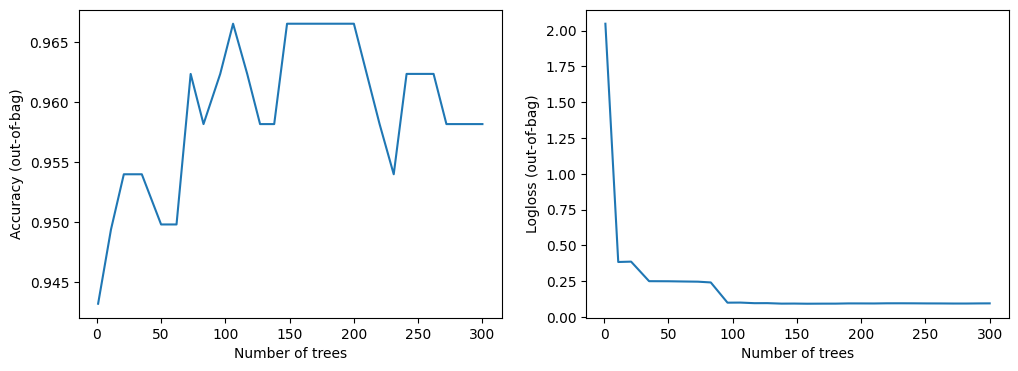
这个数据集很小。你可以看到模型几乎立即收敛。
让我们使用TensorBoard:
# 加载TensorBoard的notebook扩展
%load_ext tensorboard# 加载Google内部版本的TensorBoard的notebook扩展
# %load_ext google3.learning.brain.tensorboard.notebook.extension
# 清除已有的结果(如果有的话)
!rm -fr "/tmp/tensorboard_logs"
# Export the meta-data to tensorboard.
# 将元数据导出到tensorboard。
model_1.make_inspector().export_to_tensorboard("/tmp/tensorboard_logs")
# 导入的包和模块
# 无需导入任何包和模块# 设置tensorboard的日志目录为"/tmp/tensorboard_logs"
# %tensorboard是一个魔术命令,用于启动一个tensorboard实例
# --logdir参数指定了tensorboard的日志目录
%tensorboard --logdir "/tmp/tensorboard_logs"
11. 使用不同的学习算法重新训练模型
学习算法由模型类定义。例如,tfdf.keras.RandomForestModel()训练随机森林,而tfdf.keras.GradientBoostedTreesModel()训练梯度提升决策树。
可以通过调用tfdf.keras.get_all_models()或在学习器列表中列出学习算法。
# 获取所有可用的模型
tfdf.keras.get_all_models()
[tensorflow_decision_forests.keras.RandomForestModel,tensorflow_decision_forests.keras.GradientBoostedTreesModel,tensorflow_decision_forests.keras.CartModel,tensorflow_decision_forests.keras.DistributedGradientBoostedTreesModel]
学习算法的描述以及它们的超参数也可以在API参考和内置帮助中找到:
# 在任何地方都可以使用help函数来获取帮助信息。
help(tfdf.keras.RandomForestModel)# 在ipython或notebook中,可以使用?来获取帮助信息,通常会在一个单独的面板中打开。
tfdf.keras.RandomForestModel?
Help on class RandomForestModel in module tensorflow_decision_forests.keras:class RandomForestModel(tensorflow_decision_forests.keras.wrappers.RandomForestModel)| RandomForestModel(*args, **kwargs)| | Method resolution order:| RandomForestModel| tensorflow_decision_forests.keras.wrappers.RandomForestModel| tensorflow_decision_forests.keras.core.CoreModel| tensorflow_decision_forests.keras.core_inference.InferenceCoreModel| keras.src.engine.training.Model| keras.src.engine.base_layer.Layer| tensorflow.python.module.module.Module| tensorflow.python.trackable.autotrackable.AutoTrackable| tensorflow.python.trackable.base.Trackable| keras.src.utils.version_utils.LayerVersionSelector| keras.src.utils.version_utils.ModelVersionSelector| builtins.object| | Methods inherited from tensorflow_decision_forests.keras.wrappers.RandomForestModel:| | __init__(self, task: Optional[ForwardRef('abstract_model_pb2.Task')] = 1, features: Optional[List[tensorflow_decision_forests.keras.core.FeatureUsage]] = None, exclude_non_specified_features: Optional[bool] = False, preprocessing: Optional[ForwardRef('tf.keras.models.Functional')] = None, postprocessing: Optional[ForwardRef('tf.keras.models.Functional')] = None, ranking_group: Optional[str] = None, uplift_treatment: Optional[str] = None, temp_directory: Optional[str] = None, verbose: int = 1, hyperparameter_template: Optional[str] = None, advanced_arguments: Optional[tensorflow_decision_forests.keras.core_inference.AdvancedArguments] = None, num_threads: Optional[int] = None, name: Optional[str] = None, max_vocab_count: Optional[int] = 2000, try_resume_training: Optional[bool] = True, check_dataset: Optional[bool] = True, tuner: Optional[tensorflow_decision_forests.component.tuner.tuner.Tuner] = None, discretize_numerical_features: bool = False, num_discretized_numerical_bins: int = 255, multitask: Optional[List[tensorflow_decision_forests.keras.core_inference.MultiTaskItem]] = None, adapt_bootstrap_size_ratio_for_maximum_training_duration: Optional[bool] = False, allow_na_conditions: Optional[bool] = False, bootstrap_size_ratio: Optional[float] = 1.0, bootstrap_training_dataset: Optional[bool] = True, categorical_algorithm: Optional[str] = 'CART', categorical_set_split_greedy_sampling: Optional[float] = 0.1, categorical_set_split_max_num_items: Optional[int] = -1, categorical_set_split_min_item_frequency: Optional[int] = 1, compute_oob_performances: Optional[bool] = True, compute_oob_variable_importances: Optional[bool] = False, growing_strategy: Optional[str] = 'LOCAL', honest: Optional[bool] = False, honest_fixed_separation: Optional[bool] = False, honest_ratio_leaf_examples: Optional[float] = 0.5, in_split_min_examples_check: Optional[bool] = True, keep_non_leaf_label_distribution: Optional[bool] = True, max_depth: Optional[int] = 16, max_num_nodes: Optional[int] = None, maximum_model_size_in_memory_in_bytes: Optional[float] = -1.0, maximum_training_duration_seconds: Optional[float] = -1.0, min_examples: Optional[int] = 5, missing_value_policy: Optional[str] = 'GLOBAL_IMPUTATION', num_candidate_attributes: Optional[int] = 0, num_candidate_attributes_ratio: Optional[float] = -1.0, num_oob_variable_importances_permutations: Optional[int] = 1, num_trees: Optional[int] = 300, pure_serving_model: Optional[bool] = False, random_seed: Optional[int] = 123456, sampling_with_replacement: Optional[bool] = True, sorting_strategy: Optional[str] = 'PRESORT', sparse_oblique_normalization: Optional[str] = None, sparse_oblique_num_projections_exponent: Optional[float] = None, sparse_oblique_projection_density_factor: Optional[float] = None, sparse_oblique_weights: Optional[str] = None, split_axis: Optional[str] = 'AXIS_ALIGNED', uplift_min_examples_in_treatment: Optional[int] = 5, uplift_split_score: Optional[str] = 'KULLBACK_LEIBLER', winner_take_all: Optional[bool] = True, explicit_args: Optional[Set[str]] = None)| | ----------------------------------------------------------------------| Static methods inherited from tensorflow_decision_forests.keras.wrappers.RandomForestModel:| | capabilities() -> yggdrasil_decision_forests.learner.abstract_learner_pb2.LearnerCapabilities| Lists the capabilities of the learning algorithm.| | predefined_hyperparameters() -> List[tensorflow_decision_forests.keras.core.HyperParameterTemplate]| Returns a better than default set of hyper-parameters.| | They can be used directly with the `hyperparameter_template` argument of the| model constructor.| | These hyper-parameters outperform the default hyper-parameters (either| generally or in specific scenarios). Like default hyper-parameters, existing| pre-defined hyper-parameters cannot change.| | ----------------------------------------------------------------------| Methods inherited from tensorflow_decision_forests.keras.core.CoreModel:| | collect_data_step(self, data, is_training_example)| Collect examples e.g. training or validation.| | fit(self, x=None, y=None, callbacks=None, verbose: Optional[Any] = None, validation_steps: Optional[int] = None, validation_data: Optional[Any] = None, sample_weight: Optional[Any] = None, steps_per_epoch: Optional[Any] = None, class_weight: Optional[Any] = None, **kwargs) -> keras.src.callbacks.History| Trains the model.| | Local training| ==============| | It is recommended to use a Pandas Dataframe dataset and to convert it to| a TensorFlow dataset with `pd_dataframe_to_tf_dataset()`:| ```python| pd_dataset = pandas.Dataframe(...)| tf_dataset = pd_dataframe_to_tf_dataset(dataset, label="my_label")| model.fit(pd_dataset)| ```| | The following dataset formats are supported:| | 1. "x" is a `tf.data.Dataset` containing a tuple "(features, labels)".| "features" can be a dictionary a tensor, a list of tensors or a| dictionary of tensors (recommended). "labels" is a tensor.| | 2. "x" is a tensor, list of tensors or dictionary of tensors containing| the input features. "y" is a tensor.| | 3. "x" is a numpy-array, list of numpy-arrays or dictionary of| numpy-arrays containing the input features. "y" is a numpy-array.| | IMPORTANT: This model trains on the entire dataset at once. This has the| following consequences:| | 1. The dataset need to be read exactly once. If you use a TensorFlow| dataset, make sure NOT to add a "repeat" operation.| 2. The algorithm does not benefit from shuffling the dataset. If you use a| TensorFlow dataset, make sure NOT to add a "shuffle" operation.| 3. The dataset needs to be batched (i.e. with a "batch" operation).| However, the number of elements per batch has not impact on the model.| Generally, it is recommended to use batches as large as possible as its| speeds-up reading the dataset in TensorFlow.| | Input features do not need to be normalized (e.g. dividing numerical values| by the variance) or indexed (e.g. replacing categorical string values by| an integer). Additionally, missing values can be consumed natively.| | Distributed training| ====================| | Some of the learning algorithms will support distributed training with the| ParameterServerStrategy.| | In this case, the dataset is read asynchronously in between the workers. The| distribution of the training depends on the learning algorithm.| | Like for non-distributed training, the dataset should be read exactly once.| The simplest solution is to divide the dataset into different files (i.e.| shards) and have each of the worker read a non overlapping subset of shards.| | IMPORTANT: The training dataset should not be infinite i.e. the training| dataset should not contain any repeat operation.| | Currently (to be changed), the validation dataset (if provided) is simply| feed to the `model.evaluate()` method. Therefore, it should satisfy Keras'| evaluate API. Notably, for distributed training, the validation dataset| should be infinite (i.e. have a repeat operation).| | See https://www.tensorflow.org/decision_forests/distributed_training for| more details and examples.| | Here is a single example of distributed training using PSS for both dataset| reading and training distribution.| | ```python| def dataset_fn(context, paths, training=True):| ds_path = tf.data.Dataset.from_tensor_slices(paths)| | | if context is not None:| # Train on at least 2 workers.| current_worker = tfdf.keras.get_worker_idx_and_num_workers(context)| assert current_worker.num_workers > 2| | # Split the dataset's examples among the workers.| ds_path = ds_path.shard(| num_shards=current_worker.num_workers,| index=current_worker.worker_idx)| | def read_csv_file(path):| numerical = tf.constant([math.nan], dtype=tf.float32)| categorical_string = tf.constant([""], dtype=tf.string)| csv_columns = [| numerical, # age| categorical_string, # workclass| numerical, # fnlwgt| ...| ]| column_names = [| "age", "workclass", "fnlwgt", ...| ]| label_name = "label"| return tf.data.experimental.CsvDataset(path, csv_columns, header=True)| | ds_columns = ds_path.interleave(read_csv_file)| | def map_features(*columns):| assert len(column_names) == len(columns)| features = {column_names[i]: col for i, col in enumerate(columns)}| label = label_table.lookup(features.pop(label_name))| return features, label| | ds_dataset = ds_columns.map(map_features)| if not training:| dataset = dataset.repeat(None)| ds_dataset = ds_dataset.batch(batch_size)| return ds_dataset| | strategy = tf.distribute.experimental.ParameterServerStrategy(...)| sharded_train_paths = [list of dataset files]| with strategy.scope():| model = DistributedGradientBoostedTreesModel()| train_dataset = strategy.distribute_datasets_from_function(| lambda context: dataset_fn(context, sharded_train_paths))| | test_dataset = strategy.distribute_datasets_from_function(| lambda context: dataset_fn(context, sharded_test_paths))| | model.fit(sharded_train_paths)| evaluation = model.evaluate(test_dataset, steps=num_test_examples //| batch_size)| ```| | Args:| x: Training dataset (See details above for the supported formats).| y: Label of the training dataset. Only used if "x" does not contains the| labels.| callbacks: Callbacks triggered during the training. The training runs in a| single epoch, itself run in a single step. Therefore, callback logic can| be called equivalently before/after the fit function.| verbose: Verbosity mode. 0 = silent, 1 = small details, 2 = full details.| validation_steps: Number of steps in the evaluation dataset when| evaluating the trained model with `model.evaluate()`. If not specified,| evaluates the model on the entire dataset (generally recommended; not| yet supported for distributed datasets).| validation_data: Validation dataset. If specified, the learner might use| this dataset to help training e.g. early stopping.| sample_weight: Training weights. Note: training weights can also be| provided as the third output in a `tf.data.Dataset` e.g. (features,| label, weights).| steps_per_epoch: [Parameter will be removed] Number of training batch to| load before training the model. Currently, only supported for| distributed training.| class_weight: For binary classification only. Mapping class indices| (integers) to a weight (float) value. Only available for non-Distributed| training. For maximum compatibility, feed example weights through the| tf.data.Dataset or using the `weight` argument of| `pd_dataframe_to_tf_dataset`.| **kwargs: Extra arguments passed to the core keras model's fit. Note that| not all keras' model fit arguments are supported.| | Returns:| A `History` object. Its `History.history` attribute is not yet| implemented for decision forests algorithms, and will return empty.| All other fields are filled as usual for `Keras.Mode.fit()`.| | fit_on_dataset_path(self, train_path: str, label_key: Optional[str] = None, weight_key: Optional[str] = None, valid_path: Optional[str] = None, dataset_format: Optional[str] = 'csv', max_num_scanned_rows_to_accumulate_statistics: Optional[int] = 100000, try_resume_training: Optional[bool] = True, input_model_signature_fn: Optional[Callable[[tensorflow_decision_forests.component.inspector.inspector.AbstractInspector], Any]] = <function build_default_input_model_signature at 0x7f823d6db040>, num_io_threads: int = 10)| Trains the model on a dataset stored on disk.| | This solution is generally more efficient and easier than loading the| dataset with a `tf.Dataset` both for local and distributed training.| | Usage example:| | # Local training| ```python| model = keras.GradientBoostedTreesModel()| model.fit_on_dataset_path(| train_path="/path/to/dataset.csv",| label_key="label",| dataset_format="csv")| model.save("/model/path")| ```| | # Distributed training| ```python| with tf.distribute.experimental.ParameterServerStrategy(...).scope():| model = model = keras.DistributedGradientBoostedTreesModel()| model.fit_on_dataset_path(| train_path="/path/to/dataset@10",| label_key="label",| dataset_format="tfrecord+tfe")| model.save("/model/path")| ```| | Args:| train_path: Path to the training dataset. Supports comma separated files,| shard and glob notation.| label_key: Name of the label column.| weight_key: Name of the weighing column.| valid_path: Path to the validation dataset. If not provided, or if the| learning algorithm does not supports/needs a validation dataset,| `valid_path` is ignored.| dataset_format: Format of the dataset. Should be one of the registered| dataset format (see [User| Manual](https://github.com/google/yggdrasil-decision-forests/blob/main/documentation/user_manual.md#dataset-path-and-format)| for more details). The format "csv" is always available but it is| generally only suited for small datasets.| max_num_scanned_rows_to_accumulate_statistics: Maximum number of examples| to scan to determine the statistics of the features (i.e. the dataspec,| e.g. mean value, dictionaries). (Currently) the "first" examples of the| dataset are scanned (e.g. the first examples of the dataset is a single| file). Therefore, it is important that the sampled dataset is relatively| uniformly sampled, notably the scanned examples should contains all the| possible categorical values (otherwise the not seen value will be| treated as out-of-vocabulary). If set to None, the entire dataset is| scanned. This parameter has no effect if the dataset is stored in a| format that already contains those values.| try_resume_training: If true, tries to resume training from the model| checkpoint stored in the `temp_directory` directory. If `temp_directory`| does not contain any model checkpoint, start the training from the| start. Works in the following three situations: (1) The training was| interrupted by the user (e.g. ctrl+c). (2) the training job was| interrupted (e.g. rescheduling), ond (3) the hyper-parameter of the| model were changed such that an initially completed training is now| incomplete (e.g. increasing the number of trees).| input_model_signature_fn: A lambda that returns the| (Dense,Sparse,Ragged)TensorSpec (or structure of TensorSpec e.g.| dictionary, list) corresponding to input signature of the model. If not| specified, the input model signature is created by| `build_default_input_model_signature`. For example, specify| `input_model_signature_fn` if an numerical input feature (which is| consumed as DenseTensorSpec(float32) by default) will be feed| differently (e.g. RaggedTensor(int64)).| num_io_threads: Number of threads to use for IO operations e.g. reading a| dataset from disk. Increasing this value can speed-up IO operations when| IO operations are either latency or cpu bounded.| | Returns:| A `History` object. Its `History.history` attribute is not yet| implemented for decision forests algorithms, and will return empty.| All other fields are filled as usual for `Keras.Mode.fit()`.| | load_weights(self, *args, **kwargs)| No-op for TensorFlow Decision Forests models.| | `load_weights` is not supported by TensorFlow Decision Forests models.| To save and restore a model, use the SavedModel API i.e.| `model.save(...)` and `tf.keras.models.load_model(...)`. To resume the| training of an existing model, create the model with| `try_resume_training=True` (default value) and with a similar| `temp_directory` argument. See documentation of `try_resume_training`| for more details.| | Args:| *args: Passed through to base `keras.Model` implemenation.| **kwargs: Passed through to base `keras.Model` implemenation.| | save(self, filepath: str, overwrite: Optional[bool] = True, **kwargs)| Saves the model as a TensorFlow SavedModel.| | The exported SavedModel contains a standalone Yggdrasil Decision Forests| model in the "assets" sub-directory. The Yggdrasil model can be used| directly using the Yggdrasil API. However, this model does not contain the| "preprocessing" layer (if any).| | Args:| filepath: Path to the output model.| overwrite: If true, override an already existing model. If false, raise an| error if a model already exist.| **kwargs: Arguments passed to the core keras model's save.| | support_distributed_training(self)| | train_on_batch(self, *args, **kwargs)| No supported for Tensorflow Decision Forests models.| | Decision forests are not trained in batches the same way neural networks| are. To avoid confusion, train_on_batch is disabled.| | Args:| *args: Ignored| **kwargs: Ignored.| | train_step(self, data)| Collects training examples.| | valid_step(self, data)| Collects validation examples.| | ----------------------------------------------------------------------| Readonly properties inherited from tensorflow_decision_forests.keras.core.CoreModel:| | exclude_non_specified_features| If true, only use the features specified in "features".| | learner| Name of the learning algorithm used to train the model.| | learner_params| Gets the dictionary of hyper-parameters passed in the model constructor.| | Changing this dictionary will impact the training.| | num_threads| Number of threads used to train the model.| | num_training_examples| Number of training examples.| | num_validation_examples| Number of validation examples.| | training_model_id| Identifier of the model.| | ----------------------------------------------------------------------| Methods inherited from tensorflow_decision_forests.keras.core_inference.InferenceCoreModel:| | call(self, inputs, training=False)| Inference of the model.| | This method is used for prediction and evaluation of a trained model.| | Args:| inputs: Input tensors.| training: Is the model being trained. Always False.| | Returns:| Model predictions.| | call_get_leaves(self, inputs)| Computes the index of the active leaf in each tree.| | The active leaf is the leave that that receive the example during inference.| | The returned value "leaves[i,j]" is the index of the active leave for the| i-th example and the j-th tree. Leaves are indexed by depth first| exploration with the negative child visited before the positive one| (similarly as "iterate_on_nodes()" iteration). Leaf indices are also| available with LeafNode.leaf_idx.| | Args:| inputs: Input tensors. Same signature as the model's "call(inputs)".| | Returns:| Index of the active leaf for each tree in the model.| | compile(self, metrics=None, weighted_metrics=None, **kwargs)| Configure the model for training.| | Unlike for most Keras model, calling "compile" is optional before calling| "fit".| | Args:| metrics: List of metrics to be evaluated by the model during training and| testing.| weighted_metrics: List of metrics to be evaluated and weighted by| `sample_weight` or `class_weight` during training and testing.| **kwargs: Other arguments passed to compile.| | Raises:| ValueError: Invalid arguments.| | make_inspector(self, index: int = 0) -> tensorflow_decision_forests.component.inspector.inspector.AbstractInspector| Creates an inspector to access the internal model structure.| | Usage example:| | ```python| inspector = model.make_inspector()| print(inspector.num_trees())| print(inspector.variable_importances())| ```| | Args:| index: Index of the sub-model. Only used for multitask models.| | Returns:| A model inspector.| | make_predict_function(self)| Prediction of the model (!= evaluation).| | make_test_function(self)| Predictions for evaluation.| | predict_get_leaves(self, x)| Gets the index of the active leaf of each tree.| | The active leaf is the leave that that receive the example during inference.| | The returned value "leaves[i,j]" is the index of the active leave for the| i-th example and the j-th tree. Leaves are indexed by depth first| exploration with the negative child visited before the positive one| (similarly as "iterate_on_nodes()" iteration). Leaf indices are also| available with LeafNode.leaf_idx.| | Args:| x: Input samples as a tf.data.Dataset.| | Returns:| Index of the active leaf for each tree in the model.| | ranking_group(self) -> Optional[str]| | summary(self, line_length=None, positions=None, print_fn=None)| Shows information about the model.| | uplift_treatment(self) -> Optional[str]| | yggdrasil_model_path_tensor(self, multitask_model_index: int = 0) -> Optional[tensorflow.python.framework.ops.Tensor]| Gets the path to yggdrasil model, if available.| | The effective path can be obtained with:| | ```python| yggdrasil_model_path_tensor().numpy().decode("utf-8")| ```| | Args:| multitask_model_index: Index of the sub-model. Only used for multitask| models.| | Returns:| Path to the Yggdrasil model.| | yggdrasil_model_prefix(self, index: int = 0) -> str| Gets the prefix of the internal yggdrasil model.| | ----------------------------------------------------------------------| Readonly properties inherited from tensorflow_decision_forests.keras.core_inference.InferenceCoreModel:| | multitask| Tasks to solve.| | task| Task to solve (e.g. CLASSIFICATION, REGRESSION, RANKING).| | ----------------------------------------------------------------------| Methods inherited from keras.src.engine.training.Model:| | __call__(self, *args, **kwargs)| | __copy__(self)| | __deepcopy__(self, memo)| | __reduce__(self)| Helper for pickle.| | __setattr__(self, name, value)| Support self.foo = trackable syntax.| | build(self, input_shape)| Builds the model based on input shapes received.| | This is to be used for subclassed models, which do not know at| instantiation time what their inputs look like.| | This method only exists for users who want to call `model.build()` in a| standalone way (as a substitute for calling the model on real data to| build it). It will never be called by the framework (and thus it will| never throw unexpected errors in an unrelated workflow).| | Args:| input_shape: Single tuple, `TensorShape` instance, or list/dict of| shapes, where shapes are tuples, integers, or `TensorShape`| instances.| | Raises:| ValueError:| 1. In case of invalid user-provided data (not of type tuple,| list, `TensorShape`, or dict).| 2. If the model requires call arguments that are agnostic| to the input shapes (positional or keyword arg in call| signature).| 3. If not all layers were properly built.| 4. If float type inputs are not supported within the layers.| | In each of these cases, the user should build their model by calling| it on real tensor data.| | compile_from_config(self, config)| Compiles the model with the information given in config.| | This method uses the information in the config (optimizer, loss,| metrics, etc.) to compile the model.| | Args:| config: Dict containing information for compiling the model.| | compute_loss(self, x=None, y=None, y_pred=None, sample_weight=None)| Compute the total loss, validate it, and return it.| | Subclasses can optionally override this method to provide custom loss| computation logic.| | Example:| ```python| class MyModel(tf.keras.Model):| | def __init__(self, *args, **kwargs):| super(MyModel, self).__init__(*args, **kwargs)| self.loss_tracker = tf.keras.metrics.Mean(name='loss')| | def compute_loss(self, x, y, y_pred, sample_weight):| loss = tf.reduce_mean(tf.math.squared_difference(y_pred, y))| loss += tf.add_n(self.losses)| self.loss_tracker.update_state(loss)| return loss| | def reset_metrics(self):| self.loss_tracker.reset_states()| | @property| def metrics(self):| return [self.loss_tracker]| | tensors = tf.random.uniform((10, 10)), tf.random.uniform((10,))| dataset = tf.data.Dataset.from_tensor_slices(tensors).repeat().batch(1)| | inputs = tf.keras.layers.Input(shape=(10,), name='my_input')| outputs = tf.keras.layers.Dense(10)(inputs)| model = MyModel(inputs, outputs)| model.add_loss(tf.reduce_sum(outputs))| | optimizer = tf.keras.optimizers.SGD()| model.compile(optimizer, loss='mse', steps_per_execution=10)| model.fit(dataset, epochs=2, steps_per_epoch=10)| print('My custom loss: ', model.loss_tracker.result().numpy())| ```| | Args:| x: Input data.| y: Target data.| y_pred: Predictions returned by the model (output of `model(x)`)| sample_weight: Sample weights for weighting the loss function.| | Returns:| The total loss as a `tf.Tensor`, or `None` if no loss results (which| is the case when called by `Model.test_step`).| | compute_metrics(self, x, y, y_pred, sample_weight)| Update metric states and collect all metrics to be returned.| | Subclasses can optionally override this method to provide custom metric| updating and collection logic.| | Example:| ```python| class MyModel(tf.keras.Sequential):| | def compute_metrics(self, x, y, y_pred, sample_weight):| | # This super call updates `self.compiled_metrics` and returns| # results for all metrics listed in `self.metrics`.| metric_results = super(MyModel, self).compute_metrics(| x, y, y_pred, sample_weight)| | # Note that `self.custom_metric` is not listed in `self.metrics`.| self.custom_metric.update_state(x, y, y_pred, sample_weight)| metric_results['custom_metric_name'] = self.custom_metric.result()| return metric_results| ```| | Args:| x: Input data.| y: Target data.| y_pred: Predictions returned by the model (output of `model.call(x)`)| sample_weight: Sample weights for weighting the loss function.| | Returns:| A `dict` containing values that will be passed to| `tf.keras.callbacks.CallbackList.on_train_batch_end()`. Typically, the| values of the metrics listed in `self.metrics` are returned. Example:| `{'loss': 0.2, 'accuracy': 0.7}`.| | evaluate(self, x=None, y=None, batch_size=None, verbose='auto', sample_weight=None, steps=None, callbacks=None, max_queue_size=10, workers=1, use_multiprocessing=False, return_dict=False, **kwargs)| Returns the loss value & metrics values for the model in test mode.| | Computation is done in batches (see the `batch_size` arg.)| | Args:| x: Input data. It could be:| - A Numpy array (or array-like), or a list of arrays| (in case the model has multiple inputs).| - A TensorFlow tensor, or a list of tensors| (in case the model has multiple inputs).| - A dict mapping input names to the corresponding array/tensors,| if the model has named inputs.| - A `tf.data` dataset. Should return a tuple| of either `(inputs, targets)` or| `(inputs, targets, sample_weights)`.| - A generator or `keras.utils.Sequence` returning `(inputs,| targets)` or `(inputs, targets, sample_weights)`.| A more detailed description of unpacking behavior for iterator| types (Dataset, generator, Sequence) is given in the `Unpacking| behavior for iterator-like inputs` section of `Model.fit`.| y: Target data. Like the input data `x`, it could be either Numpy| array(s) or TensorFlow tensor(s). It should be consistent with `x`| (you cannot have Numpy inputs and tensor targets, or inversely).| If `x` is a dataset, generator or `keras.utils.Sequence` instance,| `y` should not be specified (since targets will be obtained from| the iterator/dataset).| batch_size: Integer or `None`. Number of samples per batch of| computation. If unspecified, `batch_size` will default to 32. Do| not specify the `batch_size` if your data is in the form of a| dataset, generators, or `keras.utils.Sequence` instances (since| they generate batches).| verbose: `"auto"`, 0, 1, or 2. Verbosity mode.| 0 = silent, 1 = progress bar, 2 = single line.| `"auto"` becomes 1 for most cases, and to 2 when used with| `ParameterServerStrategy`. Note that the progress bar is not| particularly useful when logged to a file, so `verbose=2` is| recommended when not running interactively (e.g. in a production| environment). Defaults to 'auto'.| sample_weight: Optional Numpy array of weights for the test samples,| used for weighting the loss function. You can either pass a flat| (1D) Numpy array with the same length as the input samples| (1:1 mapping between weights and samples), or in the case of| temporal data, you can pass a 2D array with shape `(samples,| sequence_length)`, to apply a different weight to every| timestep of every sample. This argument is not supported when| `x` is a dataset, instead pass sample weights as the third| element of `x`.| steps: Integer or `None`. Total number of steps (batches of samples)| before declaring the evaluation round finished. Ignored with the| default value of `None`. If x is a `tf.data` dataset and `steps`| is None, 'evaluate' will run until the dataset is exhausted. This| argument is not supported with array inputs.| callbacks: List of `keras.callbacks.Callback` instances. List of| callbacks to apply during evaluation. See| [callbacks](https://www.tensorflow.org/api_docs/python/tf/keras/callbacks).| max_queue_size: Integer. Used for generator or| `keras.utils.Sequence` input only. Maximum size for the generator| queue. If unspecified, `max_queue_size` will default to 10.| workers: Integer. Used for generator or `keras.utils.Sequence` input| only. Maximum number of processes to spin up when using| process-based threading. If unspecified, `workers` will default to| 1.| use_multiprocessing: Boolean. Used for generator or| `keras.utils.Sequence` input only. If `True`, use process-based| threading. If unspecified, `use_multiprocessing` will default to| `False`. Note that because this implementation relies on| multiprocessing, you should not pass non-picklable arguments to| the generator as they can't be passed easily to children| processes.| return_dict: If `True`, loss and metric results are returned as a| dict, with each key being the name of the metric. If `False`, they| are returned as a list.| **kwargs: Unused at this time.| | See the discussion of `Unpacking behavior for iterator-like inputs` for| `Model.fit`.| | Returns:| Scalar test loss (if the model has a single output and no metrics)| or list of scalars (if the model has multiple outputs| and/or metrics). The attribute `model.metrics_names` will give you| the display labels for the scalar outputs.| | Raises:| RuntimeError: If `model.evaluate` is wrapped in a `tf.function`.| | evaluate_generator(self, generator, steps=None, callbacks=None, max_queue_size=10, workers=1, use_multiprocessing=False, verbose=0)| Evaluates the model on a data generator.| | DEPRECATED:| `Model.evaluate` now supports generators, so there is no longer any| need to use this endpoint.| | export(self, filepath)| Create a SavedModel artifact for inference (e.g. via TF-Serving).| | This method lets you export a model to a lightweight SavedModel artifact| that contains the model's forward pass only (its `call()` method)| and can be served via e.g. TF-Serving. The forward pass is registered| under the name `serve()` (see example below).| | The original code of the model (including any custom layers you may| have used) is *no longer* necessary to reload the artifact -- it is| entirely standalone.| | Args:| filepath: `str` or `pathlib.Path` object. Path where to save| the artifact.| | Example:| | ```python| # Create the artifact| model.export("path/to/location")| | # Later, in a different process / environment...| reloaded_artifact = tf.saved_model.load("path/to/location")| predictions = reloaded_artifact.serve(input_data)| ```| | If you would like to customize your serving endpoints, you can| use the lower-level `keras.export.ExportArchive` class. The `export()`| method relies on `ExportArchive` internally.| | fit_generator(self, generator, steps_per_epoch=None, epochs=1, verbose=1, callbacks=None, validation_data=None, validation_steps=None, validation_freq=1, class_weight=None, max_queue_size=10, workers=1, use_multiprocessing=False, shuffle=True, initial_epoch=0)| Fits the model on data yielded batch-by-batch by a Python generator.| | DEPRECATED:| `Model.fit` now supports generators, so there is no longer any need to| use this endpoint.| | get_compile_config(self)| Returns a serialized config with information for compiling the model.| | This method returns a config dictionary containing all the information| (optimizer, loss, metrics, etc.) with which the model was compiled.| | Returns:| A dict containing information for compiling the model.| | get_config(self)| Returns the config of the `Model`.| | Config is a Python dictionary (serializable) containing the| configuration of an object, which in this case is a `Model`. This allows| the `Model` to be be reinstantiated later (without its trained weights)| from this configuration.| | Note that `get_config()` does not guarantee to return a fresh copy of| dict every time it is called. The callers should make a copy of the| returned dict if they want to modify it.| | Developers of subclassed `Model` are advised to override this method,| and continue to update the dict from `super(MyModel, self).get_config()`| to provide the proper configuration of this `Model`. The default config| will return config dict for init parameters if they are basic types.| Raises `NotImplementedError` when in cases where a custom| `get_config()` implementation is required for the subclassed model.| | Returns:| Python dictionary containing the configuration of this `Model`.| | get_layer(self, name=None, index=None)| Retrieves a layer based on either its name (unique) or index.| | If `name` and `index` are both provided, `index` will take precedence.| Indices are based on order of horizontal graph traversal (bottom-up).| | Args:| name: String, name of layer.| index: Integer, index of layer.| | Returns:| A layer instance.| | get_metrics_result(self)| Returns the model's metrics values as a dict.| | If any of the metric result is a dict (containing multiple metrics),| each of them gets added to the top level returned dict of this method.| | Returns:| A `dict` containing values of the metrics listed in `self.metrics`.| Example:| `{'loss': 0.2, 'accuracy': 0.7}`.| | get_weight_paths(self)| Retrieve all the variables and their paths for the model.| | The variable path (string) is a stable key to identify a `tf.Variable`| instance owned by the model. It can be used to specify variable-specific| configurations (e.g. DTensor, quantization) from a global view.| | This method returns a dict with weight object paths as keys| and the corresponding `tf.Variable` instances as values.| | Note that if the model is a subclassed model and the weights haven't| been initialized, an empty dict will be returned.| | Returns:| A dict where keys are variable paths and values are `tf.Variable`| instances.| | Example:| | ```python| class SubclassModel(tf.keras.Model):| | def __init__(self, name=None):| super().__init__(name=name)| self.d1 = tf.keras.layers.Dense(10)| self.d2 = tf.keras.layers.Dense(20)| | def call(self, inputs):| x = self.d1(inputs)| return self.d2(x)| | model = SubclassModel()| model(tf.zeros((10, 10)))| weight_paths = model.get_weight_paths()| # weight_paths:| # {| # 'd1.kernel': model.d1.kernel,| # 'd1.bias': model.d1.bias,| # 'd2.kernel': model.d2.kernel,| # 'd2.bias': model.d2.bias,| # }| | # Functional model| inputs = tf.keras.Input((10,), batch_size=10)| x = tf.keras.layers.Dense(20, name='d1')(inputs)| output = tf.keras.layers.Dense(30, name='d2')(x)| model = tf.keras.Model(inputs, output)| d1 = model.layers[1]| d2 = model.layers[2]| weight_paths = model.get_weight_paths()| # weight_paths:| # {| # 'd1.kernel': d1.kernel,| # 'd1.bias': d1.bias,| # 'd2.kernel': d2.kernel,| # 'd2.bias': d2.bias,| # }| ```| | get_weights(self)| Retrieves the weights of the model.| | Returns:| A flat list of Numpy arrays.| | make_train_function(self, force=False)| Creates a function that executes one step of training.| | This method can be overridden to support custom training logic.| This method is called by `Model.fit` and `Model.train_on_batch`.| | Typically, this method directly controls `tf.function` and| `tf.distribute.Strategy` settings, and delegates the actual training| logic to `Model.train_step`.| | This function is cached the first time `Model.fit` or| `Model.train_on_batch` is called. The cache is cleared whenever| `Model.compile` is called. You can skip the cache and generate again the| function with `force=True`.| | Args:| force: Whether to regenerate the train function and skip the cached| function if available.| | Returns:| Function. The function created by this method should accept a| `tf.data.Iterator`, and return a `dict` containing values that will| be passed to `tf.keras.Callbacks.on_train_batch_end`, such as| `{'loss': 0.2, 'accuracy': 0.7}`.| | predict(self, x, batch_size=None, verbose='auto', steps=None, callbacks=None, max_queue_size=10, workers=1, use_multiprocessing=False)| Generates output predictions for the input samples.| | Computation is done in batches. This method is designed for batch| processing of large numbers of inputs. It is not intended for use inside| of loops that iterate over your data and process small numbers of inputs| at a time.| | For small numbers of inputs that fit in one batch,| directly use `__call__()` for faster execution, e.g.,| `model(x)`, or `model(x, training=False)` if you have layers such as| `tf.keras.layers.BatchNormalization` that behave differently during| inference. You may pair the individual model call with a `tf.function`| for additional performance inside your inner loop.| If you need access to numpy array values instead of tensors after your| model call, you can use `tensor.numpy()` to get the numpy array value of| an eager tensor.| | Also, note the fact that test loss is not affected by| regularization layers like noise and dropout.| | Note: See [this FAQ entry](| https://keras.io/getting_started/faq/#whats-the-difference-between-model-methods-predict-and-call)| for more details about the difference between `Model` methods| `predict()` and `__call__()`.| | Args:| x: Input samples. It could be:| - A Numpy array (or array-like), or a list of arrays| (in case the model has multiple inputs).| - A TensorFlow tensor, or a list of tensors| (in case the model has multiple inputs).| - A `tf.data` dataset.| - A generator or `keras.utils.Sequence` instance.| A more detailed description of unpacking behavior for iterator| types (Dataset, generator, Sequence) is given in the `Unpacking| behavior for iterator-like inputs` section of `Model.fit`.| batch_size: Integer or `None`.| Number of samples per batch.| If unspecified, `batch_size` will default to 32.| Do not specify the `batch_size` if your data is in the| form of dataset, generators, or `keras.utils.Sequence` instances| (since they generate batches).| verbose: `"auto"`, 0, 1, or 2. Verbosity mode.| 0 = silent, 1 = progress bar, 2 = single line.| `"auto"` becomes 1 for most cases, and to 2 when used with| `ParameterServerStrategy`. Note that the progress bar is not| particularly useful when logged to a file, so `verbose=2` is| recommended when not running interactively (e.g. in a production| environment). Defaults to 'auto'.| steps: Total number of steps (batches of samples)| before declaring the prediction round finished.| Ignored with the default value of `None`. If x is a `tf.data`| dataset and `steps` is None, `predict()` will| run until the input dataset is exhausted.| callbacks: List of `keras.callbacks.Callback` instances.| List of callbacks to apply during prediction.| See [callbacks](| https://www.tensorflow.org/api_docs/python/tf/keras/callbacks).| max_queue_size: Integer. Used for generator or| `keras.utils.Sequence` input only. Maximum size for the| generator queue. If unspecified, `max_queue_size` will default| to 10.| workers: Integer. Used for generator or `keras.utils.Sequence` input| only. Maximum number of processes to spin up when using| process-based threading. If unspecified, `workers` will default| to 1.| use_multiprocessing: Boolean. Used for generator or| `keras.utils.Sequence` input only. If `True`, use process-based| threading. If unspecified, `use_multiprocessing` will default to| `False`. Note that because this implementation relies on| multiprocessing, you should not pass non-picklable arguments to| the generator as they can't be passed easily to children| processes.| | See the discussion of `Unpacking behavior for iterator-like inputs` for| `Model.fit`. Note that Model.predict uses the same interpretation rules| as `Model.fit` and `Model.evaluate`, so inputs must be unambiguous for| all three methods.| | Returns:| Numpy array(s) of predictions.| | Raises:| RuntimeError: If `model.predict` is wrapped in a `tf.function`.| ValueError: In case of mismatch between the provided| input data and the model's expectations,| or in case a stateful model receives a number of samples| that is not a multiple of the batch size.| | predict_generator(self, generator, steps=None, callbacks=None, max_queue_size=10, workers=1, use_multiprocessing=False, verbose=0)| Generates predictions for the input samples from a data generator.| | DEPRECATED:| `Model.predict` now supports generators, so there is no longer any| need to use this endpoint.| | predict_on_batch(self, x)| Returns predictions for a single batch of samples.| | Args:| x: Input data. It could be:| - A Numpy array (or array-like), or a list of arrays (in case the| model has multiple inputs).| - A TensorFlow tensor, or a list of tensors (in case the model has| multiple inputs).| | Returns:| Numpy array(s) of predictions.| | Raises:| RuntimeError: If `model.predict_on_batch` is wrapped in a| `tf.function`.| | predict_step(self, data)| The logic for one inference step.| | This method can be overridden to support custom inference logic.| This method is called by `Model.make_predict_function`.| | This method should contain the mathematical logic for one step of| inference. This typically includes the forward pass.| | Configuration details for *how* this logic is run (e.g. `tf.function`| and `tf.distribute.Strategy` settings), should be left to| `Model.make_predict_function`, which can also be overridden.| | Args:| data: A nested structure of `Tensor`s.| | Returns:| The result of one inference step, typically the output of calling the| `Model` on data.| | reset_metrics(self)| Resets the state of all the metrics in the model.| | Examples:| | >>> inputs = tf.keras.layers.Input(shape=(3,))| >>> outputs = tf.keras.layers.Dense(2)(inputs)| >>> model = tf.keras.models.Model(inputs=inputs, outputs=outputs)| >>> model.compile(optimizer="Adam", loss="mse", metrics=["mae"])| | >>> x = np.random.random((2, 3))| >>> y = np.random.randint(0, 2, (2, 2))| >>> _ = model.fit(x, y, verbose=0)| >>> assert all(float(m.result()) for m in model.metrics)| | >>> model.reset_metrics()| >>> assert all(float(m.result()) == 0 for m in model.metrics)| | reset_states(self)| | save_spec(self, dynamic_batch=True)| Returns the `tf.TensorSpec` of call args as a tuple `(args, kwargs)`.| | This value is automatically defined after calling the model for the| first time. Afterwards, you can use it when exporting the model for| serving:| | ```python| model = tf.keras.Model(...)| | @tf.function| def serve(*args, **kwargs):| outputs = model(*args, **kwargs)| # Apply postprocessing steps, or add additional outputs.| ...| return outputs| | # arg_specs is `[tf.TensorSpec(...), ...]`. kwarg_specs, in this| # example, is an empty dict since functional models do not use keyword| # arguments.| arg_specs, kwarg_specs = model.save_spec()| | model.save(path, signatures={| 'serving_default': serve.get_concrete_function(*arg_specs,| **kwarg_specs)| })| ```| | Args:| dynamic_batch: Whether to set the batch sizes of all the returned| `tf.TensorSpec` to `None`. (Note that when defining functional or| Sequential models with `tf.keras.Input([...], batch_size=X)`, the| batch size will always be preserved). Defaults to `True`.| Returns:| If the model inputs are defined, returns a tuple `(args, kwargs)`. All| elements in `args` and `kwargs` are `tf.TensorSpec`.| If the model inputs are not defined, returns `None`.| The model inputs are automatically set when calling the model,| `model.fit`, `model.evaluate` or `model.predict`.| | save_weights(self, filepath, overwrite=True, save_format=None, options=None)| Saves all layer weights.| | Either saves in HDF5 or in TensorFlow format based on the `save_format`| argument.| | When saving in HDF5 format, the weight file has:| - `layer_names` (attribute), a list of strings| (ordered names of model layers).| - For every layer, a `group` named `layer.name`| - For every such layer group, a group attribute `weight_names`,| a list of strings| (ordered names of weights tensor of the layer).| - For every weight in the layer, a dataset| storing the weight value, named after the weight tensor.| | When saving in TensorFlow format, all objects referenced by the network| are saved in the same format as `tf.train.Checkpoint`, including any| `Layer` instances or `Optimizer` instances assigned to object| attributes. For networks constructed from inputs and outputs using| `tf.keras.Model(inputs, outputs)`, `Layer` instances used by the network| are tracked/saved automatically. For user-defined classes which inherit| from `tf.keras.Model`, `Layer` instances must be assigned to object| attributes, typically in the constructor. See the documentation of| `tf.train.Checkpoint` and `tf.keras.Model` for details.| | While the formats are the same, do not mix `save_weights` and| `tf.train.Checkpoint`. Checkpoints saved by `Model.save_weights` should| be loaded using `Model.load_weights`. Checkpoints saved using| `tf.train.Checkpoint.save` should be restored using the corresponding| `tf.train.Checkpoint.restore`. Prefer `tf.train.Checkpoint` over| `save_weights` for training checkpoints.| | The TensorFlow format matches objects and variables by starting at a| root object, `self` for `save_weights`, and greedily matching attribute| names. For `Model.save` this is the `Model`, and for `Checkpoint.save`| this is the `Checkpoint` even if the `Checkpoint` has a model attached.| This means saving a `tf.keras.Model` using `save_weights` and loading| into a `tf.train.Checkpoint` with a `Model` attached (or vice versa)| will not match the `Model`'s variables. See the| [guide to training checkpoints](| https://www.tensorflow.org/guide/checkpoint) for details on| the TensorFlow format.| | Args:| filepath: String or PathLike, path to the file to save the weights| to. When saving in TensorFlow format, this is the prefix used| for checkpoint files (multiple files are generated). Note that| the '.h5' suffix causes weights to be saved in HDF5 format.| overwrite: Whether to silently overwrite any existing file at the| target location, or provide the user with a manual prompt.| save_format: Either 'tf' or 'h5'. A `filepath` ending in '.h5' or| '.keras' will default to HDF5 if `save_format` is `None`.| Otherwise, `None` becomes 'tf'. Defaults to `None`.| options: Optional `tf.train.CheckpointOptions` object that specifies| options for saving weights.| | Raises:| ImportError: If `h5py` is not available when attempting to save in| HDF5 format.| | test_on_batch(self, x, y=None, sample_weight=None, reset_metrics=True, return_dict=False)| Test the model on a single batch of samples.| | Args:| x: Input data. It could be:| - A Numpy array (or array-like), or a list of arrays (in case the| model has multiple inputs).| - A TensorFlow tensor, or a list of tensors (in case the model has| multiple inputs).| - A dict mapping input names to the corresponding array/tensors,| if the model has named inputs.| y: Target data. Like the input data `x`, it could be either Numpy| array(s) or TensorFlow tensor(s). It should be consistent with `x`| (you cannot have Numpy inputs and tensor targets, or inversely).| sample_weight: Optional array of the same length as x, containing| weights to apply to the model's loss for each sample. In the case| of temporal data, you can pass a 2D array with shape (samples,| sequence_length), to apply a different weight to every timestep of| every sample.| reset_metrics: If `True`, the metrics returned will be only for this| batch. If `False`, the metrics will be statefully accumulated| across batches.| return_dict: If `True`, loss and metric results are returned as a| dict, with each key being the name of the metric. If `False`, they| are returned as a list.| | Returns:| Scalar test loss (if the model has a single output and no metrics)| or list of scalars (if the model has multiple outputs| and/or metrics). The attribute `model.metrics_names` will give you| the display labels for the scalar outputs.| | Raises:| RuntimeError: If `model.test_on_batch` is wrapped in a| `tf.function`.| | test_step(self, data)| The logic for one evaluation step.| | This method can be overridden to support custom evaluation logic.| This method is called by `Model.make_test_function`.| | This function should contain the mathematical logic for one step of| evaluation.| This typically includes the forward pass, loss calculation, and metrics| updates.| | Configuration details for *how* this logic is run (e.g. `tf.function`| and `tf.distribute.Strategy` settings), should be left to| `Model.make_test_function`, which can also be overridden.| | Args:| data: A nested structure of `Tensor`s.| | Returns:| A `dict` containing values that will be passed to| `tf.keras.callbacks.CallbackList.on_train_batch_end`. Typically, the| values of the `Model`'s metrics are returned.| | to_json(self, **kwargs)| Returns a JSON string containing the network configuration.| | To load a network from a JSON save file, use| `keras.models.model_from_json(json_string, custom_objects={})`.| | Args:| **kwargs: Additional keyword arguments to be passed to| *`json.dumps()`.| | Returns:| A JSON string.| | to_yaml(self, **kwargs)| Returns a yaml string containing the network configuration.| | Note: Since TF 2.6, this method is no longer supported and will raise a| RuntimeError.| | To load a network from a yaml save file, use| `keras.models.model_from_yaml(yaml_string, custom_objects={})`.| | `custom_objects` should be a dictionary mapping| the names of custom losses / layers / etc to the corresponding| functions / classes.| | Args:| **kwargs: Additional keyword arguments| to be passed to `yaml.dump()`.| | Returns:| A YAML string.| | Raises:| RuntimeError: announces that the method poses a security risk| | ----------------------------------------------------------------------| Class methods inherited from keras.src.engine.training.Model:| | from_config(config, custom_objects=None) from builtins.type| Creates a layer from its config.| | This method is the reverse of `get_config`,| capable of instantiating the same layer from the config| dictionary. It does not handle layer connectivity| (handled by Network), nor weights (handled by `set_weights`).| | Args:| config: A Python dictionary, typically the| output of get_config.| | Returns:| A layer instance.| | ----------------------------------------------------------------------| Static methods inherited from keras.src.engine.training.Model:| | __new__(cls, *args, **kwargs)| Create and return a new object. See help(type) for accurate signature.| | ----------------------------------------------------------------------| Readonly properties inherited from keras.src.engine.training.Model:| | distribute_strategy| The `tf.distribute.Strategy` this model was created under.| | metrics| Return metrics added using `compile()` or `add_metric()`.| | Note: Metrics passed to `compile()` are available only after a| `keras.Model` has been trained/evaluated on actual data.| | Examples:| | >>> inputs = tf.keras.layers.Input(shape=(3,))| >>> outputs = tf.keras.layers.Dense(2)(inputs)| >>> model = tf.keras.models.Model(inputs=inputs, outputs=outputs)| >>> model.compile(optimizer="Adam", loss="mse", metrics=["mae"])| >>> [m.name for m in model.metrics]| []| | >>> x = np.random.random((2, 3))| >>> y = np.random.randint(0, 2, (2, 2))| >>> model.fit(x, y)| >>> [m.name for m in model.metrics]| ['loss', 'mae']| | >>> inputs = tf.keras.layers.Input(shape=(3,))| >>> d = tf.keras.layers.Dense(2, name='out')| >>> output_1 = d(inputs)| >>> output_2 = d(inputs)| >>> model = tf.keras.models.Model(| ... inputs=inputs, outputs=[output_1, output_2])| >>> model.add_metric(| ... tf.reduce_sum(output_2), name='mean', aggregation='mean')| >>> model.compile(optimizer="Adam", loss="mse", metrics=["mae", "acc"])| >>> model.fit(x, (y, y))| >>> [m.name for m in model.metrics]| ['loss', 'out_loss', 'out_1_loss', 'out_mae', 'out_acc', 'out_1_mae',| 'out_1_acc', 'mean']| | metrics_names| Returns the model's display labels for all outputs.| | Note: `metrics_names` are available only after a `keras.Model` has been| trained/evaluated on actual data.| | Examples:| | >>> inputs = tf.keras.layers.Input(shape=(3,))| >>> outputs = tf.keras.layers.Dense(2)(inputs)| >>> model = tf.keras.models.Model(inputs=inputs, outputs=outputs)| >>> model.compile(optimizer="Adam", loss="mse", metrics=["mae"])| >>> model.metrics_names| []| | >>> x = np.random.random((2, 3))| >>> y = np.random.randint(0, 2, (2, 2))| >>> model.fit(x, y)| >>> model.metrics_names| ['loss', 'mae']| | >>> inputs = tf.keras.layers.Input(shape=(3,))| >>> d = tf.keras.layers.Dense(2, name='out')| >>> output_1 = d(inputs)| >>> output_2 = d(inputs)| >>> model = tf.keras.models.Model(| ... inputs=inputs, outputs=[output_1, output_2])| >>> model.compile(optimizer="Adam", loss="mse", metrics=["mae", "acc"])| >>> model.fit(x, (y, y))| >>> model.metrics_names| ['loss', 'out_loss', 'out_1_loss', 'out_mae', 'out_acc', 'out_1_mae',| 'out_1_acc']| | non_trainable_weights| List of all non-trainable weights tracked by this layer.| | Non-trainable weights are *not* updated during training. They are| expected to be updated manually in `call()`.| | Returns:| A list of non-trainable variables.| | state_updates| Deprecated, do NOT use!| | Returns the `updates` from all layers that are stateful.| | This is useful for separating training updates and| state updates, e.g. when we need to update a layer's internal state| during prediction.| | Returns:| A list of update ops.| | trainable_weights| List of all trainable weights tracked by this layer.| | Trainable weights are updated via gradient descent during training.| | Returns:| A list of trainable variables.| | weights| Returns the list of all layer variables/weights.| | Note: This will not track the weights of nested `tf.Modules` that are| not themselves Keras layers.| | Returns:| A list of variables.| | ----------------------------------------------------------------------| Data descriptors inherited from keras.src.engine.training.Model:| | distribute_reduction_method| The method employed to reduce per-replica values during training.| | Unless specified, the value "auto" will be assumed, indicating that| the reduction strategy should be chosen based on the current| running environment.| See `reduce_per_replica` function for more details.| | jit_compile| Specify whether to compile the model with XLA.| | [XLA](https://www.tensorflow.org/xla) is an optimizing compiler| for machine learning. `jit_compile` is not enabled by default.| Note that `jit_compile=True` may not necessarily work for all models.| | For more information on supported operations please refer to the| [XLA documentation](https://www.tensorflow.org/xla). Also refer to| [known XLA issues](https://www.tensorflow.org/xla/known_issues)| for more details.| | layers| | run_eagerly| Settable attribute indicating whether the model should run eagerly.| | Running eagerly means that your model will be run step by step,| like Python code. Your model might run slower, but it should become| easier for you to debug it by stepping into individual layer calls.| | By default, we will attempt to compile your model to a static graph to| deliver the best execution performance.| | Returns:| Boolean, whether the model should run eagerly.| | ----------------------------------------------------------------------| Methods inherited from keras.src.engine.base_layer.Layer:| | __delattr__(self, name)| Implement delattr(self, name).| | __getstate__(self)| | __setstate__(self, state)| | add_loss(self, losses, **kwargs)| Add loss tensor(s), potentially dependent on layer inputs.| | Some losses (for instance, activity regularization losses) may be| dependent on the inputs passed when calling a layer. Hence, when reusing| the same layer on different inputs `a` and `b`, some entries in| `layer.losses` may be dependent on `a` and some on `b`. This method| automatically keeps track of dependencies.| | This method can be used inside a subclassed layer or model's `call`| function, in which case `losses` should be a Tensor or list of Tensors.| | Example:| | ```python| class MyLayer(tf.keras.layers.Layer):| def call(self, inputs):| self.add_loss(tf.abs(tf.reduce_mean(inputs)))| return inputs| ```| | The same code works in distributed training: the input to `add_loss()`| is treated like a regularization loss and averaged across replicas| by the training loop (both built-in `Model.fit()` and compliant custom| training loops).| | The `add_loss` method can also be called directly on a Functional Model| during construction. In this case, any loss Tensors passed to this Model| must be symbolic and be able to be traced back to the model's `Input`s.| These losses become part of the model's topology and are tracked in| `get_config`.| | Example:| | ```python| inputs = tf.keras.Input(shape=(10,))| x = tf.keras.layers.Dense(10)(inputs)| outputs = tf.keras.layers.Dense(1)(x)| model = tf.keras.Model(inputs, outputs)| # Activity regularization.| model.add_loss(tf.abs(tf.reduce_mean(x)))| ```| | If this is not the case for your loss (if, for example, your loss| references a `Variable` of one of the model's layers), you can wrap your| loss in a zero-argument lambda. These losses are not tracked as part of| the model's topology since they can't be serialized.| | Example:| | ```python| inputs = tf.keras.Input(shape=(10,))| d = tf.keras.layers.Dense(10)| x = d(inputs)| outputs = tf.keras.layers.Dense(1)(x)| model = tf.keras.Model(inputs, outputs)| # Weight regularization.| model.add_loss(lambda: tf.reduce_mean(d.kernel))| ```| | Args:| losses: Loss tensor, or list/tuple of tensors. Rather than tensors,| losses may also be zero-argument callables which create a loss| tensor.| **kwargs: Used for backwards compatibility only.| | add_metric(self, value, name=None, **kwargs)| Adds metric tensor to the layer.| | This method can be used inside the `call()` method of a subclassed layer| or model.| | ```python| class MyMetricLayer(tf.keras.layers.Layer):| def __init__(self):| super(MyMetricLayer, self).__init__(name='my_metric_layer')| self.mean = tf.keras.metrics.Mean(name='metric_1')| | def call(self, inputs):| self.add_metric(self.mean(inputs))| self.add_metric(tf.reduce_sum(inputs), name='metric_2')| return inputs| ```| | This method can also be called directly on a Functional Model during| construction. In this case, any tensor passed to this Model must| be symbolic and be able to be traced back to the model's `Input`s. These| metrics become part of the model's topology and are tracked when you| save the model via `save()`.| | ```python| inputs = tf.keras.Input(shape=(10,))| x = tf.keras.layers.Dense(10)(inputs)| outputs = tf.keras.layers.Dense(1)(x)| model = tf.keras.Model(inputs, outputs)| model.add_metric(math_ops.reduce_sum(x), name='metric_1')| ```| | Note: Calling `add_metric()` with the result of a metric object on a| Functional Model, as shown in the example below, is not supported. This| is because we cannot trace the metric result tensor back to the model's| inputs.| | ```python| inputs = tf.keras.Input(shape=(10,))| x = tf.keras.layers.Dense(10)(inputs)| outputs = tf.keras.layers.Dense(1)(x)| model = tf.keras.Model(inputs, outputs)| model.add_metric(tf.keras.metrics.Mean()(x), name='metric_1')| ```| | Args:| value: Metric tensor.| name: String metric name.| **kwargs: Additional keyword arguments for backward compatibility.| Accepted values:| `aggregation` - When the `value` tensor provided is not the result| of calling a `keras.Metric` instance, it will be aggregated by| default using a `keras.Metric.Mean`.| | add_update(self, updates)| Add update op(s), potentially dependent on layer inputs.| | Weight updates (for instance, the updates of the moving mean and| variance in a BatchNormalization layer) may be dependent on the inputs| passed when calling a layer. Hence, when reusing the same layer on| different inputs `a` and `b`, some entries in `layer.updates` may be| dependent on `a` and some on `b`. This method automatically keeps track| of dependencies.| | This call is ignored when eager execution is enabled (in that case,| variable updates are run on the fly and thus do not need to be tracked| for later execution).| | Args:| updates: Update op, or list/tuple of update ops, or zero-arg callable| that returns an update op. A zero-arg callable should be passed in| order to disable running the updates by setting `trainable=False`| on this Layer, when executing in Eager mode.| | add_variable(self, *args, **kwargs)| Deprecated, do NOT use! Alias for `add_weight`.| | add_weight(self, name=None, shape=None, dtype=None, initializer=None, regularizer=None, trainable=None, constraint=None, use_resource=None, synchronization=<VariableSynchronization.AUTO: 0>, aggregation=<VariableAggregationV2.NONE: 0>, **kwargs)| Adds a new variable to the layer.| | Args:| name: Variable name.| shape: Variable shape. Defaults to scalar if unspecified.| dtype: The type of the variable. Defaults to `self.dtype`.| initializer: Initializer instance (callable).| regularizer: Regularizer instance (callable).| trainable: Boolean, whether the variable should be part of the layer's| "trainable_variables" (e.g. variables, biases)| or "non_trainable_variables" (e.g. BatchNorm mean and variance).| Note that `trainable` cannot be `True` if `synchronization`| is set to `ON_READ`.| constraint: Constraint instance (callable).| use_resource: Whether to use a `ResourceVariable` or not.| See [this guide](| https://www.tensorflow.org/guide/migrate/tf1_vs_tf2#resourcevariables_instead_of_referencevariables)| for more information.| synchronization: Indicates when a distributed a variable will be| aggregated. Accepted values are constants defined in the class| `tf.VariableSynchronization`. By default the synchronization is set| to `AUTO` and the current `DistributionStrategy` chooses when to| synchronize. If `synchronization` is set to `ON_READ`, `trainable`| must not be set to `True`.| aggregation: Indicates how a distributed variable will be aggregated.| Accepted values are constants defined in the class| `tf.VariableAggregation`.| **kwargs: Additional keyword arguments. Accepted values are `getter`,| `collections`, `experimental_autocast` and `caching_device`.| | Returns:| The variable created.| | Raises:| ValueError: When giving unsupported dtype and no initializer or when| trainable has been set to True with synchronization set as| `ON_READ`.| | build_from_config(self, config)| Builds the layer's states with the supplied config dict.| | By default, this method calls the `build(config["input_shape"])` method,| which creates weights based on the layer's input shape in the supplied| config. If your config contains other information needed to load the| layer's state, you should override this method.| | Args:| config: Dict containing the input shape associated with this layer.| | compute_mask(self, inputs, mask=None)| Computes an output mask tensor.| | Args:| inputs: Tensor or list of tensors.| mask: Tensor or list of tensors.| | Returns:| None or a tensor (or list of tensors,| one per output tensor of the layer).| | compute_output_shape(self, input_shape)| Computes the output shape of the layer.| | This method will cause the layer's state to be built, if that has not| happened before. This requires that the layer will later be used with| inputs that match the input shape provided here.| | Args:| input_shape: Shape tuple (tuple of integers) or `tf.TensorShape`,| or structure of shape tuples / `tf.TensorShape` instances| (one per output tensor of the layer).| Shape tuples can include None for free dimensions,| instead of an integer.| | Returns:| A `tf.TensorShape` instance| or structure of `tf.TensorShape` instances.| | compute_output_signature(self, input_signature)| Compute the output tensor signature of the layer based on the inputs.| | Unlike a TensorShape object, a TensorSpec object contains both shape| and dtype information for a tensor. This method allows layers to provide| output dtype information if it is different from the input dtype.| For any layer that doesn't implement this function,| the framework will fall back to use `compute_output_shape`, and will| assume that the output dtype matches the input dtype.| | Args:| input_signature: Single TensorSpec or nested structure of TensorSpec| objects, describing a candidate input for the layer.| | Returns:| Single TensorSpec or nested structure of TensorSpec objects,| describing how the layer would transform the provided input.| | Raises:| TypeError: If input_signature contains a non-TensorSpec object.| | count_params(self)| Count the total number of scalars composing the weights.| | Returns:| An integer count.| | Raises:| ValueError: if the layer isn't yet built| (in which case its weights aren't yet defined).| | finalize_state(self)| Finalizes the layers state after updating layer weights.| | This function can be subclassed in a layer and will be called after| updating a layer weights. It can be overridden to finalize any| additional layer state after a weight update.| | This function will be called after weights of a layer have been restored| from a loaded model.| | get_build_config(self)| Returns a dictionary with the layer's input shape.| | This method returns a config dict that can be used by| `build_from_config(config)` to create all states (e.g. Variables and| Lookup tables) needed by the layer.| | By default, the config only contains the input shape that the layer| was built with. If you're writing a custom layer that creates state in| an unusual way, you should override this method to make sure this state| is already created when Keras attempts to load its value upon model| loading.| | Returns:| A dict containing the input shape associated with the layer.| | get_input_at(self, node_index)| Retrieves the input tensor(s) of a layer at a given node.| | Args:| node_index: Integer, index of the node| from which to retrieve the attribute.| E.g. `node_index=0` will correspond to the| first input node of the layer.| | Returns:| A tensor (or list of tensors if the layer has multiple inputs).| | Raises:| RuntimeError: If called in Eager mode.| | get_input_mask_at(self, node_index)| Retrieves the input mask tensor(s) of a layer at a given node.| | Args:| node_index: Integer, index of the node| from which to retrieve the attribute.| E.g. `node_index=0` will correspond to the| first time the layer was called.| | Returns:| A mask tensor| (or list of tensors if the layer has multiple inputs).| | get_input_shape_at(self, node_index)| Retrieves the input shape(s) of a layer at a given node.| | Args:| node_index: Integer, index of the node| from which to retrieve the attribute.| E.g. `node_index=0` will correspond to the| first time the layer was called.| | Returns:| A shape tuple| (or list of shape tuples if the layer has multiple inputs).| | Raises:| RuntimeError: If called in Eager mode.| | get_output_at(self, node_index)| Retrieves the output tensor(s) of a layer at a given node.| | Args:| node_index: Integer, index of the node| from which to retrieve the attribute.| E.g. `node_index=0` will correspond to the| first output node of the layer.| | Returns:| A tensor (or list of tensors if the layer has multiple outputs).| | Raises:| RuntimeError: If called in Eager mode.| | get_output_mask_at(self, node_index)| Retrieves the output mask tensor(s) of a layer at a given node.| | Args:| node_index: Integer, index of the node| from which to retrieve the attribute.| E.g. `node_index=0` will correspond to the| first time the layer was called.| | Returns:| A mask tensor| (or list of tensors if the layer has multiple outputs).| | get_output_shape_at(self, node_index)| Retrieves the output shape(s) of a layer at a given node.| | Args:| node_index: Integer, index of the node| from which to retrieve the attribute.| E.g. `node_index=0` will correspond to the| first time the layer was called.| | Returns:| A shape tuple| (or list of shape tuples if the layer has multiple outputs).| | Raises:| RuntimeError: If called in Eager mode.| | load_own_variables(self, store)| Loads the state of the layer.| | You can override this method to take full control of how the state of| the layer is loaded upon calling `keras.models.load_model()`.| | Args:| store: Dict from which the state of the model will be loaded.| | save_own_variables(self, store)| Saves the state of the layer.| | You can override this method to take full control of how the state of| the layer is saved upon calling `model.save()`.| | Args:| store: Dict where the state of the model will be saved.| | set_weights(self, weights)| Sets the weights of the layer, from NumPy arrays.| | The weights of a layer represent the state of the layer. This function| sets the weight values from numpy arrays. The weight values should be| passed in the order they are created by the layer. Note that the layer's| weights must be instantiated before calling this function, by calling| the layer.| | For example, a `Dense` layer returns a list of two values: the kernel| matrix and the bias vector. These can be used to set the weights of| another `Dense` layer:| | >>> layer_a = tf.keras.layers.Dense(1,| ... kernel_initializer=tf.constant_initializer(1.))| >>> a_out = layer_a(tf.convert_to_tensor([[1., 2., 3.]]))| >>> layer_a.get_weights()| [array([[1.],| [1.],| [1.]], dtype=float32), array([0.], dtype=float32)]| >>> layer_b = tf.keras.layers.Dense(1,| ... kernel_initializer=tf.constant_initializer(2.))| >>> b_out = layer_b(tf.convert_to_tensor([[10., 20., 30.]]))| >>> layer_b.get_weights()| [array([[2.],| [2.],| [2.]], dtype=float32), array([0.], dtype=float32)]| >>> layer_b.set_weights(layer_a.get_weights())| >>> layer_b.get_weights()| [array([[1.],| [1.],| [1.]], dtype=float32), array([0.], dtype=float32)]| | Args:| weights: a list of NumPy arrays. The number| of arrays and their shape must match| number of the dimensions of the weights| of the layer (i.e. it should match the| output of `get_weights`).| | Raises:| ValueError: If the provided weights list does not match the| layer's specifications.| | ----------------------------------------------------------------------| Readonly properties inherited from keras.src.engine.base_layer.Layer:| | compute_dtype| The dtype of the layer's computations.| | This is equivalent to `Layer.dtype_policy.compute_dtype`. Unless| mixed precision is used, this is the same as `Layer.dtype`, the dtype of| the weights.| | Layers automatically cast their inputs to the compute dtype, which| causes computations and the output to be in the compute dtype as well.| This is done by the base Layer class in `Layer.__call__`, so you do not| have to insert these casts if implementing your own layer.| | Layers often perform certain internal computations in higher precision| when `compute_dtype` is float16 or bfloat16 for numeric stability. The| output will still typically be float16 or bfloat16 in such cases.| | Returns:| The layer's compute dtype.| | dtype| The dtype of the layer weights.| | This is equivalent to `Layer.dtype_policy.variable_dtype`. Unless| mixed precision is used, this is the same as `Layer.compute_dtype`, the| dtype of the layer's computations.| | dtype_policy| The dtype policy associated with this layer.| | This is an instance of a `tf.keras.mixed_precision.Policy`.| | dynamic| Whether the layer is dynamic (eager-only); set in the constructor.| | inbound_nodes| Return Functional API nodes upstream of this layer.| | input| Retrieves the input tensor(s) of a layer.| | Only applicable if the layer has exactly one input,| i.e. if it is connected to one incoming layer.| | Returns:| Input tensor or list of input tensors.| | Raises:| RuntimeError: If called in Eager mode.| AttributeError: If no inbound nodes are found.| | input_mask| Retrieves the input mask tensor(s) of a layer.| | Only applicable if the layer has exactly one inbound node,| i.e. if it is connected to one incoming layer.| | Returns:| Input mask tensor (potentially None) or list of input| mask tensors.| | Raises:| AttributeError: if the layer is connected to| more than one incoming layers.| | input_shape| Retrieves the input shape(s) of a layer.| | Only applicable if the layer has exactly one input,| i.e. if it is connected to one incoming layer, or if all inputs| have the same shape.| | Returns:| Input shape, as an integer shape tuple| (or list of shape tuples, one tuple per input tensor).| | Raises:| AttributeError: if the layer has no defined input_shape.| RuntimeError: if called in Eager mode.| | losses| List of losses added using the `add_loss()` API.| | Variable regularization tensors are created when this property is| accessed, so it is eager safe: accessing `losses` under a| `tf.GradientTape` will propagate gradients back to the corresponding| variables.| | Examples:| | >>> class MyLayer(tf.keras.layers.Layer):| ... def call(self, inputs):| ... self.add_loss(tf.abs(tf.reduce_mean(inputs)))| ... return inputs| >>> l = MyLayer()| >>> l(np.ones((10, 1)))| >>> l.losses| [1.0]| | >>> inputs = tf.keras.Input(shape=(10,))| >>> x = tf.keras.layers.Dense(10)(inputs)| >>> outputs = tf.keras.layers.Dense(1)(x)| >>> model = tf.keras.Model(inputs, outputs)| >>> # Activity regularization.| >>> len(model.losses)| 0| >>> model.add_loss(tf.abs(tf.reduce_mean(x)))| >>> len(model.losses)| 1| | >>> inputs = tf.keras.Input(shape=(10,))| >>> d = tf.keras.layers.Dense(10, kernel_initializer='ones')| >>> x = d(inputs)| >>> outputs = tf.keras.layers.Dense(1)(x)| >>> model = tf.keras.Model(inputs, outputs)| >>> # Weight regularization.| >>> model.add_loss(lambda: tf.reduce_mean(d.kernel))| >>> model.losses| [<tf.Tensor: shape=(), dtype=float32, numpy=1.0>]| | Returns:| A list of tensors.| | name| Name of the layer (string), set in the constructor.| | non_trainable_variables| Sequence of non-trainable variables owned by this module and its submodules.| | Note: this method uses reflection to find variables on the current instance| and submodules. For performance reasons you may wish to cache the result| of calling this method if you don't expect the return value to change.| | Returns:| A sequence of variables for the current module (sorted by attribute| name) followed by variables from all submodules recursively (breadth| first).| | outbound_nodes| Return Functional API nodes downstream of this layer.| | output| Retrieves the output tensor(s) of a layer.| | Only applicable if the layer has exactly one output,| i.e. if it is connected to one incoming layer.| | Returns:| Output tensor or list of output tensors.| | Raises:| AttributeError: if the layer is connected to more than one incoming| layers.| RuntimeError: if called in Eager mode.| | output_mask| Retrieves the output mask tensor(s) of a layer.| | Only applicable if the layer has exactly one inbound node,| i.e. if it is connected to one incoming layer.| | Returns:| Output mask tensor (potentially None) or list of output| mask tensors.| | Raises:| AttributeError: if the layer is connected to| more than one incoming layers.| | output_shape| Retrieves the output shape(s) of a layer.| | Only applicable if the layer has one output,| or if all outputs have the same shape.| | Returns:| Output shape, as an integer shape tuple| (or list of shape tuples, one tuple per output tensor).| | Raises:| AttributeError: if the layer has no defined output shape.| RuntimeError: if called in Eager mode.| | trainable_variables| Sequence of trainable variables owned by this module and its submodules.| | Note: this method uses reflection to find variables on the current instance| and submodules. For performance reasons you may wish to cache the result| of calling this method if you don't expect the return value to change.| | Returns:| A sequence of variables for the current module (sorted by attribute| name) followed by variables from all submodules recursively (breadth| first).| | updates| | variable_dtype| Alias of `Layer.dtype`, the dtype of the weights.| | variables| Returns the list of all layer variables/weights.| | Alias of `self.weights`.| | Note: This will not track the weights of nested `tf.Modules` that are| not themselves Keras layers.| | Returns:| A list of variables.| | ----------------------------------------------------------------------| Data descriptors inherited from keras.src.engine.base_layer.Layer:| | activity_regularizer| Optional regularizer function for the output of this layer.| | input_spec| `InputSpec` instance(s) describing the input format for this layer.| | When you create a layer subclass, you can set `self.input_spec` to| enable the layer to run input compatibility checks when it is called.| Consider a `Conv2D` layer: it can only be called on a single input| tensor of rank 4. As such, you can set, in `__init__()`:| | ```python| self.input_spec = tf.keras.layers.InputSpec(ndim=4)| ```| | Now, if you try to call the layer on an input that isn't rank 4| (for instance, an input of shape `(2,)`, it will raise a| nicely-formatted error:| | ```| ValueError: Input 0 of layer conv2d is incompatible with the layer:| expected ndim=4, found ndim=1. Full shape received: [2]| ```| | Input checks that can be specified via `input_spec` include:| - Structure (e.g. a single input, a list of 2 inputs, etc)| - Shape| - Rank (ndim)| - Dtype| | For more information, see `tf.keras.layers.InputSpec`.| | Returns:| A `tf.keras.layers.InputSpec` instance, or nested structure thereof.| | stateful| | supports_masking| Whether this layer supports computing a mask using `compute_mask`.| | trainable| | ----------------------------------------------------------------------| Class methods inherited from tensorflow.python.module.module.Module:| | with_name_scope(method) from builtins.type| Decorator to automatically enter the module name scope.| | >>> class MyModule(tf.Module):| ... @tf.Module.with_name_scope| ... def __call__(self, x):| ... if not hasattr(self, 'w'):| ... self.w = tf.Variable(tf.random.normal([x.shape[1], 3]))| ... return tf.matmul(x, self.w)| | Using the above module would produce `tf.Variable`s and `tf.Tensor`s whose| names included the module name:| | >>> mod = MyModule()| >>> mod(tf.ones([1, 2]))| <tf.Tensor: shape=(1, 3), dtype=float32, numpy=..., dtype=float32)>| >>> mod.w| <tf.Variable 'my_module/Variable:0' shape=(2, 3) dtype=float32,| numpy=..., dtype=float32)>| | Args:| method: The method to wrap.| | Returns:| The original method wrapped such that it enters the module's name scope.| | ----------------------------------------------------------------------| Readonly properties inherited from tensorflow.python.module.module.Module:| | name_scope| Returns a `tf.name_scope` instance for this class.| | submodules| Sequence of all sub-modules.| | Submodules are modules which are properties of this module, or found as| properties of modules which are properties of this module (and so on).| | >>> a = tf.Module()| >>> b = tf.Module()| >>> c = tf.Module()| >>> a.b = b| >>> b.c = c| >>> list(a.submodules) == [b, c]| True| >>> list(b.submodules) == [c]| True| >>> list(c.submodules) == []| True| | Returns:| A sequence of all submodules.| | ----------------------------------------------------------------------| Data descriptors inherited from tensorflow.python.trackable.base.Trackable:| | __dict__| dictionary for instance variables (if defined)| | __weakref__| list of weak references to the object (if defined)
12. 使用特征子集
前面的例子没有指定特征,所以所有的列都被用作输入特征(除了标签)。下面的例子展示了如何指定输入特征。
# 创建特征对象 feature_1 和 feature_2
feature_1 = tfdf.keras.FeatureUsage(name="bill_length_mm")
feature_2 = tfdf.keras.FeatureUsage(name="island")# 将特征对象添加到特征列表 all_features 中
all_features = [feature_1, feature_2]# 注意:该模型仅使用了两个特征进行训练,因此它的性能不如使用所有特征训练的模型好。# 创建梯度提升树模型对象 model_2
model_2 = tfdf.keras.GradientBoostedTreesModel(features=all_features, exclude_non_specified_features=True)# 编译模型,指定评估指标为准确率
model_2.compile(metrics=["accuracy"])# 使用训练数据集 train_ds 进行训练,并使用验证数据集 test_ds 进行验证
model_2.fit(train_ds, validation_data=test_ds)# 打印模型在测试数据集上的评估结果,以字典形式返回
print(model_2.evaluate(test_ds, return_dict=True))
Warning: The `num_threads` constructor argument is not set and the number of CPU is os.cpu_count()=32 > 32. Setting num_threads to 32. Set num_threads manually to use more than 32 cpus.WARNING:absl:The `num_threads` constructor argument is not set and the number of CPU is os.cpu_count()=32 > 32. Setting num_threads to 32. Set num_threads manually to use more than 32 cpus.Use /tmpfs/tmp/tmpoow4zpd8 as temporary training directory
Reading training dataset...
Training dataset read in 0:00:00.144474. Found 239 examples.
Reading validation dataset...[WARNING 23-08-16 11:05:24.8447 UTC gradient_boosted_trees.cc:1818] "goss_alpha" set but "sampling_method" not equal to "GOSS".
[WARNING 23-08-16 11:05:24.8447 UTC gradient_boosted_trees.cc:1829] "goss_beta" set but "sampling_method" not equal to "GOSS".
[WARNING 23-08-16 11:05:24.8447 UTC gradient_boosted_trees.cc:1843] "selective_gradient_boosting_ratio" set but "sampling_method" not equal to "SELGB".Num validation examples: tf.Tensor(105, shape=(), dtype=int32)
Validation dataset read in 0:00:00.205776. Found 105 examples.
Training model...
Model trained in 0:00:00.610888
Compiling model...
Model compiled.[INFO 23-08-16 11:05:25.7975 UTC kernel.cc:1243] Loading model from path /tmpfs/tmp/tmpoow4zpd8/model/ with prefix 730fc7c477154271
[INFO 23-08-16 11:05:25.8146 UTC decision_forest.cc:660] Model loaded with 168 root(s), 5352 node(s), and 2 input feature(s).
[INFO 23-08-16 11:05:25.8146 UTC kernel.cc:1075] Use fast generic engine1/1 [==============================] - ETA: 0s - loss: 0.0000e+00 - accuracy: 0.9810
1/1 [==============================] - 0s 87ms/step - loss: 0.0000e+00 - accuracy: 0.9810
{'loss': 0.0, 'accuracy': 0.9809523820877075}
**注意:**正如预期的那样,准确率低于以前。
TF-DF为每个特征附加了一个语义。这个语义控制了模型如何使用该特征。目前支持以下语义:
- 数值型:通常用于具有完全排序的数量或计数。例如,一个人的年龄或一个袋子中的物品数量。可以是浮点数或整数。缺失值用浮点数(Nan)或空稀疏张量表示。
- 分类型:通常用于有限可能值集合中的类型/类别,没有排序。例如,集合{RED, BLUE, GREEN}中的颜色RED。可以是字符串或整数。缺失值表示为空字符串"",值为-2或空稀疏张量。
- 分类集合型:一组分类值。非常适合表示分词文本。可以是字符串或整数,存储在稀疏张量或不规则张量(推荐)中。每个项的顺序/索引无关紧要。
如果未指定语义,则从表示类型中推断语义,并在训练日志中显示:
- int、float(密集或稀疏)→ 数值型语义。
- str(密集或稀疏)→ 分类型语义。
- int、str(不规则)→ 分类集合型语义。
在某些情况下,推断的语义是错误的。例如:将枚举存储为整数的情况下,语义上是分类型的,但会被检测为数值型。在这种情况下,应在输入中指定语义参数。成人数据集的education_num字段就是一个经典例子。
该数据集不包含这样的特征。然而,为了演示,我们将使模型将year视为分类特征:
# 设置单元格高度为300
%set_cell_height 300# 创建一个特征使用对象,表示一个分类特征"year"
feature_1 = tfdf.keras.FeatureUsage(name="year", semantic=tfdf.keras.FeatureSemantic.CATEGORICAL)# 创建一个特征使用对象,表示一个数值特征"bill_length_mm"
feature_2 = tfdf.keras.FeatureUsage(name="bill_length_mm")# 创建一个特征使用对象,表示一个分类特征"sex"
feature_3 = tfdf.keras.FeatureUsage(name="sex")# 将所有特征使用对象放入列表中
all_features = [feature_1, feature_2, feature_3]# 创建一个梯度提升树模型对象,指定使用的特征为all_features,排除未指定的特征
model_3 = tfdf.keras.GradientBoostedTreesModel(features=all_features, exclude_non_specified_features=True)# 编译模型,指定评估指标为准确率
model_3.compile(metrics=["accuracy"])# 使用训练数据集进行模型训练,并使用验证数据集进行模型验证
model_3.fit(train_ds, validation_data=test_ds)
<IPython.core.display.Javascript object>Warning: The `num_threads` constructor argument is not set and the number of CPU is os.cpu_count()=32 > 32. Setting num_threads to 32. Set num_threads manually to use more than 32 cpus.WARNING:absl:The `num_threads` constructor argument is not set and the number of CPU is os.cpu_count()=32 > 32. Setting num_threads to 32. Set num_threads manually to use more than 32 cpus.Use /tmpfs/tmp/tmpg9srb1ip as temporary training directory
Reading training dataset...
Training dataset read in 0:00:00.143701. Found 239 examples.
Reading validation dataset...[WARNING 23-08-16 11:05:26.3095 UTC gradient_boosted_trees.cc:1818] "goss_alpha" set but "sampling_method" not equal to "GOSS".
[WARNING 23-08-16 11:05:26.3095 UTC gradient_boosted_trees.cc:1829] "goss_beta" set but "sampling_method" not equal to "GOSS".
[WARNING 23-08-16 11:05:26.3095 UTC gradient_boosted_trees.cc:1843] "selective_gradient_boosting_ratio" set but "sampling_method" not equal to "SELGB".Num validation examples: tf.Tensor(105, shape=(), dtype=int32)
Validation dataset read in 0:00:00.152938. Found 105 examples.
Training model...
Model trained in 0:00:00.267350
Compiling model...
Model compiled.[INFO 23-08-16 11:05:26.8771 UTC kernel.cc:1243] Loading model from path /tmpfs/tmp/tmpg9srb1ip/model/ with prefix caa2217206e3449f
[INFO 23-08-16 11:05:26.8819 UTC decision_forest.cc:660] Model loaded with 42 root(s), 1322 node(s), and 3 input feature(s).
[INFO 23-08-16 11:05:26.8819 UTC kernel.cc:1075] Use fast generic engine<keras.src.callbacks.History at 0x7f823404dc70>
请注意year在CATEGORICAL特征列表中(与第一次运行不同)。
13. 超参数
超参数是训练算法的参数,会影响最终模型的质量。它们在模型类的构造函数中指定。可以使用问号 colab命令(例如?tfdf.keras.GradientBoostedTreesModel)查看超参数列表。
或者,您可以在TensorFlow决策森林Github或Yggdrasil决策森林文档中找到它们。
每个算法的默认超参数大致与初始发表的论文相匹配。为了确保一致性,默认情况下始终禁用新功能及其匹配的超参数。这就是为什么调整超参数是一个好主意的原因。
# 创建一个梯度提升树模型,使用BEST_FIRST_GLOBAL作为生长策略,最大深度为8,共有500棵树
model_6 = tfdf.keras.GradientBoostedTreesModel(num_trees=500, growing_strategy="BEST_FIRST_GLOBAL", max_depth=8)# 使用训练数据集来训练模型
model_6.fit(train_ds)
Warning: The `num_threads` constructor argument is not set and the number of CPU is os.cpu_count()=32 > 32. Setting num_threads to 32. Set num_threads manually to use more than 32 cpus.WARNING:absl:The `num_threads` constructor argument is not set and the number of CPU is os.cpu_count()=32 > 32. Setting num_threads to 32. Set num_threads manually to use more than 32 cpus.Use /tmpfs/tmp/tmp3ys0wqar as temporary training directory
Reading training dataset...
Training dataset read in 0:00:00.173451. Found 239 examples.
Training model...[WARNING 23-08-16 11:05:27.1239 UTC gradient_boosted_trees.cc:1818] "goss_alpha" set but "sampling_method" not equal to "GOSS".
[WARNING 23-08-16 11:05:27.1240 UTC gradient_boosted_trees.cc:1829] "goss_beta" set but "sampling_method" not equal to "GOSS".
[WARNING 23-08-16 11:05:27.1240 UTC gradient_boosted_trees.cc:1843] "selective_gradient_boosting_ratio" set but "sampling_method" not equal to "SELGB".
[INFO 23-08-16 11:05:33.8276 UTC kernel.cc:1243] Loading model from path /tmpfs/tmp/tmp3ys0wqar/model/ with prefix 10ca7d5d94bb4882Model trained in 0:00:06.802956
Compiling model...
Model compiled.[INFO 23-08-16 11:05:34.0959 UTC decision_forest.cc:660] Model loaded with 1500 root(s), 86196 node(s), and 7 input feature(s).
[INFO 23-08-16 11:05:34.0960 UTC abstract_model.cc:1311] Engine "GradientBoostedTreesGeneric" built
[INFO 23-08-16 11:05:34.0960 UTC kernel.cc:1075] Use fast generic engine<keras.src.callbacks.History at 0x7f8234107490>
# 创建一个更复杂但可能更准确的模型# 使用GradientBoostedTreesModel创建一个模型,参数如下:
# num_trees=500:使用500棵树来构建模型
# growing_strategy="BEST_FIRST_GLOBAL":使用最佳优先全局生长策略,即每次选择最佳的特征进行分裂
# max_depth=8:每棵树的最大深度为8
# split_axis="SPARSE_OBLIQUE":使用稀疏斜分裂轴,即使用斜线进行特征分裂
# categorical_algorithm="RANDOM":对于分类特征,使用随机算法进行处理
model_7 = tfdf.keras.GradientBoostedTreesModel(num_trees=500,growing_strategy="BEST_FIRST_GLOBAL",max_depth=8,split_axis="SPARSE_OBLIQUE",categorical_algorithm="RANDOM",)# 使用训练数据集train_ds对模型进行训练
model_7.fit(train_ds)
Warning: The `num_threads` constructor argument is not set and the number of CPU is os.cpu_count()=32 > 32. Setting num_threads to 32. Set num_threads manually to use more than 32 cpus.WARNING:absl:The `num_threads` constructor argument is not set and the number of CPU is os.cpu_count()=32 > 32. Setting num_threads to 32. Set num_threads manually to use more than 32 cpus.Use /tmpfs/tmp/tmpkpibv70a as temporary training directory
Reading training dataset...[WARNING 23-08-16 11:05:34.2860 UTC gradient_boosted_trees.cc:1818] "goss_alpha" set but "sampling_method" not equal to "GOSS".
[WARNING 23-08-16 11:05:34.2860 UTC gradient_boosted_trees.cc:1829] "goss_beta" set but "sampling_method" not equal to "GOSS".
[WARNING 23-08-16 11:05:34.2860 UTC gradient_boosted_trees.cc:1843] "selective_gradient_boosting_ratio" set but "sampling_method" not equal to "SELGB".WARNING:tensorflow:5 out of the last 5 calls to <function CoreModel._consumes_training_examples_until_eof at 0x7f823cda3310> triggered tf.function retracing. Tracing is expensive and the excessive number of tracings could be due to (1) creating @tf.function repeatedly in a loop, (2) passing tensors with different shapes, (3) passing Python objects instead of tensors. For (1), please define your @tf.function outside of the loop. For (2), @tf.function has reduce_retracing=True option that can avoid unnecessary retracing. For (3), please refer to https://www.tensorflow.org/guide/function#controlling_retracing and https://www.tensorflow.org/api_docs/python/tf/function for  more details.WARNING:tensorflow:5 out of the last 5 calls to <function CoreModel._consumes_training_examples_until_eof at 0x7f823cda3310> triggered tf.function retracing. Tracing is expensive and the excessive number of tracings could be due to (1) creating @tf.function repeatedly in a loop, (2) passing tensors with different shapes, (3) passing Python objects instead of tensors. For (1), please define your @tf.function outside of the loop. For (2), @tf.function has reduce_retracing=True option that can avoid unnecessary retracing. For (3), please refer to https://www.tensorflow.org/guide/function#controlling_retracing and https://www.tensorflow.org/api_docs/python/tf/function for  more details.Training dataset read in 0:00:00.171961. Found 239 examples.
Training model...[INFO 23-08-16 11:05:42.9485 UTC kernel.cc:1243] Loading model from path /tmpfs/tmp/tmpkpibv70a/model/ with prefix c697f69f5a7e4d74Model trained in 0:00:08.763151
Compiling model...
WARNING:tensorflow:5 out of the last 5 calls to <function InferenceCoreModel.make_predict_function.<locals>.predict_function_trained at 0x7f823050ec10> triggered tf.function retracing. Tracing is expensive and the excessive number of tracings could be due to (1) creating @tf.function repeatedly in a loop, (2) passing tensors with different shapes, (3) passing Python objects instead of tensors. For (1), please define your @tf.function outside of the loop. For (2), @tf.function has reduce_retracing=True option that can avoid unnecessary retracing. For (3), please refer to https://www.tensorflow.org/guide/function#controlling_retracing and https://www.tensorflow.org/api_docs/python/tf/function for  more details.[INFO 23-08-16 11:05:43.2128 UTC decision_forest.cc:660] Model loaded with 1500 root(s), 85322 node(s), and 7 input feature(s).
[INFO 23-08-16 11:05:43.2128 UTC kernel.cc:1075] Use fast generic engine
WARNING:tensorflow:5 out of the last 5 calls to <function InferenceCoreModel.make_predict_function.<locals>.predict_function_trained at 0x7f823050ec10> triggered tf.function retracing. Tracing is expensive and the excessive number of tracings could be due to (1) creating @tf.function repeatedly in a loop, (2) passing tensors with different shapes, (3) passing Python objects instead of tensors. For (1), please define your @tf.function outside of the loop. For (2), @tf.function has reduce_retracing=True option that can avoid unnecessary retracing. For (3), please refer to https://www.tensorflow.org/guide/function#controlling_retracing and https://www.tensorflow.org/api_docs/python/tf/function for  more details.Model compiled.<keras.src.callbacks.History at 0x7f8230484760>
随着新的训练方法的发布和实施,超参数的组合可以出现比默认参数好或几乎总是更好的情况。为了避免改变默认的超参数值,这些好的组合被索引并作为超参数模板提供。
例如,benchmark_rank1模板是我们内部基准测试中最佳的组合。这些模板被版本化,以确保训练配置的稳定性,例如benchmark_rank1@v1。
# 导入所需的库
import tensorflow_decision_forests as tfdf# 创建一个使用预定义超参数模板的梯度提升树模型
# 使用"benchmark_rank1"超参数模板,该模板是一个良好的模板选择
model_8 = tfdf.keras.GradientBoostedTreesModel(hyperparameter_template="benchmark_rank1")# 使用训练数据集来训练模型
model_8.fit(train_ds)
Resolve hyper-parameter template "benchmark_rank1" to "benchmark_rank1@v1" -> {'growing_strategy': 'BEST_FIRST_GLOBAL', 'categorical_algorithm': 'RANDOM', 'split_axis': 'SPARSE_OBLIQUE', 'sparse_oblique_normalization': 'MIN_MAX', 'sparse_oblique_num_projections_exponent': 1.0}.
Warning: The `num_threads` constructor argument is not set and the number of CPU is os.cpu_count()=32 > 32. Setting num_threads to 32. Set num_threads manually to use more than 32 cpus.WARNING:absl:The `num_threads` constructor argument is not set and the number of CPU is os.cpu_count()=32 > 32. Setting num_threads to 32. Set num_threads manually to use more than 32 cpus.Use /tmpfs/tmp/tmpzjvgcmpm as temporary training directory
Reading training dataset...
WARNING:tensorflow:6 out of the last 6 calls to <function CoreModel._consumes_training_examples_until_eof at 0x7f823cda3310> triggered tf.function retracing. Tracing is expensive and the excessive number of tracings could be due to (1) creating @tf.function repeatedly in a loop, (2) passing tensors with different shapes, (3) passing Python objects instead of tensors. For (1), please define your @tf.function outside of the loop. For (2), @tf.function has reduce_retracing=True option that can avoid unnecessary retracing. For (3), please refer to https://www.tensorflow.org/guide/function#controlling_retracing and https://www.tensorflow.org/api_docs/python/tf/function for  more details.[WARNING 23-08-16 11:05:43.4453 UTC gradient_boosted_trees.cc:1818] "goss_alpha" set but "sampling_method" not equal to "GOSS".
[WARNING 23-08-16 11:05:43.4453 UTC gradient_boosted_trees.cc:1829] "goss_beta" set but "sampling_method" not equal to "GOSS".
[WARNING 23-08-16 11:05:43.4453 UTC gradient_boosted_trees.cc:1843] "selective_gradient_boosting_ratio" set but "sampling_method" not equal to "SELGB".
WARNING:tensorflow:6 out of the last 6 calls to <function CoreModel._consumes_training_examples_until_eof at 0x7f823cda3310> triggered tf.function retracing. Tracing is expensive and the excessive number of tracings could be due to (1) creating @tf.function repeatedly in a loop, (2) passing tensors with different shapes, (3) passing Python objects instead of tensors. For (1), please define your @tf.function outside of the loop. For (2), @tf.function has reduce_retracing=True option that can avoid unnecessary retracing. For (3), please refer to https://www.tensorflow.org/guide/function#controlling_retracing and https://www.tensorflow.org/api_docs/python/tf/function for  more details.Training dataset read in 0:00:00.169369. Found 239 examples.
Training model...
Model trained in 0:00:03.481820
Compiling model...[INFO 23-08-16 11:05:46.9935 UTC kernel.cc:1243] Loading model from path /tmpfs/tmp/tmpzjvgcmpm/model/ with prefix 5763241a118b4af3
[INFO 23-08-16 11:05:47.0978 UTC decision_forest.cc:660] Model loaded with 900 root(s), 35042 node(s), and 7 input feature(s).
[INFO 23-08-16 11:05:47.0978 UTC abstract_model.cc:1311] Engine "GradientBoostedTreesGeneric" built
[INFO 23-08-16 11:05:47.0978 UTC kernel.cc:1075] Use fast generic engineWARNING:tensorflow:6 out of the last 6 calls to <function InferenceCoreModel.make_predict_function.<locals>.predict_function_trained at 0x7f82304539d0> triggered tf.function retracing. Tracing is expensive and the excessive number of tracings could be due to (1) creating @tf.function repeatedly in a loop, (2) passing tensors with different shapes, (3) passing Python objects instead of tensors. For (1), please define your @tf.function outside of the loop. For (2), @tf.function has reduce_retracing=True option that can avoid unnecessary retracing. For (3), please refer to https://www.tensorflow.org/guide/function#controlling_retracing and https://www.tensorflow.org/api_docs/python/tf/function for  more details.WARNING:tensorflow:6 out of the last 6 calls to <function InferenceCoreModel.make_predict_function.<locals>.predict_function_trained at 0x7f82304539d0> triggered tf.function retracing. Tracing is expensive and the excessive number of tracings could be due to (1) creating @tf.function repeatedly in a loop, (2) passing tensors with different shapes, (3) passing Python objects instead of tensors. For (1), please define your @tf.function outside of the loop. For (2), @tf.function has reduce_retracing=True option that can avoid unnecessary retracing. For (3), please refer to https://www.tensorflow.org/guide/function#controlling_retracing and https://www.tensorflow.org/api_docs/python/tf/function for  more details.Model compiled.<keras.src.callbacks.History at 0x7f82303c9430>
可用的模板可通过predefined_hyperparameters进行访问。请注意,即使名称相似,不同的学习算法也有不同的模板。
# 导入tfdf库
import tensorflow_decision_forests as tfdf# 打印梯度提升树模型的预定义超参数模板
print(tfdf.keras.GradientBoostedTreesModel.predefined_hyperparameters())
[HyperParameterTemplate(name='better_default', version=1, parameters={'growing_strategy': 'BEST_FIRST_GLOBAL'}, description='A configuration that is generally better than the default parameters without being more expensive.'), HyperParameterTemplate(name='benchmark_rank1', version=1, parameters={'growing_strategy': 'BEST_FIRST_GLOBAL', 'categorical_algorithm': 'RANDOM', 'split_axis': 'SPARSE_OBLIQUE', 'sparse_oblique_normalization': 'MIN_MAX', 'sparse_oblique_num_projections_exponent': 1.0}, description='Top ranking hyper-parameters on our benchmark slightly modified to run in reasonable time.')]
14. 特征预处理
有时需要对特征进行预处理,以便处理具有复杂结构的信号,规范化模型或应用迁移学习。可以通过以下三种方式进行预处理:
-
在Pandas数据框上进行预处理。这种解决方案易于实现,通常适用于实验。但是,通过
model.save()无法导出预处理逻辑。 -
Keras预处理:虽然比前一种解决方案更复杂,但Keras预处理已打包在模型中。
-
TensorFlow特征列:此API是TF Estimator库(!= Keras)的一部分,并计划停用。在使用现有预处理代码时,此解决方案非常有趣。
注意:使用TensorFlow Hub预训练的嵌入通常是使用TF-DF处理文本和图像的好方法。例如,hub.KerasLayer("https://tfhub.dev/google/nnlm-en-dim128/2")。有关更多详细信息,请参阅中级教程。
在下一个示例中,将body_mass_g特征预处理为body_mass_kg = body_mass_g / 1000。bill_length_mm不经过预处理。请注意,这种单调转换通常不会对决策森林模型产生影响。
# 定义输入层,shape为(1,),名称为"body_mass_g"
body_mass_g = tf.keras.layers.Input(shape=(1,), name="body_mass_g")# 将"body_mass_g"除以1000,得到"body_mass_kg"
body_mass_kg = body_mass_g / 1000.0# 定义输入层,shape为(1,),名称为"bill_length_mm"
bill_length_mm = tf.keras.layers.Input(shape=(1,), name="bill_length_mm")# 将输入层封装成字典形式,键为输入层的名称,值为输入层本身
raw_inputs = {"body_mass_g": body_mass_g, "bill_length_mm": bill_length_mm}# 将处理后的输入层封装成字典形式,键为处理后的输入层的名称,值为输入层本身
processed_inputs = {"body_mass_kg": body_mass_kg, "bill_length_mm": bill_length_mm}# 创建一个包含预处理逻辑的模型,输入为raw_inputs,输出为processed_inputs
preprocessor = tf.keras.Model(inputs=raw_inputs, outputs=processed_inputs)# 创建一个包含预处理逻辑和决策森林的模型,预处理逻辑为preprocessor
model_4 = tfdf.keras.RandomForestModel(preprocessing=preprocessor)# 使用训练数据集训练模型
model_4.fit(train_ds)# 打印模型的摘要信息
model_4.summary()
<IPython.core.display.Javascript object>Warning: The `num_threads` constructor argument is not set and the number of CPU is os.cpu_count()=32 > 32. Setting num_threads to 32. Set num_threads manually to use more than 32 cpus.WARNING:absl:The `num_threads` constructor argument is not set and the number of CPU is os.cpu_count()=32 > 32. Setting num_threads to 32. Set num_threads manually to use more than 32 cpus.Use /tmpfs/tmp/tmpmthx2t9p as temporary training directory
Reading training dataset.../tmpfs/src/tf_docs_env/lib/python3.9/site-packages/keras/src/engine/functional.py:639: UserWarning: Input dict contained keys ['island', 'bill_depth_mm', 'flipper_length_mm', 'sex', 'year'] which did not match any model input. They will be ignored by the model.inputs = self._flatten_to_reference_inputs(inputs)Training dataset read in 0:00:00.226996. Found 239 examples.
Training model...
Model trained in 0:00:00.072877
Compiling model...
Model compiled.
WARNING:tensorflow:5 out of the last 12 calls to <function InferenceCoreModel.yggdrasil_model_path_tensor at 0x7f82302b1f70> triggered tf.function retracing. Tracing is expensive and the excessive number of tracings could be due to (1) creating @tf.function repeatedly in a loop, (2) passing tensors with different shapes, (3) passing Python objects instead of tensors. For (1), please define your @tf.function outside of the loop. For (2), @tf.function has reduce_retracing=True option that can avoid unnecessary retracing. For (3), please refer to https://www.tensorflow.org/guide/function#controlling_retracing and https://www.tensorflow.org/api_docs/python/tf/function for  more details.[INFO 23-08-16 11:05:47.5902 UTC kernel.cc:1243] Loading model from path /tmpfs/tmp/tmpmthx2t9p/model/ with prefix 124e9d64a10e49f0
[INFO 23-08-16 11:05:47.6086 UTC decision_forest.cc:660] Model loaded with 300 root(s), 6310 node(s), and 2 input feature(s).
[INFO 23-08-16 11:05:47.6086 UTC kernel.cc:1075] Use fast generic engine
WARNING:tensorflow:5 out of the last 12 calls to <function InferenceCoreModel.yggdrasil_model_path_tensor at 0x7f82302b1f70> triggered tf.function retracing. Tracing is expensive and the excessive number of tracings could be due to (1) creating @tf.function repeatedly in a loop, (2) passing tensors with different shapes, (3) passing Python objects instead of tensors. For (1), please define your @tf.function outside of the loop. For (2), @tf.function has reduce_retracing=True option that can avoid unnecessary retracing. For (3), please refer to https://www.tensorflow.org/guide/function#controlling_retracing and https://www.tensorflow.org/api_docs/python/tf/function for  more details.Model: "random_forest_model_1"
_________________________________________________________________Layer (type)                Output Shape              Param #
=================================================================model (Functional)          {'body_mass_kg': (None,   0         1),                                'bill_length_mm': (Non             e, 1)}                              =================================================================
Total params: 1 (1.00 Byte)
Trainable params: 0 (0.00 Byte)
Non-trainable params: 1 (1.00 Byte)
_________________________________________________________________
Type: "RANDOM_FOREST"
Task: CLASSIFICATION
Label: "__LABEL"Input Features (2):bill_length_mmbody_mass_kgNo weightsVariable Importance: INV_MEAN_MIN_DEPTH:1. "bill_length_mm"  0.866916 ################2.   "body_mass_kg"  0.488533 Variable Importance: NUM_AS_ROOT:1. "bill_length_mm" 263.000000 ################2.   "body_mass_kg" 37.000000 Variable Importance: NUM_NODES:1. "bill_length_mm" 1537.000000 ################2.   "body_mass_kg" 1468.000000 Variable Importance: SUM_SCORE:1. "bill_length_mm" 41227.008434 ################2.   "body_mass_kg" 27680.406197 Winner takes all: true
Out-of-bag evaluation: accuracy:0.920502 logloss:0.636824
Number of trees: 300
Total number of nodes: 6310Number of nodes by tree:
Count: 300 Average: 21.0333 StdDev: 3.13882
Min: 11 Max: 29 Ignored: 0
----------------------------------------------
[ 11, 12)  1   0.33%   0.33%
[ 12, 13)  0   0.00%   0.33%
[ 13, 14)  1   0.33%   0.67%
[ 14, 15)  0   0.00%   0.67%
[ 15, 16) 15   5.00%   5.67% ##
[ 16, 17)  0   0.00%   5.67%
[ 17, 18) 35  11.67%  17.33% ####
[ 18, 19)  0   0.00%  17.33%
[ 19, 20) 56  18.67%  36.00% #######
[ 20, 21)  0   0.00%  36.00%
[ 21, 22) 79  26.33%  62.33% ##########
[ 22, 23)  0   0.00%  62.33%
[ 23, 24) 58  19.33%  81.67% #######
[ 24, 25)  0   0.00%  81.67%
[ 25, 26) 40  13.33%  95.00% #####
[ 26, 27)  0   0.00%  95.00%
[ 27, 28) 13   4.33%  99.33% ##
[ 28, 29)  0   0.00%  99.33%
[ 29, 29]  2   0.67% 100.00%Depth by leafs:
Count: 3305 Average: 4.01755 StdDev: 1.39146
Min: 1 Max: 8 Ignored: 0
----------------------------------------------
[ 1, 2)  20   0.61%   0.61%
[ 2, 3) 368  11.13%  11.74% ####
[ 3, 4) 918  27.78%  39.52% #########
[ 4, 5) 973  29.44%  68.96% ##########
[ 5, 6) 517  15.64%  84.60% #####
[ 6, 7) 318   9.62%  94.22% ###
[ 7, 8) 145   4.39%  98.61% #
[ 8, 8]  46   1.39% 100.00%Number of training obs by leaf:
Count: 3305 Average: 21.6944 StdDev: 26.3178
Min: 5 Max: 107 Ignored: 0
----------------------------------------------
[   5,  10) 2102  63.60%  63.60% ##########
[  10,  15)  237   7.17%  70.77% #
[  15,  20)   54   1.63%  72.41%
[  20,  25)   17   0.51%  72.92%
[  25,  30)   53   1.60%  74.52%
[  30,  35)   74   2.24%  76.76%
[  35,  41)   99   3.00%  79.76%
[  41,  46)   58   1.75%  81.51%
[  46,  51)   23   0.70%  82.21%
[  51,  56)   18   0.54%  82.75%
[  56,  61)   58   1.75%  84.51%
[  61,  66)   70   2.12%  86.63%
[  66,  71)  102   3.09%  89.71%
[  71,  77)  109   3.30%  93.01% #
[  77,  82)   76   2.30%  95.31%
[  82,  87)   70   2.12%  97.43%
[  87,  92)   40   1.21%  98.64%
[  92,  97)   23   0.70%  99.33%
[  97, 102)   16   0.48%  99.82%
[ 102, 107]    6   0.18% 100.00%Attribute in nodes:1537 : bill_length_mm [NUMERICAL]1468 : body_mass_kg [NUMERICAL]Attribute in nodes with depth <= 0:263 : bill_length_mm [NUMERICAL]37 : body_mass_kg [NUMERICAL]Attribute in nodes with depth <= 1:446 : bill_length_mm [NUMERICAL]434 : body_mass_kg [NUMERICAL]Attribute in nodes with depth <= 2:917 : body_mass_kg [NUMERICAL]755 : bill_length_mm [NUMERICAL]Attribute in nodes with depth <= 3:1195 : body_mass_kg [NUMERICAL]1143 : bill_length_mm [NUMERICAL]Attribute in nodes with depth <= 5:1477 : bill_length_mm [NUMERICAL]1421 : body_mass_kg [NUMERICAL]Condition type in nodes:3005 : HigherCondition
Condition type in nodes with depth <= 0:300 : HigherCondition
Condition type in nodes with depth <= 1:880 : HigherCondition
Condition type in nodes with depth <= 2:1672 : HigherCondition
Condition type in nodes with depth <= 3:2338 : HigherCondition
Condition type in nodes with depth <= 5:2898 : HigherCondition
Node format: NOT_SETTraining OOB:trees: 1, Out-of-bag evaluation: accuracy:0.875 logloss:4.50546trees: 13, Out-of-bag evaluation: accuracy:0.890295 logloss:2.35926trees: 23, Out-of-bag evaluation: accuracy:0.891213 logloss:1.76382trees: 35, Out-of-bag evaluation: accuracy:0.903766 logloss:1.61533trees: 46, Out-of-bag evaluation: accuracy:0.912134 logloss:1.61544trees: 59, Out-of-bag evaluation: accuracy:0.912134 logloss:1.33186trees: 69, Out-of-bag evaluation: accuracy:0.916318 logloss:1.19735trees: 80, Out-of-bag evaluation: accuracy:0.920502 logloss:1.20323trees: 90, Out-of-bag evaluation: accuracy:0.916318 logloss:1.06613trees: 102, Out-of-bag evaluation: accuracy:0.916318 logloss:0.920117trees: 112, Out-of-bag evaluation: accuracy:0.916318 logloss:0.919398trees: 122, Out-of-bag evaluation: accuracy:0.916318 logloss:0.918544trees: 132, Out-of-bag evaluation: accuracy:0.916318 logloss:0.917733trees: 143, Out-of-bag evaluation: accuracy:0.920502 logloss:0.916464trees: 154, Out-of-bag evaluation: accuracy:0.920502 logloss:0.916065trees: 167, Out-of-bag evaluation: accuracy:0.920502 logloss:0.915384trees: 178, Out-of-bag evaluation: accuracy:0.920502 logloss:0.781669trees: 188, Out-of-bag evaluation: accuracy:0.924686 logloss:0.782319trees: 200, Out-of-bag evaluation: accuracy:0.920502 logloss:0.774758trees: 210, Out-of-bag evaluation: accuracy:0.924686 logloss:0.774025trees: 221, Out-of-bag evaluation: accuracy:0.924686 logloss:0.770531trees: 231, Out-of-bag evaluation: accuracy:0.924686 logloss:0.77066trees: 241, Out-of-bag evaluation: accuracy:0.924686 logloss:0.767545trees: 251, Out-of-bag evaluation: accuracy:0.924686 logloss:0.767962trees: 261, Out-of-bag evaluation: accuracy:0.924686 logloss:0.767063trees: 271, Out-of-bag evaluation: accuracy:0.924686 logloss:0.767585trees: 281, Out-of-bag evaluation: accuracy:0.924686 logloss:0.766893trees: 292, Out-of-bag evaluation: accuracy:0.924686 logloss:0.634927trees: 300, Out-of-bag evaluation: accuracy:0.920502 logloss:0.636824
以下示例使用TensorFlow特征列重新实现了相同的逻辑。
# 定义一个函数 g_to_kg,用于将克转换为千克
def g_to_kg(x):return x / 1000# 定义特征列,包括 "body_mass_g" 和 "bill_length_mm"
feature_columns = [tf.feature_column.numeric_column("body_mass_g", normalizer_fn=g_to_kg),  # 对 "body_mass_g" 应用 g_to_kg 函数进行归一化处理tf.feature_column.numeric_column("bill_length_mm"),
]# 创建一个预处理层,将特征列应用到输入数据上
preprocessing = tf.keras.layers.DenseFeatures(feature_columns)# 创建一个随机森林模型,将预处理层作为输入
model_5 = tfdf.keras.RandomForestModel(preprocessing=preprocessing)# 使用训练数据集对模型进行训练
model_5.fit(train_ds)
WARNING:tensorflow:From /tmpfs/tmp/ipykernel_10582/2850711544.py:5: numeric_column (from tensorflow.python.feature_column.feature_column_v2) is deprecated and will be removed in a future version.
Instructions for updating:
Use Keras preprocessing layers instead, either directly or via the `tf.keras.utils.FeatureSpace` utility. Each of `tf.feature_column.*` has a functional equivalent in `tf.keras.layers` for feature preprocessing when training a Keras model.WARNING:tensorflow:From /tmpfs/tmp/ipykernel_10582/2850711544.py:5: numeric_column (from tensorflow.python.feature_column.feature_column_v2) is deprecated and will be removed in a future version.
Instructions for updating:
Use Keras preprocessing layers instead, either directly or via the `tf.keras.utils.FeatureSpace` utility. Each of `tf.feature_column.*` has a functional equivalent in `tf.keras.layers` for feature preprocessing when training a Keras model.Warning: The `num_threads` constructor argument is not set and the number of CPU is os.cpu_count()=32 > 32. Setting num_threads to 32. Set num_threads manually to use more than 32 cpus.WARNING:absl:The `num_threads` constructor argument is not set and the number of CPU is os.cpu_count()=32 > 32. Setting num_threads to 32. Set num_threads manually to use more than 32 cpus.Use /tmpfs/tmp/tmpiqyvbd4a as temporary training directory
Reading training dataset...
Training dataset read in 0:00:00.163336. Found 239 examples.
Training model...
Model trained in 0:00:00.050388
Compiling model...
Model compiled.
WARNING:tensorflow:6 out of the last 13 calls to <function InferenceCoreModel.yggdrasil_model_path_tensor at 0x7f82301805e0> triggered tf.function retracing. Tracing is expensive and the excessive number of tracings could be due to (1) creating @tf.function repeatedly in a loop, (2) passing tensors with different shapes, (3) passing Python objects instead of tensors. For (1), please define your @tf.function outside of the loop. For (2), @tf.function has reduce_retracing=True option that can avoid unnecessary retracing. For (3), please refer to https://www.tensorflow.org/guide/function#controlling_retracing and https://www.tensorflow.org/api_docs/python/tf/function for  more details.[INFO 23-08-16 11:05:47.9585 UTC kernel.cc:1243] Loading model from path /tmpfs/tmp/tmpiqyvbd4a/model/ with prefix b3488dac1bd3468f
[INFO 23-08-16 11:05:47.9775 UTC decision_forest.cc:660] Model loaded with 300 root(s), 6310 node(s), and 2 input feature(s).
[INFO 23-08-16 11:05:47.9776 UTC kernel.cc:1075] Use fast generic engine
WARNING:tensorflow:6 out of the last 13 calls to <function InferenceCoreModel.yggdrasil_model_path_tensor at 0x7f82301805e0> triggered tf.function retracing. Tracing is expensive and the excessive number of tracings could be due to (1) creating @tf.function repeatedly in a loop, (2) passing tensors with different shapes, (3) passing Python objects instead of tensors. For (1), please define your @tf.function outside of the loop. For (2), @tf.function has reduce_retracing=True option that can avoid unnecessary retracing. For (3), please refer to https://www.tensorflow.org/guide/function#controlling_retracing and https://www.tensorflow.org/api_docs/python/tf/function for  more details.<keras.src.callbacks.History at 0x7f82301a90a0>
15. 训练回归模型
前面的例子训练了一个分类模型(TF-DF不区分二元分类和多元分类)。在下一个例子中,我们将在鲍鱼数据集上训练一个回归模型。该数据集的目标是预测鲍鱼的贝壳环数。
注意: CSV文件是通过附加UCI的标题和数据文件组装而成的。没有应用任何预处理。

# 下载数据集
!wget -q https://storage.googleapis.com/download.tensorflow.org/data/abalone_raw.csv -O /tmp/abalone.csv# 读取CSV文件并将其存储在名为dataset_df的DataFrame中
dataset_df = pd.read_csv("/tmp/abalone.csv")# 打印DataFrame的前3行数据
print(dataset_df.head(3))
  Type  LongestShell  Diameter  Height  WholeWeight  ShuckedWeight  \
0    M         0.455     0.365   0.095       0.5140         0.2245
1    M         0.350     0.265   0.090       0.2255         0.0995
2    F         0.530     0.420   0.135       0.6770         0.2565   VisceraWeight  ShellWeight  Rings
0         0.1010         0.15     15
1         0.0485         0.07      7
2         0.1415         0.21      9
# 将数据集分为训练集和测试集。
train_ds_pd, test_ds_pd = split_dataset(dataset_df)# 输出训练集和测试集的样本数量。
print("{} 个样本用于训练,{} 个样本用于测试。".format(len(train_ds_pd), len(test_ds_pd)))# 定义标签列的名称。
label = "Rings"# 将 Pandas 数据框转换为 TensorFlow 数据集,用于回归任务。
train_ds = tfdf.keras.pd_dataframe_to_tf_dataset(train_ds_pd, label=label, task=tfdf.keras.Task.REGRESSION)
test_ds = tfdf.keras.pd_dataframe_to_tf_dataset(test_ds_pd, label=label, task=tfdf.keras.Task.REGRESSION)
2885 examples in training, 1292 examples for testing.
# 设置单元格高度为300# 配置模型。
# 创建一个随机森林模型,用于回归任务。
model_7 = tfdf.keras.RandomForestModel(task=tfdf.keras.Task.REGRESSION)# 训练模型。
# 使用训练数据集train_ds对模型进行训练。
model_7.fit(train_ds)
<IPython.core.display.Javascript object>Warning: The `num_threads` constructor argument is not set and the number of CPU is os.cpu_count()=32 > 32. Setting num_threads to 32. Set num_threads manually to use more than 32 cpus.WARNING:absl:The `num_threads` constructor argument is not set and the number of CPU is os.cpu_count()=32 > 32. Setting num_threads to 32. Set num_threads manually to use more than 32 cpus.Use /tmpfs/tmp/tmpr6p677s9 as temporary training directory
Reading training dataset...
Training dataset read in 0:00:00.210193. Found 2885 examples.
Training model...[INFO 23-08-16 11:05:49.2476 UTC kernel.cc:1243] Loading model from path /tmpfs/tmp/tmpr6p677s9/model/ with prefix 8e87bf0ca0c24b13Model trained in 0:00:01.408931
Compiling model...[INFO 23-08-16 11:05:50.0462 UTC decision_forest.cc:660] Model loaded with 300 root(s), 260570 node(s), and 8 input feature(s).
[INFO 23-08-16 11:05:50.0463 UTC kernel.cc:1075] Use fast generic engineModel compiled.<keras.src.callbacks.History at 0x7f823b7d6100>
# 评估模型在测试数据集上的性能。
model_7.compile(metrics=["mse"])  # 编译模型,指定评估指标为均方误差(Mean Squared Error)
evaluation = model_7.evaluate(test_ds, return_dict=True)  # 在测试数据集上评估模型,并返回评估结果字典print(evaluation)  # 打印评估结果字典
print()
print(f"MSE: {evaluation['mse']}")  # 打印均方误差(Mean Squared Error)
print(f"RMSE: {math.sqrt(evaluation['mse'])}")  # 打印均方根误差(Root Mean Squared Error)
WARNING:tensorflow:5 out of the last 5 calls to <function InferenceCoreModel.make_test_function.<locals>.test_function at 0x7f82300f5310> triggered tf.function retracing. Tracing is expensive and the excessive number of tracings could be due to (1) creating @tf.function repeatedly in a loop, (2) passing tensors with different shapes, (3) passing Python objects instead of tensors. For (1), please define your @tf.function outside of the loop. For (2), @tf.function has reduce_retracing=True option that can avoid unnecessary retracing. For (3), please refer to https://www.tensorflow.org/guide/function#controlling_retracing and https://www.tensorflow.org/api_docs/python/tf/function for  more details.WARNING:tensorflow:5 out of the last 5 calls to <function InferenceCoreModel.make_test_function.<locals>.test_function at 0x7f82300f5310> triggered tf.function retracing. Tracing is expensive and the excessive number of tracings could be due to (1) creating @tf.function repeatedly in a loop, (2) passing tensors with different shapes, (3) passing Python objects instead of tensors. For (1), please define your @tf.function outside of the loop. For (2), @tf.function has reduce_retracing=True option that can avoid unnecessary retracing. For (3), please refer to https://www.tensorflow.org/guide/function#controlling_retracing and https://www.tensorflow.org/api_docs/python/tf/function for  more details.1/2 [==============>...............] - ETA: 0s - loss: 0.0000e+00 - mse: 4.7546
2/2 [==============================] - 0s 15ms/step - loss: 0.0000e+00 - mse: 4.6777
{'loss': 0.0, 'mse': 4.677670955657959}MSE: 4.677670955657959
RMSE: 2.1627923977252093